
A Year in Plates
Reading the seasonal calendar inside an 1893 kimono pattern book, and what it teaches us about reading an obi today

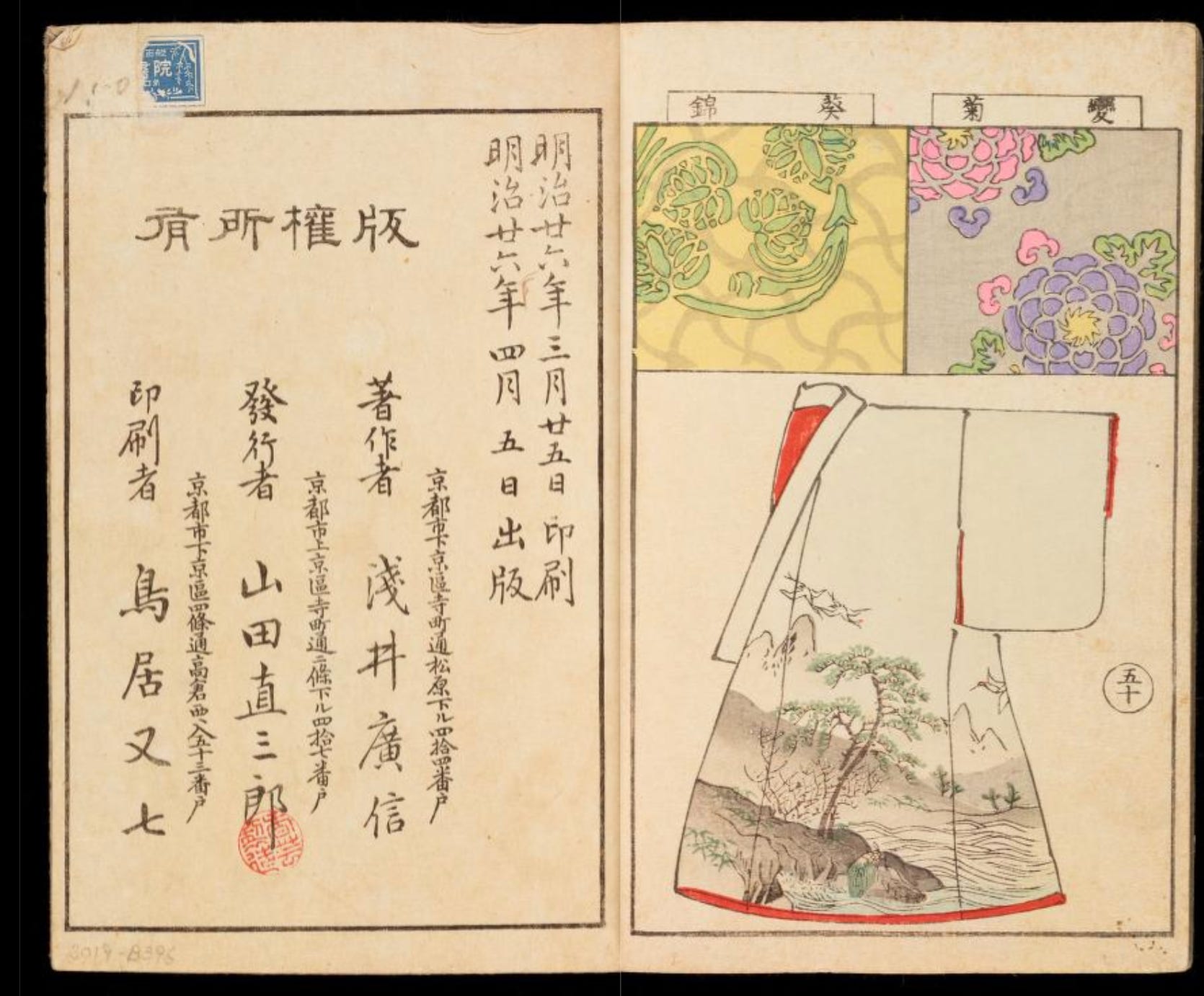
A thread-bound book published in Kyoto in the spring of 1893. Fifty-odd plates, each one a kimono drawn in flat elevation with two motif studies above it. The cover is foxed; the binding has loosened with handling. It survives now as a digitised scan, which is how most working manuals of its kind survive at all: not as treasures kept under glass, but as documents passed from hand to hand until someone thought to photograph the pages before they were lost.
The book is called Moyō Bijutsu Benran, 模様美術便覽, which translates, awkwardly, as A Handy Guide to Pattern Arts. It is a working manual, not a treasure. The kind of object a Kyoto designer in the late nineteenth century would have kept on his bench, opened and closed a hundred times a year, consulted while drawing up a commission for a customer in Osaka or a buyer’s agent assembling a shipment for the Chicago World’s Columbian Exposition, which opened the same month the book went on sale.
What is striking about it, when you sit with it long enough, is that the plates are not arranged by motif type or by colour family or by formal weave structure: the categorisations a contemporary Western design book would impose. The plates are arranged by season. Open the book to its first plate and you find a pink kimono scattered with sparrows in ripe rice grasses, with wild geese flying through pink mist in the inset above. Open it to its last and you find a turtle in a winter stream and a snow-laden pine. Between those two endpoints, the book walks straight through a Japanese year.
I have taken to opening the scan to wherever the calendar happens to be on a given day, and reading the plate as if it were a weather report. It is a more useful exercise than it sounds.
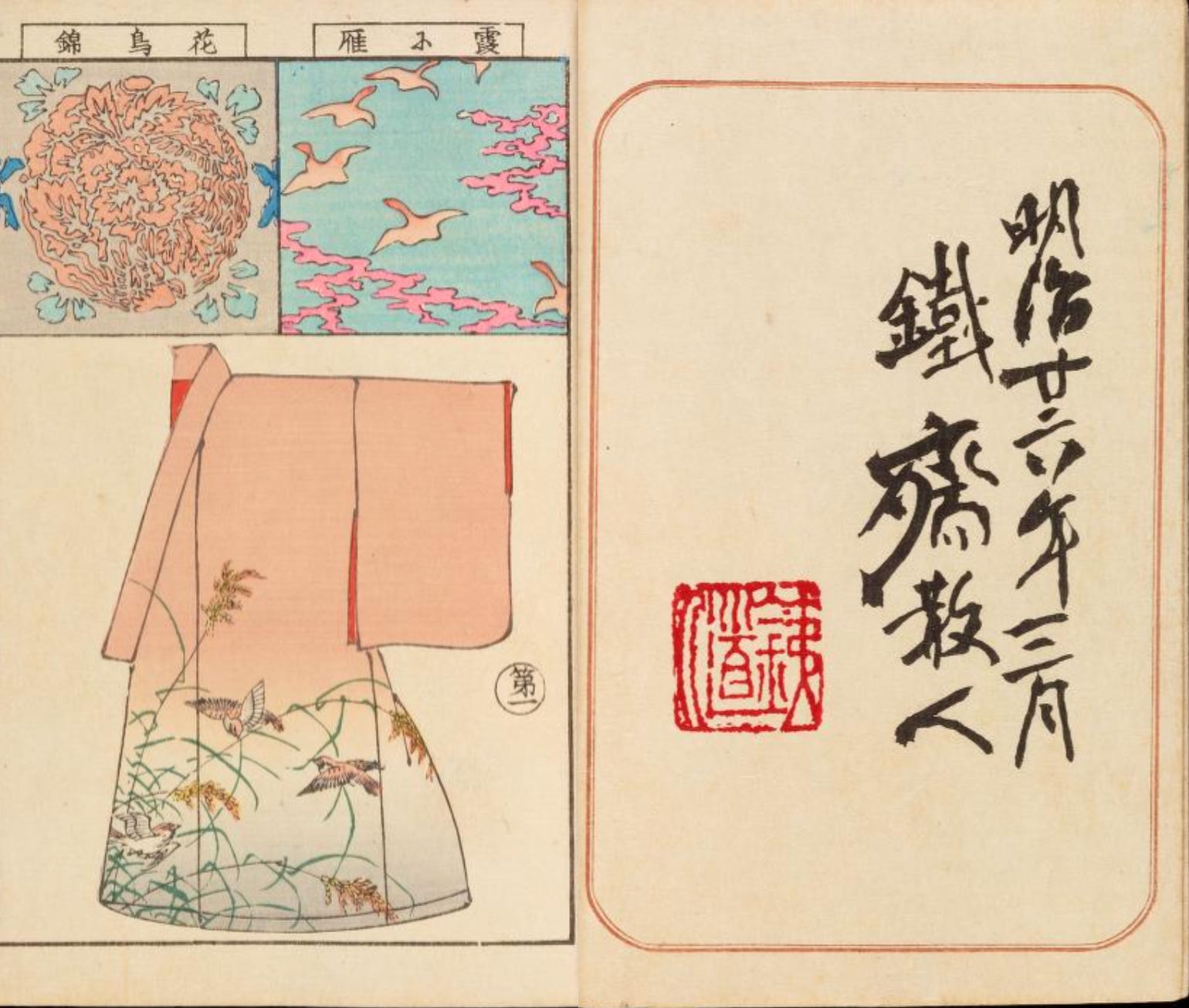
Moyō Bijutsu Benran, 模様美術便覽,
Why a manual, why 1893
The publication date matters more than it first appears. Meiji 26, 1893, sits exactly in the middle of the Japanese state’s deliberate effort to codify and export its visual culture. The unequal treaties had not yet been revised. The Chicago Exposition opened in May, and Japan was preparing for it with seriousness: a full Hōōden pavilion built on Wooded Island in Jackson Park, decorative arts displays in the Manufactures Building, a textile section that would astonish Tiffany and influence the next generation of American designers. A Kyoto pattern manual published in the spring of 1893 is part of that ecosystem. It is a working tool for the people producing the goods that would represent Japan to the world.
What the book does not do, and this is its quiet education, is invent a ‘timeless’ Japanese aesthetic. It assumes the seasonal calendar as the organising structure of textile design and proceeds from there. The motifs the contemporary Western reader recognises as ‘classic Japanese pattern’ are not floating decorative elements in this book. Pine, bamboo, plum; cranes; chrysanthemums; flowing water. They are calendar entries. Each motif belongs to a moment. To wear the wrong motif at the wrong time was, for the original audience of this manual, a small social failure. The book’s arrangement assumes a reader who knows this and needs help executing it well, not a reader who needs to be taught it from scratch.
This is the first thing the book teaches a contemporary collector: the motifs in vintage Japanese silk are never neutral. They are time-stamped. An obi’s pattern is not just decoration; it is a declaration of when the obi was meant to be worn. A piece you bring home and live with carries that timing inside it whether or not you have learned to read it.
Walking the year, plate by plate
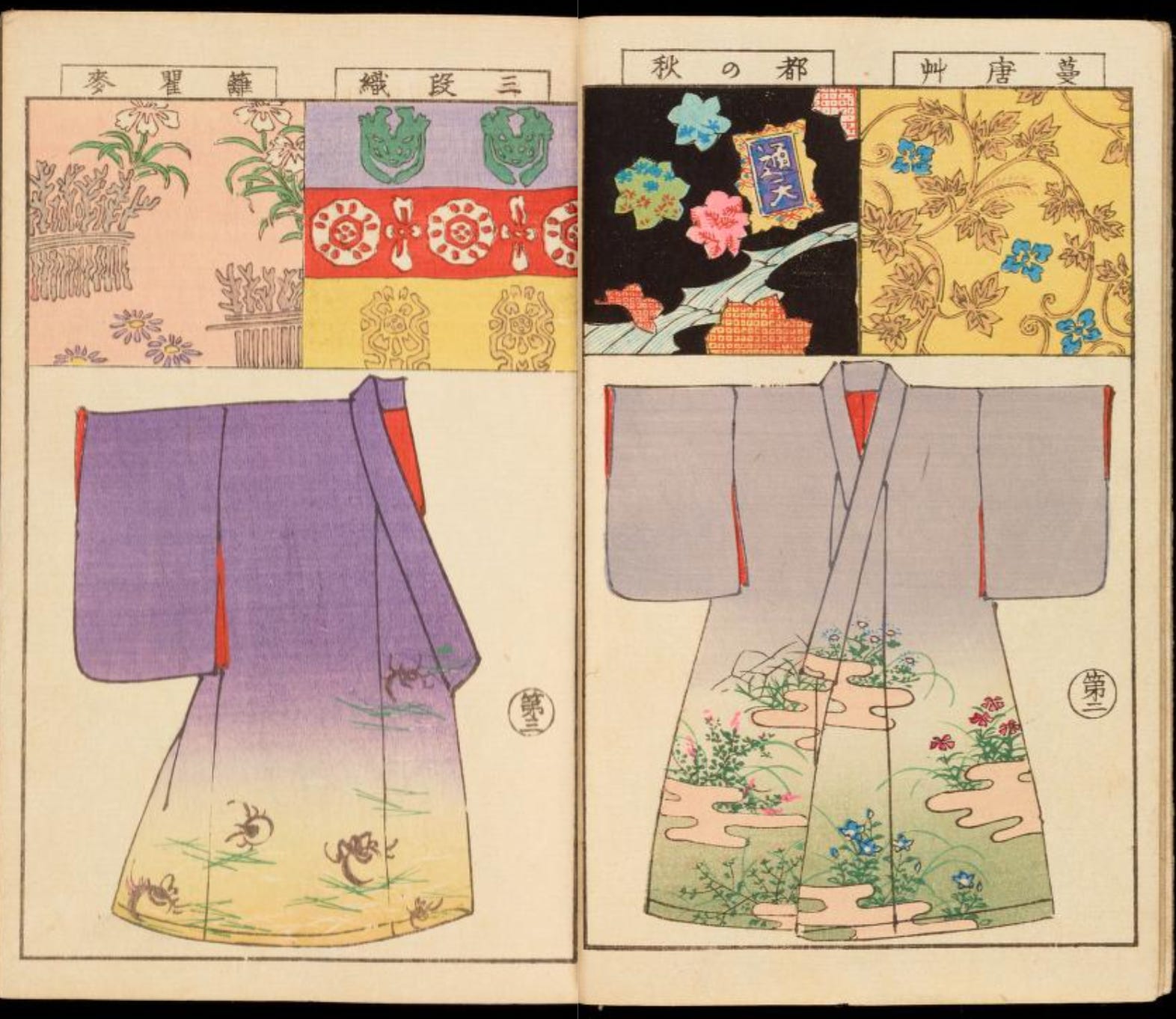
The book opens, as the year traditionally opens for textile purposes, in autumn: the season when the formal wardrobe is being prepared for the months of greatest social density. Plate one’s sparrows in rice grasses sit precisely at the kō called Kome no toki minoru, the moment in late September when the rice ripens and the small birds descend on the fields. The wild geese in the inset are kōgan kitaru, wild geese arrive, the micro-season that opens the second week of October. Two related observations about a single moment, fixed in cloth.
Turn the page and the calendar advances. Plate two’s grey kimono with autumn flowers rising through pale-pink stream-banks belongs to the deeper autumn: the moment when the chrysanthemums open and the maples begin their turn. The momiji motif on black ground, in the upper inset, is the Kyoto autumn at its most concentrated: kiku no hana hiraku, chrysanthemums bloom, in mid-October.
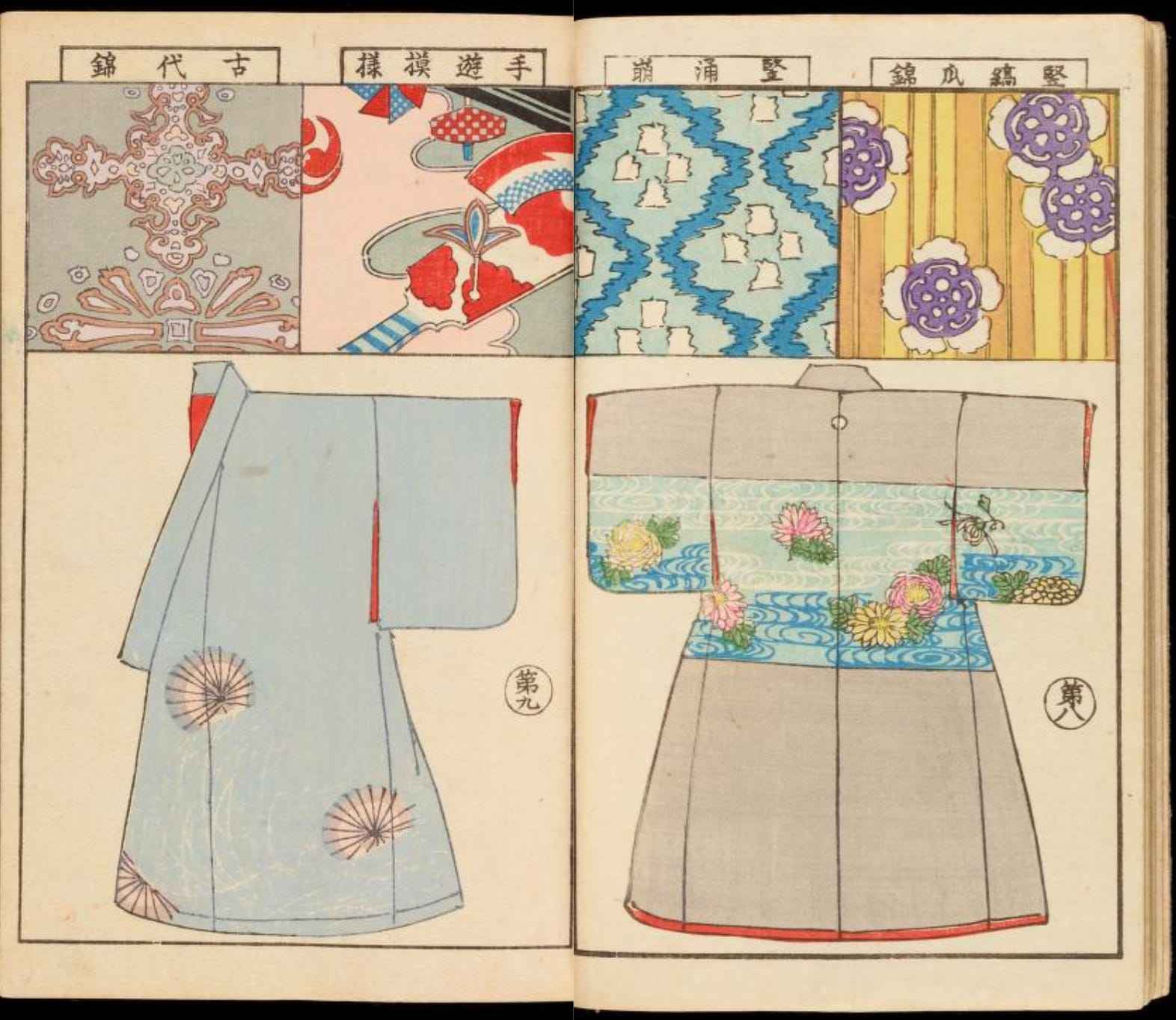
This is not the only way to read the plates, but it is the way the book itself proposes. By plate sixteen, deep into the book, the manual reaches the height of summer: a purple kimono whose insets explicitly reference Tanabata, the seventh-night festival when the Weaver Star Orihime crosses the Milky Way to meet Hikoboshi. The motif is autumn chrysanthemums on flowing water, but the framing belongs to early July: the calendar is layered, summer in the present tense and autumn already arriving in the imagination of the cloth.
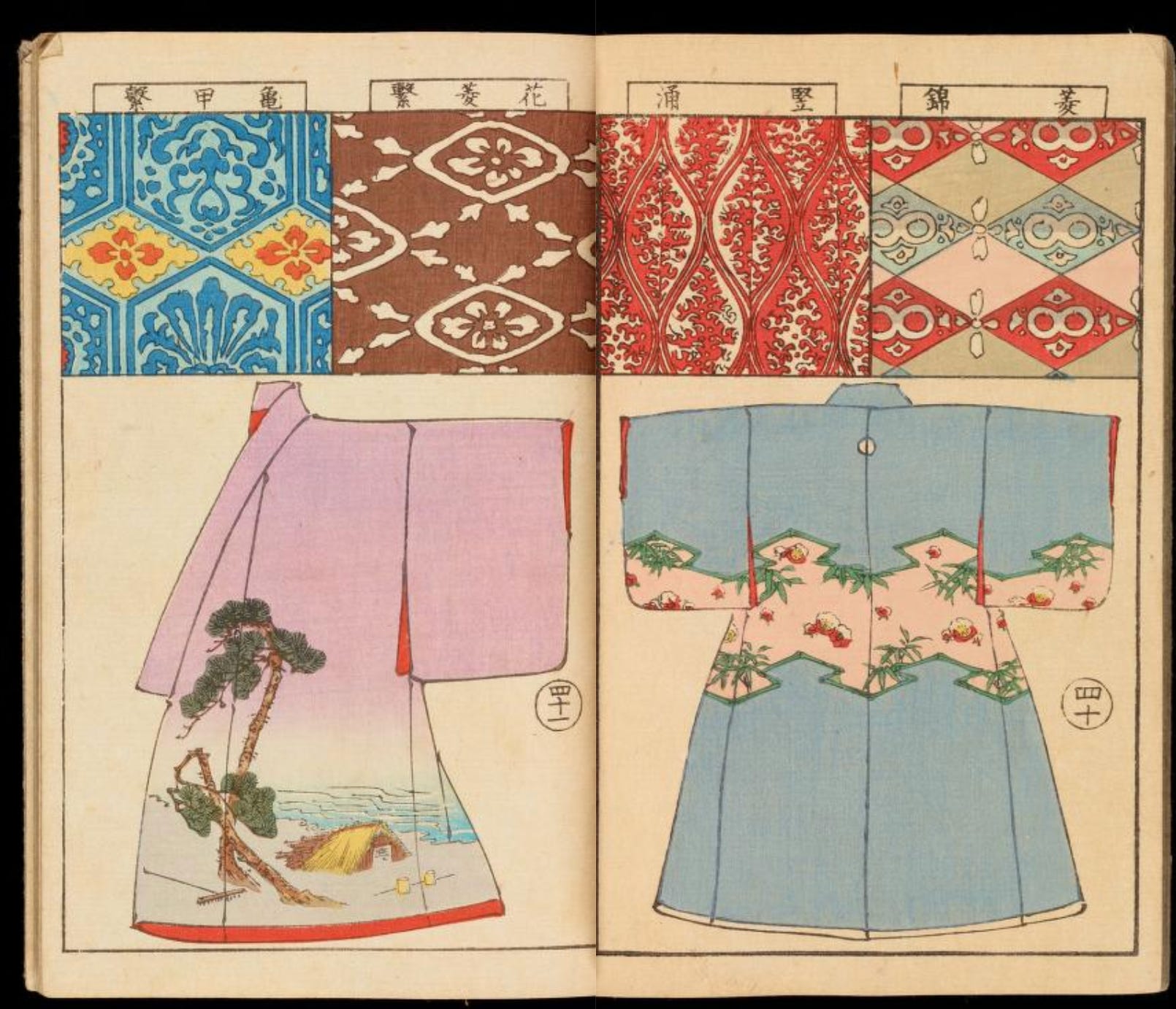
By plate twenty-seven the year has turned. A pine on a rocky shore with a rising sun, snow-edged at its branches. This is the new-year register: the moment when shōchikubai (pine-bamboo-plum) becomes mandatory, when the cranes appear, when the cloth carries the wish for longevity into the year ahead. By plate thirty-one, a warbler in snow against a kimono banded with maple leaves: the bittersweet uguisu-in-snow motif, koharu-biyori, the brief warm spell in the depth of winter that fools the warbler into singing. By the closing plates the cloth has emptied of figure almost entirely: winter pines, snow-streams, turtles. The year ends quietly, the way it should.
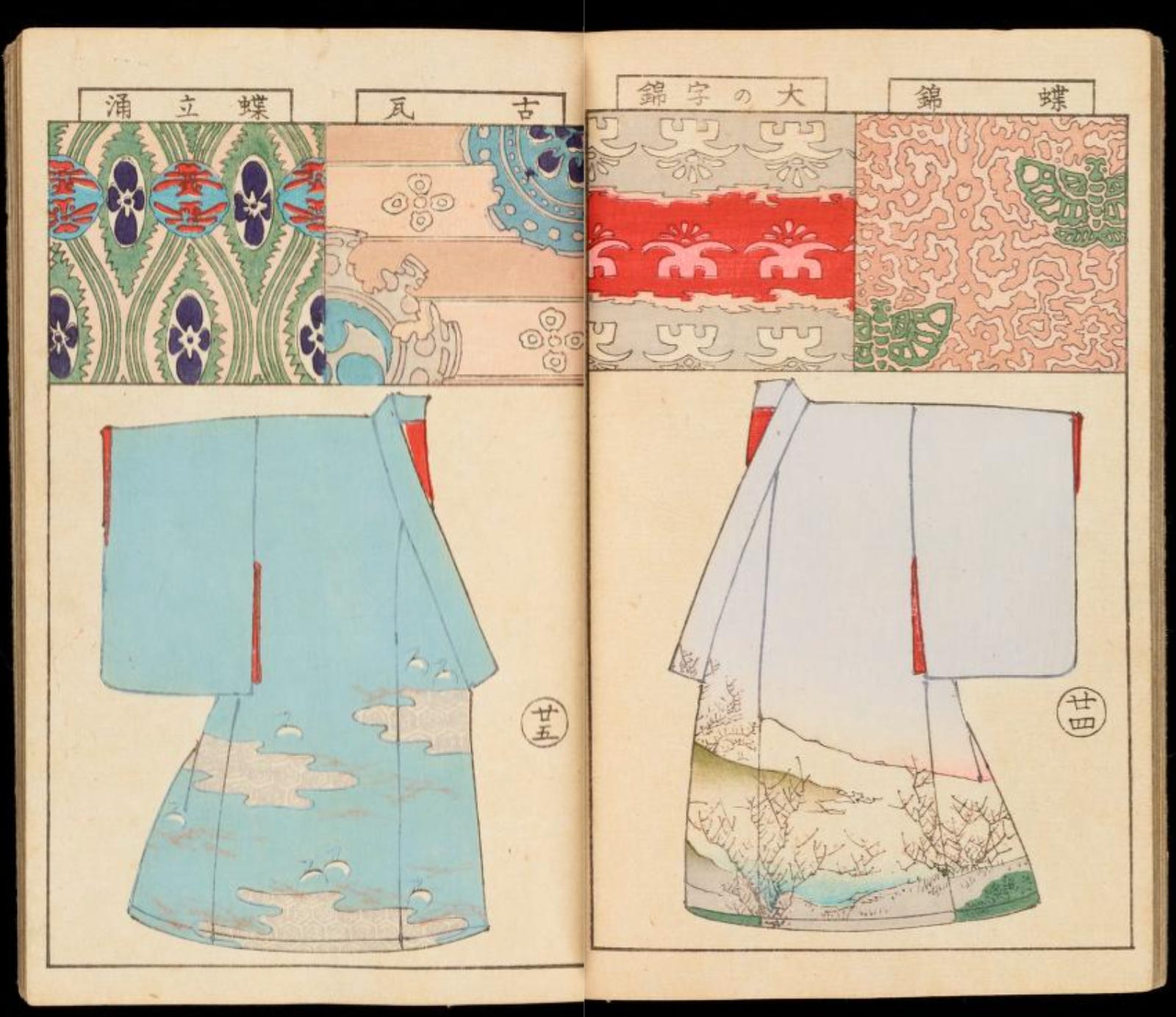
Reading the book this way, plate by plate, in calendrical order, produces a curious effect. The motifs stop reading as ‘Japanese decoration’ and start reading as something closer to a meteorological vocabulary. Pine is not pine; pine is the longevity wish that belongs to the new year and to the deep winter. Crane is not crane; crane is the auspicious bird whose calligraphic flight belongs to particular moments of celebration. Chrysanthemum is not chrysanthemum; chrysanthemum is the ninth-month flower, and its appearance on a textile is a date stamp.
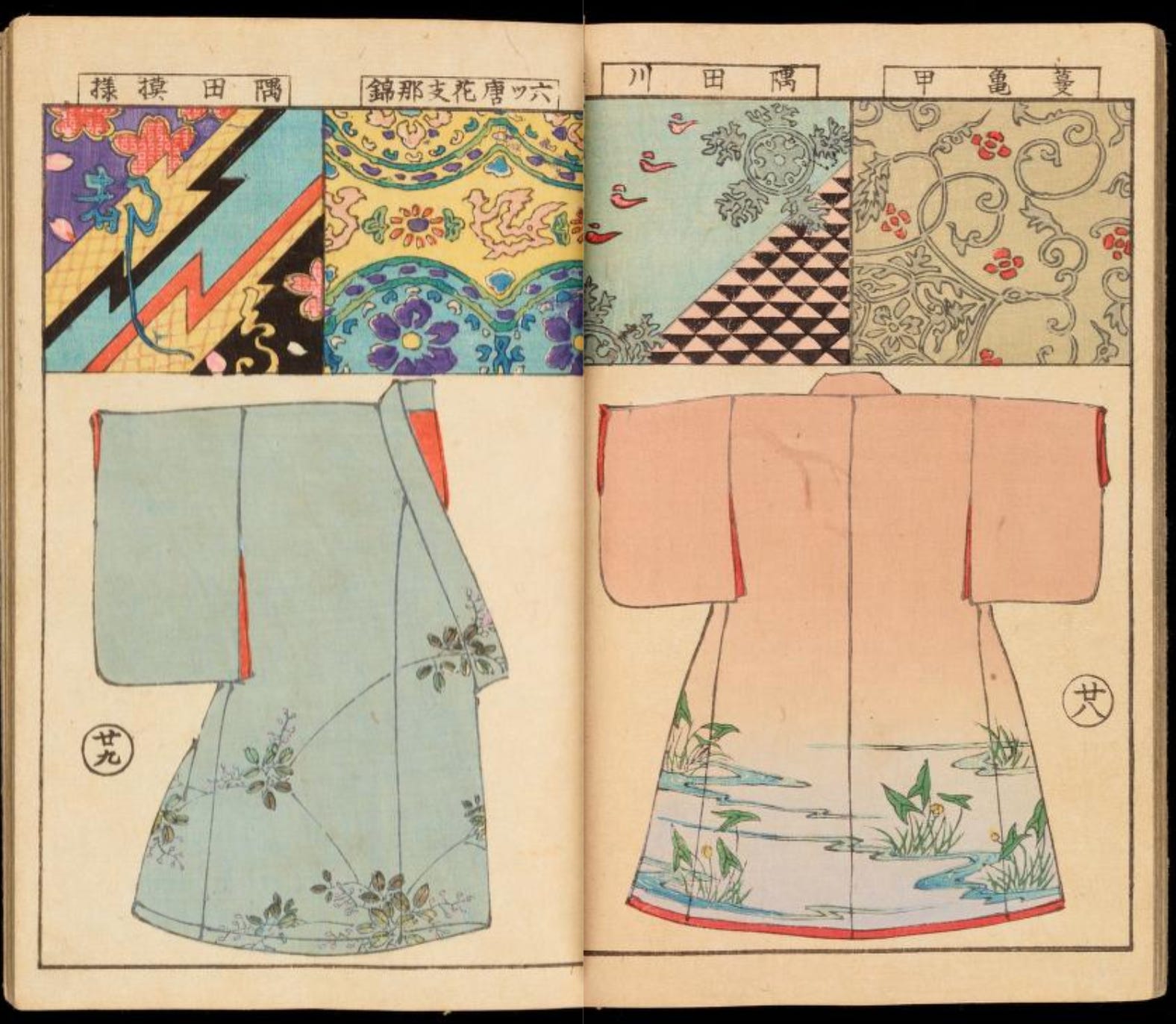
How this teaches you to read an obi
An obi from the 1960s comes into the atelier with no documentation. The seller knows it was a formal piece. The seller does not know, or does not say, what season it was woven for. The motif is what tells you. And the 1893 manual, opened at random, is one of the better tools for learning to listen.
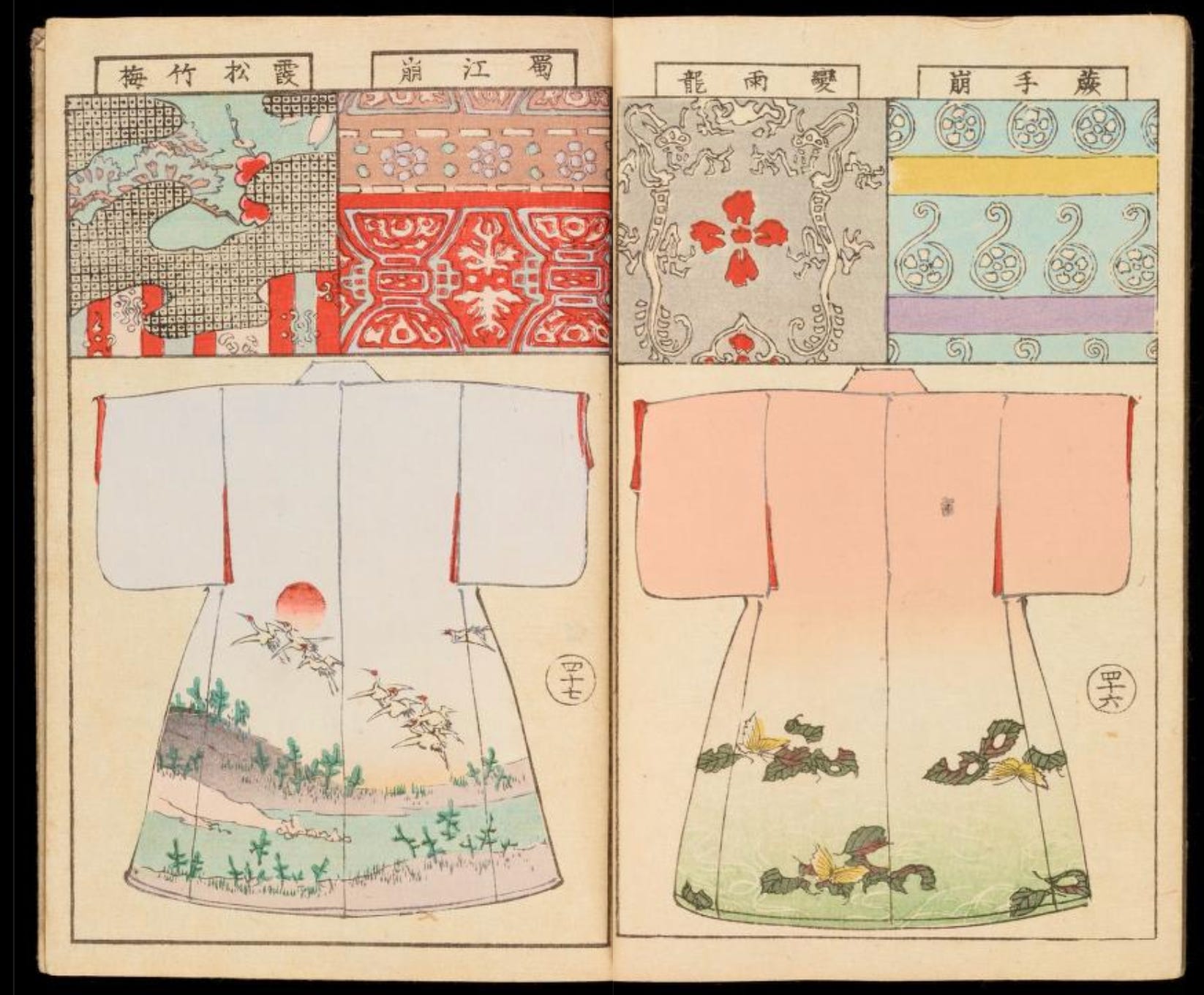
A fukuro obi I cut last month carries a scatter of small pine needles in oxidised silver thread on a deep indigo ground, with a single crane near the upper edge. The pine-and-crane combination is the manual’s plate seventeen vocabulary almost exactly: a winter and new-year piece, woven for the most formal moments of the cold months. The original wearer, in the early 1960s, was not choosing this obi for an October dinner. She was choosing it for January, for a wedding congratulation visit, for a tea gathering at the deepest point of winter when the longevity wish belonged in every detail of the room. Sixty years later, the obi still wants to be that piece. Hung as a textile painting above a dining table in Amsterdam, it is at its most beautiful in the dim light of January afternoons. It quietens, slightly, in July. The cloth has not forgotten what it is for.
Another piece: a spring obi, ivory ground, cherry petals scattered among iris foliage, with a pale wave-pattern running behind. The manual would place this somewhere around its plate four: the Eight Bridges of the Ise Monogatari, that exact transitional moment between late spring and early summer when the cherries have finished and the irises begin. In a contemporary interior, this obi reads quietly through autumn and winter and then, in late April, suddenly becomes the most alive thing in the room. The Heian court ladies who originally codified these correspondences would not have been surprised. The cloth is keeping its own calendar, and your room, if you let it, will keep that calendar with the cloth.
This is the practical use of the 1893 book to a contemporary collector. You do not need to memorise the seventy-two micro-seasons. You do not need to learn classical Japanese. You need only sit with a manual like this one, or with the obi you are considering, long enough to begin asking the question the book itself asks on every page: what time of year is this cloth speaking from? Once you can hear the answer, even imperfectly, the cloth becomes legible in a way that no amount of collector’s notes about provenance or weave structure can replicate.
What the manual is for
The Moyō Bijutsu Benran was never a museum object and does not deserve to be treated like one now. It was, as it has always been, a working manual: a small, dog-eared, foxed reminder that Japanese textile design has never been about timeless decoration and has always been about time itself. Each plate names a moment. The book’s deepest assumption, never stated, is that a person dressing herself for a particular day in a particular month should know what the cloth is supposed to say.
The contemporary collector who lives with vintage ceremonial silk is heir, whether or not they realise it, to that assumption. The obi above your dining table is not a generic piece of Japanese design. It is a calendar entry, woven by hand sixty years ago, addressed to a specific season. Learning to read that, slowly, one plate at a time, is one of the small, durable pleasures of living with these textiles. The 1893 manual is a generous teacher. It will sit with you as long as you need it to.
The book https://archive.org/details/gri_33125015551803/mode/2up
· · ·
Each obi reads as a calendar.