

To perceive time through four static seasons is to observe the world through a blunt instrument. Where the Western calendar imposes months-long brushstrokes on the natural world, compressing the whole of spring into a single category, Japanese environmental thought works at a finer resolution. Time here is not merely observed. It is felt, named, and answered.
The framework for this attention is the 七十二候 (Shichijūniko): the Seventy-Two Micro-Seasons. Each lasts about five days, and each is named with real precision: 桃始笑 (‘First Peach Blossoms Unfurl’) is one such micro-season. The old almanacs reach for the same poetic register in phrases like ‘plum blossoms open’ (梅花乃開) and ‘distant thunder’ (遠雷), each fixing a mood to a moment in the turning year. This calibration of the year was not, in the court tradition, a meteorological curiosity. It was the governing logic of material culture: the frame within which every decision about silk weight, colour, and weave was made. It remains the foundation of the Japanese textile tradition that Renaras curates and continues.
To hold a piece of vintage Japanese ceremonial silk without understanding the Koyomi is to read a document in an unknown language: the words are beautiful, but the meaning escapes you. To hold the same piece knowing the micro-season it was woven for is to receive it fully: to understand which moment in the turning year it was made to inhabit, and why its weight, its colours, and its structure are what they are.
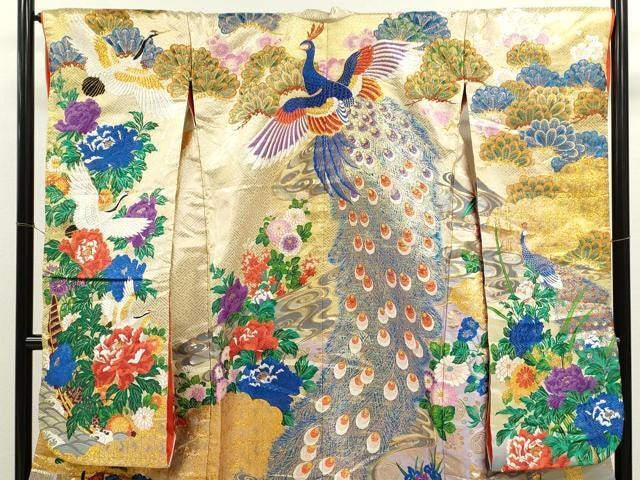
The Celestial Loom and the Ephemeral Earth
In classical Japanese mythology, the loom and the cosmos are linked by design. The best known of the celestial textile legends is the story of 織姫 (Orihime), the Weaving Princess, who sits beside the Milky Way, her loom always in motion, weaving the fabric of the heavens. Her labour is not ornamental. It is cosmological: her work sets the passage of the stars, the turning of the seasons, and the quality of light that falls to earth.
Each year, on the seventh night of the seventh month, the river of the Milky Way parts to let Orihime cross to her beloved, the cowherd 彦星 (Hikoboshi), who tends his cattle on the far bank. For three hundred and sixty days her longing drives her weaving, and the cloth she makes in his absence is, quite literally, the texture of the year. The legend holds something the textile tradition has always known: that fine cloth is not made by hands alone, but by a whole life given to the work.
This reverence for the weaver’s art carries the philosophy of 儚さ (hakanasa): the aching ephemerality of the natural world, the sense that beauty is inseparable from transience, and that the aesthetic experiences that matter most carry the knowledge of their own passing. The textile tradition is an extended meditation on hakanasa: each piece woven in full awareness that its micro-season will vanish in five days, that the quality of light it holds will not return for another year, and that the weaver’s own hands are as mortal as the blossoms being set into thread.
To capture a micro-season in fabric is to arrest a fleeting, impermanent beauty before it dissolves. This meeting of the material and the ephemeral is what lifts Japanese textile arts (the obi, the furisode, the nagajuban, the uchikake) from garment-making into a discipline. And it is this quality, this weight held at the level of weave and dye, that a vintage Japanese silk brings into a contemporary room.
“To capture a micro-season in fabric is to arrest a fleeting moment of beauty before it vanishes: to encode the ephemeral in a medium that endures.”
The Shichijūniko: Reading the Natural World at Full Resolution
The outer frame of the Koyomi is the 二十四節気 (Nijūshi sekki), the Twenty-Four Solar Terms, each marking a turning point in the solar year. Each term divides into three micro-seasons, giving the seventy-two periods of the Shichijūniko. What sets the Japanese version apart from its Chinese source is the precision of its descriptions. Each micro-season is named not for a weather abstraction but for a specific observable event: the moment, in a particular landscape, when something happens.
A selection:
東風解凍 (Harukaze kōri wo toku): the east wind softens the ice, the opening of spring.
黄鶯睍睆 (Kōō kenkan su): the bush warbler begins its mountain song.
魚上氷 (Uo kōri wo izuru): fish rise toward the surface as the ice thins.
霞始靆 (Kasumi hajimete tanabiku): mist begins to linger in the valleys.
草木萌動 (Sōmoku mebae izuru): grasses and trees begin to sprout.
蛙始鳴 (Kawazu hajimete naku): the frogs begin to call.
玄鳥至 (Tsubame kitaru): the swallows arrive from the south.
蟋蟀在戸 (Kirigirisu tobira ni ari): crickets sing at the threshold of the door.
楓蔦黄 (Momiji tsuta kibamu): maples and ivies begin their turn towards gold.
水始氷 (Mizu hajimete kōru): water first begins to freeze.
雪下出麦 (Yukishita mugi wo nobasu): wheat sprouts, invisibly, beneath the snow.
These are not quaint observations. They are precision instruments: signals, refined over more than twelve centuries of court and scholarly practice, about what the world asks of you within a five-day window. The textile tradition listened to each of them.
The Architecture of Breath: Engineering Silk Weight for the Living World
This environmental attention was not, in the Japanese tradition, a matter of poetry. It was applied engineering: a long study of the relationship between atmospheric conditions and the body’s experience of cloth. The result was a system of textile weight, weave, and layering with few equivalents in the history of dress.
As the Koyomi progresses, the demands on silk shift with it: from the damp warmth of 土脉潤起 (‘Earth Stirs’, when the soil softens and the first warmth rises from the ground), through the dry clarity of 清明 (‘Pure and Clear Light’), to the crisp descent of 霜始降 (‘Frost Begins’). The best practitioners of the kimono tradition read these transitions not as seasonal generalities but as precise atmospheric events, and the cloth they wore was made to answer each one.
袷 (Awase) — The Architecture of Warmth: October Through May
Awase, the fully lined kimono, is the garment of the cold months and the long spring. Its construction is more complex than it looks: an outer silk paired with an inner lining, typically habutai, a fine, tightly woven white silk that adds warmth without bulk. The two layers are not merely stacked; they are in dialogue. The inner colour, glimpsed at hem and collar, is set against the outer palette according to the codified system of kasane no irome, the layered colour grammar of the micro-seasons. The result is a garment that is not simply warm but chromatically complete: the visible edge an argument about where in the year one stands.
The change from awase to the unlined hitoe does not fall on a fixed date. It comes when the micro-season declares, through the evidence of the natural world, that the body’s relationship with warmth has shifted. The practised wearer felt it weeks before the formal 衣替え (Koromogae) change of early June: in the arrival of the swallows, in the particular quality of April light, in the way the earth began to warm from below rather than only from above.
単衣 (Hitoe) — The Garment of the Threshold: June and September
Hitoe, a single unlined layer of silk, holds the transitional months with a studied ambivalence that is itself a position. June and September are months in transit: the year moving toward or away from its extremes. The hitoe does not resolve that ambivalence. It inhabits it, precisely. It is a garment of the threshold, neither warm nor cool, calibrated to the quality of air in those weeks when the natural world is between states.
The silks chosen for hitoe were selected not only for lighter weight but for their structure. The weave must let the body breathe more than the dense awase allows, the skin in more direct contact with the surrounding air, but without the near-transparency of the summer gauze weaves. The hitoe sits at a point of calibrated opacity: present enough for ceremony, open enough for the season.
絽 (Ro) and 紗 (Sha) — The Gauze Weaves: The High Achievement of Summer Silk
The summer silks are the high point of the Japanese weaver’s technical ambition. Ro is made by a leno technique: pairs of warp threads twisted around the weft at measured intervals, producing a structured gauze that is at once sheer, stable, and optically complex, a fabric that seems to breathe as it moves. In the finest examples the geometry of the weave is functional in origin: the intersections of the twist form the ventilation channels through which body heat escapes.
Sha is more open still, a weave approaching transparency, a fabric that changes the body’s thermal relationship with the air through the physics of silk movement. Where a dense cloth insulates by trapping warm air against the skin, sha and ro cool through constant, subtle circulation. The fabric does not block the air; it works with it, floating above the skin with what the tradition calls the quality of not-quite-touching: a negative friction the body reads as relief in the heat of July.
That silk could be engineered into fabrics this responsive to the air is remarkable. That the calendar for wearing them was set not to the month but to the five-day micro-season, to the moment the frogs began their evening chorus, when the iris opened along the riverbank, marks a degree of environmental attunement no modern technical fabric has yet reached from a philosophical direction, even as such fabrics have made real advances in performance.
縮緬 (Chirimen) — The Thermoregulating Intelligence of Crêpe
Against the transparency of the summer gauze weaves, the 縮緬 (Chirimen) crêpe silks of the transitional and winter seasons work on a different principle. Chirimen is woven with highly twisted weft yarns; when the twist is released in finishing, it produces the granular surface texture known as ‘shibo’. This pebbly, three-dimensional surface is not merely tactile. It is thermal engineering: the texture forms a micro-topography of air pockets at the surface that acts as a distributed insulating layer, a responsive warmth against the chill of autumn and winter.
The psychological dimension of Chirimen matters as much as its physics. Against the cool of a late-October morning, the dense, yielding weight of a Chirimen silk offers something no synthetic thermoregulating fabric has replicated: the sensation of being held by a material that understands the season.
“The wardrobe, as the Japanese tradition understood it, is not a collection of garments. It is a reactive second skin: something that mediates, moment by moment, the body’s relationship with the living world.”
The Chromatic Harvest: Dyeing the Micro-Season
If the weight of Japanese silk answers atmospheric physics, the colour system answers something more complex: the feeling and appearance of the natural world in each micro-season. And the means by which those colours were reached, before synthetic aniline dyes arrived in the late nineteenth century, and in the finest traditional work ever since, is a craft as sophisticated as the weaving itself.
The practice is 草木染め (Kusaki-zome): botanical dyeing, the patient extraction of colour directly from the natural world. Colour in this tradition is not chosen from a palette. It is harvested, gathered from specific plants, at specific points in their growth, under specific conditions, and the result is a living record of the micro-season in which the dyeing was done.
A madder red, the red of the plum-blossom interior, of the blood warmth beneath winter skin, is coaxed from the roots of the 茜 (akane) plant during the brief 啓蟄 (‘Insects Awaken’) phase of early March, when the root is said to reach its peak concentration of alizarin. A twilight indigo, the indigo of deep summer evenings, of the Milky Way in a rural sky, is reached only when the leaves of polygonum tinctorium (蓼藍, tadeai) come to full maturity in the heat of late July or August, the indoxyl in the leaves concentrated enough to survive the fermentation of the traditional 建て藍 (tate-ai) vat.
The Unrepeatable Dye Lot: Each Piece a Singular Document
The chemistry of the plants shifts with every change in temperature, rainfall, and soil. The timing of harvest is set by micro-seasonal observation rather than fixed date. And the fermentation of a traditional indigo vat responds to humidity and temperature in ways no dyer fully controls. So no dye lot produced by Kusaki-zome can be precisely repeated. The colour reached on one day, from one batch of roots gathered in one micro-season, is a single occurrence.
Each piece is therefore a record of a five-day window in the Japanese landscape: the madder of one spring, the indigo of one summer afternoon, the bronze-gold of an October whose maples caught the light at an angle that will not recur in quite the same way. The vintage silks we curate carry this unrepeatable colour, not as a fixed property but as evidence: that a specific moment in the natural world was attended to, understood, and set into thread.
重ね色目 — Kasane no Irome: The Layered Colour Grammar
The practice known as 重ね色目 (kasane no irome), layered colour combinations, governs the chromatic relationships between the several silk layers a Heian-era court lady wore at once, the visible bands at hem and collar making a public statement about her reading of the micro-season. Each combination was named, codified, and mapped against the natural world:
山吹 (Yamabuki), Mountain rose, early March: golden yellow outer, pale yellow-green inner, the exact chromatic register of the kerria flower.
藤 (Fuji), Wisteria, late April: lavender-grey outer, pale new-growth green inner, the colour of wisteria hanging above spring earth.
撫子 (Nadeshiko), Wild pink, high summer: pink outer, pale blue inner, the fringed dianthus of the July grasslands.
紅葉 (Momiji), Maple, October: crimson outer, deep gold inner, a backlit autumn leaf held against the light.
枯野 (Kareno), Withered field, deep winter: pale straw outer, dark grey-brown inner, the stripped palette of the field after the final harvest.
雪の下 (Yuki no Shita), Beneath the snow: white outer, pale blue-grey inner, the compressed, muffled light of a snowbound afternoon.
To choose the wrong seasonal combination was not a sartorial misjudgement. It was a public declaration of inattentiveness. In a court culture where the capacity for attention was the chief measure of character, that was a serious failure. The woman who wore the correct kasane no irome showed, through her dress, that she had watched the world closely enough to know exactly where in the year she stood.
“In the Japanese court, to wear the correct seasonal palette was to show that one had been attending to the world with real seriousness. Clothing was not expression. It was epistemology.”
The Obi as Seasonal Inscription: Reading Time in Woven Silk
Of all the elements of the classical kimono ensemble, the obi is the densest chromatic document. Worn at the body’s centre, it is the primary statement in the hierarchy of the dressed body, and in the finest examples it is a precise seasonal declaration: a concentrated argument about a specific moment in the Koyomi, woven by a craftsperson who understood the weight of it.
The formal obi of Japanese ceremony, the 袋帯 (fukuro-obi) and the 丸帯 (maru-obi) of the most elevated occasions, was woven with seasonal motifs of exact specificity. Not flowers in general, but the precise flower of the precise micro-season: the plum (梅, ume) for the opening weeks of February, never the cherry, which would be premature and therefore wrong in a way that goes past aesthetics into factual error. The iris (菖蒲, shōbu) for the fifth month, never the chrysanthemum, which belongs to autumn and would confuse the seasons as fundamentally as confusing north with south.
A vintage obi, woven for a specific ceremony and worn by a specific woman at a specific moment in the calendar, carries this coding in its structure. The woven motif is not decoration. It is a date stamp written in thread. The palette is not preference. It is a colour argument about the quality of light in a five-day window. The weight is not arbitrary. It is the response of a weaver who knew what atmospheric conditions the garment would meet, and made the silk to meet them.
With enough scholarship, one can read the approximate micro-season of an obi’s intended use from the fabric alone. Motif, palette, and weave together are a document: a record of attention to the natural world as precise, in its way, and as unrepeatable, as the moment it encodes.
“Each vintage obi is a temporal document: a record of attention to the living world so complete, so precisely calibrated, that the twenty-first century, for all its technology, is still learning to recover it.”
Dressing in Harmony with Time: The Living Calendar in the Contemporary Home
Serious collectors and design-literate buyers eventually ask why any of this matters to someone living in Amsterdam, or London, or Copenhagen, in the twenty-first century. The answer is neither sentimental nor antiquarian.
The first reason is sensory. The silks made within the Koyomi tradition, built for the atmospheric conditions of their intended micro-season, hold a quality that contemporary fabrics, despite real advances in performance engineering, have not fully replicated. A ro-weave summer silk, even shown as a silk textile painting or a table runner in a contemporary interior, still handles light differently from any dense modern fabric: it breathes, catches, and diffuses light with the physics it was designed for. A Chirimen crêpe from the transitional season has a tactile character, that pebbly, yielding warmth, that speaks directly to the nervous system. These are not incidental qualities. They follow from centuries of environmental attunement, and they hold regardless of context.
The second reason is philosophical. To acquire a piece of vintage Japanese ceremonial silk knowing its Koyomi coding, to know that an obi’s crimson-over-gold is the colour argument for the momiji micro-season of October, that the ro weave was made for the quality of air in late July, is to meet the object on the terms it was built to reward. It is to practise, in a small and contemporary way, the attention that produced the Shichijūniko: the discipline of noticing the world at a finer resolution than daily life usually asks.
The third reason is material and lasting. The finest vintage Japanese silks, the pieces with genuine provenance, whose motifs and palettes and weave encode a specific moment in the Koyomi, are irreplaceable. They were made by weavers within a tradition refined over more than twelve centuries, using materials and processes that, in their authentic form, are increasingly rare. They cannot be reproduced on demand. They are singular and time-stamped, carrying a depth of cultural and material meaning the luxury market has not found a way to manufacture.
A Guide to Seasonal Reading: Collecting with the Koyomi
For those acquiring vintage Japanese silk, as a silk textile painting, a lumbar pillow, a table runner, or a collector’s object, understanding the seasonal coding changes the acquisition from an aesthetic transaction into something of a different order.
Begin with the motif. The 梅 (ume, plum) belongs to February’s opening micro-seasons: the ice softening, the first warmth entering the earth. The 桜 (sakura, cherry) to the clear light of April. The 牡丹 (botan, peony) to the fullness of May. The 菖蒲 (shōbu, iris) to June. The 朝顔 (asagao, morning glory) to the high heat of July. The 菊 (kiku, chrysanthemum) to the mellowing gold of October. The 椿 (tsubaki, camellia) to the compressed silence of deep winter. Each motif is not decoration: it is a micro-seasonal address, placing the piece within the Koyomi.
The palette confirms what the motif declares. A vintage obi in the warm bronze-reds and deep golds of autumn, its weft carrying the particular quality of October maple light, is a piece that knew, when it was woven, that it would be worn in October. Its colours are not preference. They are calibrated to the chromatic register of that micro-seasonal window, as codified in the kasane no irome tradition over eleven centuries of observation.
The weave tells the final part of the story. A ro-weave silk, even brought into a contemporary space as a silk textile painting or a runner, keeps the light-handling built into it for the high-summer air. A dense, highly twisted Chirimen holds its warmth however it is displayed. These are not incidental qualities. They are the silk’s response, held permanently, to the atmospheric moment it was made to inhabit.
The Seventy-Second Micro-Season: Wheat Beneath the Snow
The seventy-second and final micro-season of the Koyomi, 雪下出麦 (Yukishita mugi wo nobasu, ‘Wheat Sprouts Beneath the Snow’), falls in the deepest cold of late December. It is named for the wheat seedlings that have germinated beneath the snowpack and are growing, unseen, in the compressed dark: pressing up through frozen ground toward a spring they cannot yet perceive but are already, structurally, moving toward.
There is no more precise image for what a vintage Japanese silk holds. Folded for decades in the dark of a chest or a warehouse, it has kept, intact, everything it was given at its making: the skill of its weaver, the encoded attention of the Koyomi tradition, the chromatic and material argument of the micro-season it was woven for. It has been waiting, with the patient certainty of the wheat beneath the snow, to be returned to the light and given a new context in which to continue.
To curate a wardrobe, or an interior, guided by the Koyomi is to choose a considered kind of luxury. Not the luxury of conspicuous newness, but the more sustaining luxury of depth: objects that carry real time within them, colours that cannot be manufactured on demand, weight and weave made to meet the living world. It is to practise, in the most tangible way, the discipline that produced the Shichijūniko: attending to the world at a finer resolution than it usually receives.
The seventy-two micro-seasons do not stop. The calendar of attention is continuous, and it does not recognise the distinction between Japan and Amsterdam, between the twelfth century and the twenty-first. When you bring a vintage Japanese ceremonial silk into a contemporary space, when you give it a wall, a surface, a new context in which its colours and its weight can speak again, you are not collecting an artefact. You are extending a practice. The micro-season encoded in the silk’s fibres continues. The attention of the weaver, the court lady, the ceremony, the calendar: all of it still alive in the cloth.
This is what no fast fabric can offer. Not because it lacks beauty, but because it lacks time.
The Silk Journal · Renaras · journal.renaras.com
One silk. One story. One piece. Never repeated.