

There is a moment, in any good textile archive, when the obi asserts itself. Not through colour, though the colours can be extraordinary, and not through weight, though a formal maru obi can run to nearly four kilograms of worked silk. The assertion is quieter than that. It is the moment you realise that this long strip of fabric, sometimes no wider than thirty centimetres and yet four metres long and more, is not a garment at all. It is a text.
Every obi speaks. It speaks of season: of whether the wearer has chosen correctly, whether the crane motif belongs to the winter month in which it is worn, or whether someone has misjudged the timing and brought autumn chrysanthemums into midsummer. It speaks of occasion: of whether the weight of the weave matches the gathering, whether the gold is present in the right measure and not too much. It speaks of region, Kyoto or Fukuoka, the Nishijin loom or the Hakata shuttle, and of the decade in which it was made, a decade that a skilled eye can locate not from labels or markings but from the relationship between warp and weft, the way the motif sits within its ground.
I keep the longest obi on the highest shelf. Not for safekeeping, though it is the oldest piece in the atelier, and the most fragile, but because something about its position there, folded into itself like a sleeping decision, feels correct. When I lift it down and unroll it across the worktable, the silk releases a scent I have never been able to describe precisely: dry, slightly mineral, something between old paper and autumn earth. It is the scent of dormancy. Of a life folded away.
The kimono is the canvas. The obi is the argument.
What the Obi Is 帯とは何か
The word obi (帯) translates directly as belt or sash, a translation that is only anatomical description and fails entirely as cultural introduction. The obi wraps the waist: what the Japanese philosophical tradition calls the hara (腹), the abdomen understood not merely as anatomy but as the seat of intention, will, and the deepest quality of a person’s character. To bind the hara with care and precision, with the right textile and the right knot, is not merely an act of fastening. It is an act of alignment.
Before the obi existed in anything approaching its present form, silk itself had arrived in Japan trailing myth. The sun goddess Amaterasu is said in the Kojiki to have kept a celestial weaving hall, a haven of light and making, before her long retreat into the cave that darkened the world. When the goddess Ame-no-Uzume danced at the cave’s entrance and laughter drew Amaterasu back into the light, silk returned with her: the tradition that followed was understood to carry something of the divine in its making. Whether one holds this as cosmology or as metaphor — and in the daily handling of these silks, the distinction becomes surprisingly difficult to maintain — it establishes that the Japanese relationship to woven silk has never been merely functional. From the beginning, it was weighted with meaning.
Its documented history in anything approaching its present form begins in the Heian period (794–1185), when court robes were tied with narrow silk cords worn outside the robe. The Edo period (1603–1868) saw the obi expand in width, length, and ambition. By the mid-1700s, the broad, structured sash we recognise today had emerged: a product of Nishijin’s expanding weaving industry in Kyoto and a culture of conspicuous display in which textile literacy was a social skill and an obi a social statement. Women of the merchant class competed through their obi; the samurai class wore theirs as markers of rank and formal affiliation. The shogunate issued sumptuary laws restricting the use of gold thread and expensive dyes. The excess continued regardless.
By the Meiji period (1868–1912), as Japan opened to Western trade and Western dress began to infiltrate the cities, the obi paradoxically became more elaborate, not less. As if the kimono tradition were consolidating its grammar before a long silence, the weavers of Nishijin produced obi of staggering complexity: silk brocades with metallic thread counts legible only under magnification, figurative panels depicting scenes from classical literature, geometric patterns drawn from Tang dynasty court textiles and reimagined in Kyoto’s particular aesthetic of restrained extravagance. What the Meiji obi-makers seem to have understood, whether consciously or not, was that the tradition would need to be complete in itself if it was to survive. And so they made it complete.
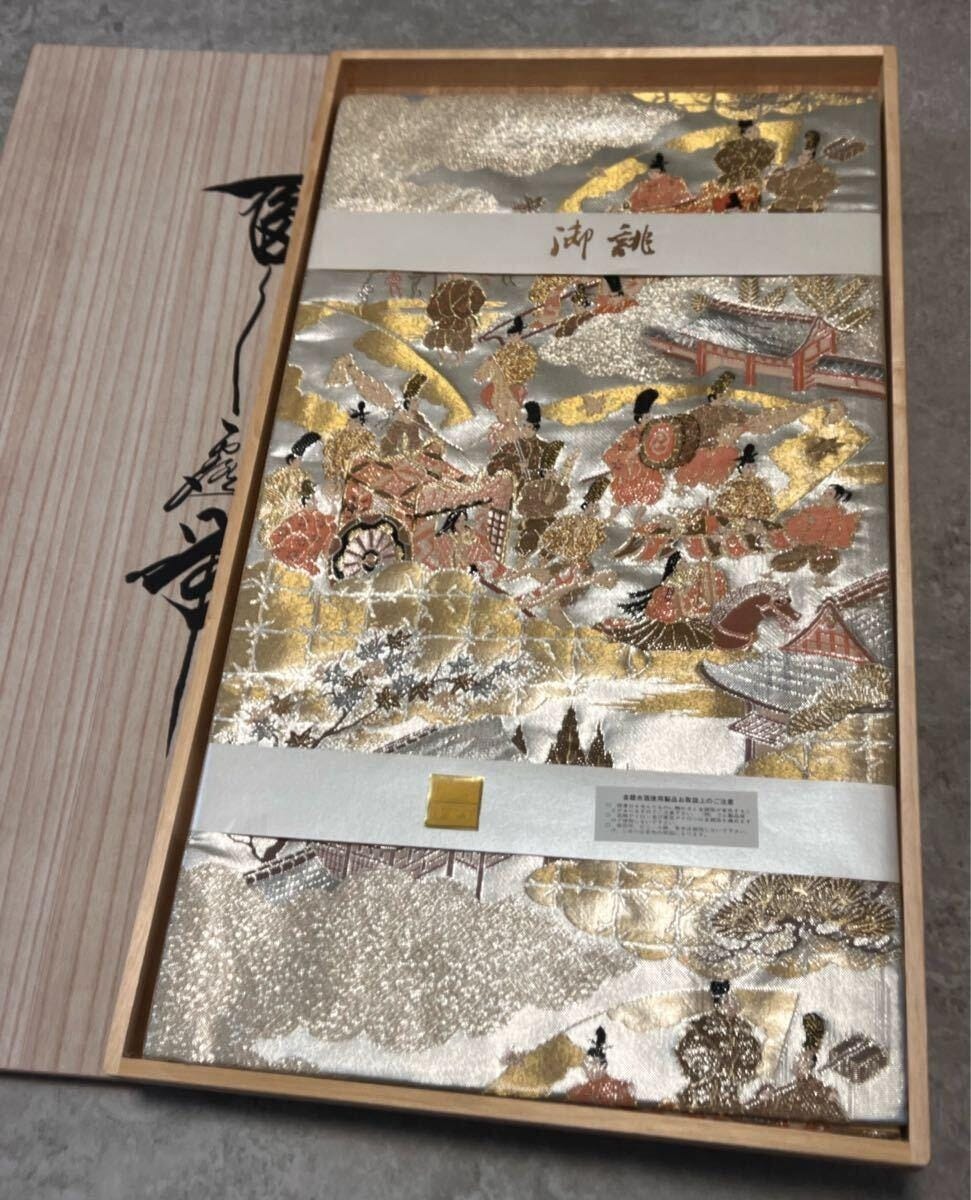
A figurative Nishijin maru obi depicting Heian court scenes, resting in its original paulownia storage box — calligraphy on the lid, gold thread catching the workshop light. The box is not packaging. It is part of the object’s provenance.
A Taxonomy 種類の文法
No field guide to the obi can proceed without taxonomy, because the type of obi is not a matter of preference but of grammar. The wrong obi worn to the wrong occasion carries the same weight of error as the wrong register in a formal letter: a mistake that those who know the language will read immediately, and that signals something about the wearer’s relationship to the tradition.
The Maru Obi 丸帯
The maru obi (丸帯) is the highest ranking, the most demanding, and now the rarest in everyday use. Woven on both faces, maru meaning round or complete, it is the only obi that is fully patterned on every visible surface, with no plain reverse. It runs to approximately four and a half metres in length and thirty centimetres in width, and in formal Nishijin brocade it achieves a weight and stiffness that requires considerable physical effort to tie. To wear one correctly is a skilled act. To make one correctly may require months.
The maru obi appears today almost exclusively at weddings (for the bride, in white and gold) and at the most formal classical events: tea ceremony gatherings of the highest rank, imperial-adjacent ceremonies, first performances of the new year in the traditional arts. In the collector’s world, a quality vintage maru obi in undamaged condition, properly attributed, is something close to a holy grail: a textile object of such technical density and cultural weight that its appearance in the secondary market commands the kind of attention normally reserved for museum acquisitions.
The Fukuro Obi 袋帯
The fukuro obi (袋帯) is the obi that most Japanese women know as the standard formal sash, the one they learn to tie first and return to most often. Developed in the early twentieth century as a practical evolution of the maru obi (lighter, less expensive to produce, easier to manage when tying), the fukuro obi is woven as a tube (fukuro: bag or pocket), with patterned panels on the face and a plain or simply woven reverse. At four metres and twenty centimetres or more in length, it accommodates the elaborate knot required for formal dress.
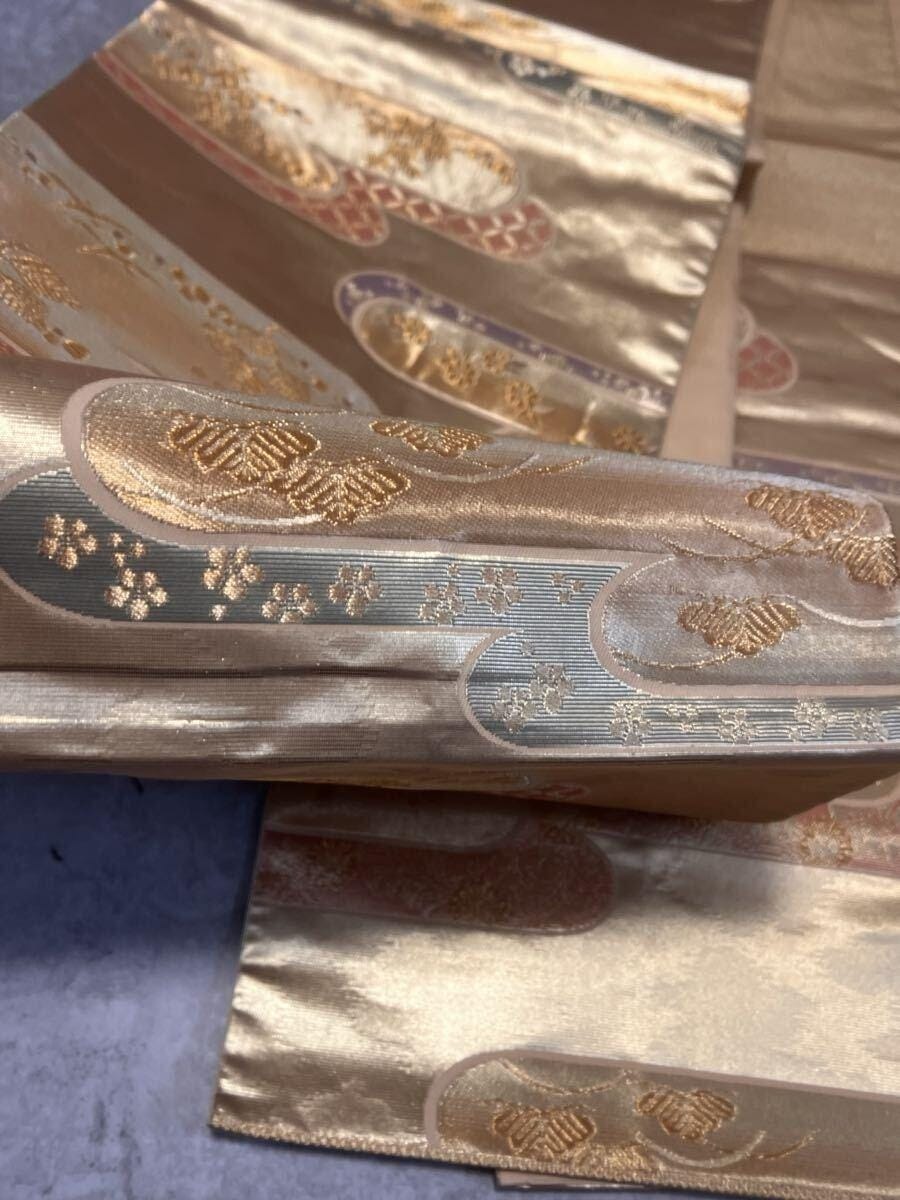
A formal fukuro obi in gold kinran brocade, folded for presentation — the streaming cloud motifs and scattered paulownia crests worked in raised gold thread against a lustrous gold ground. The weight of the metallic thread holds the silk in its own architecture.
The fukuro obi is the instrument of the otaiko, the drum knot, and it is the otaiko that has defined the silhouette of formal Japanese women’s dress for two centuries. The style is documented as having been popularised at the opening celebrations of the Tomioka Hachiman Shrine in Edo in 1817, where women attending the festival began tying the back knot in the structured square form that gave the style its name. The otaiko: a drum, and a drum’s shape, a frame held open at the back, precise in its depth and height, the hanging tail below it exactly measured. This is the silhouette the fukuro obi is made to create.
The Nagoya Obi 名古屋帯
The Nagoya obi (名古屋帯) occupies the productive middle ground: semi-formal to casual, depending on the fabric and the motif, a range broad enough to make it the most versatile obi in a working wardrobe. Developed in the 1920s in Nagoya, it simplified the tying process by pre-folding and stitching one end of the obi into a narrower section, reducing the quantity of fabric a woman must manage. The Nagoya obi is shorter than the fukuro, approximately three metres sixty, and in woven or dyed silk it is the obi of the everyday formal occasion: a tea ceremony at a friend’s home, a gallery opening, a restaurant in which someone has taken care with the reservation.
The Hanhaba Obi 半幅帯
The hanhaba obi (半幅帯), half-width, is the obi of summer, of the yukata, of the young woman at the matsuri in the warm evening. Approximately fifteen centimetres wide and three to four metres long, it is tied in any number of informal knots: the bunko musubi, the chō-chō (butterfly), the kai-no-kuchi. Its silk can be simple and playful (striped Hakata weave, printed cotton, occasionally a fine rinzu with a subtle self-pattern), and its formality sits well below that of its wider relations. The hanhaba is where the obi tradition opens its door to experiment, and where a new generation of kimono wearers has found it most approachable.
How to Read an Obi 帯の読み方
To stand before an obi and read it correctly is to enter a system of signs developed over three centuries of increasingly precise encoding. Three registers of meaning operate simultaneously: the motif, the material, and the moment. All three must be read together; none is sufficient alone.
The Motif
Japanese textile motifs are not decorative in the Western sense, not pattern chosen for pleasingness or novelty alone. They are calendrical, literary, and hierarchical, subject to conventions that have no perfect Western analogue. Wearing the wrong motif at the wrong season is not a minor transgression. It is a failure of reading.
The crane (tsuru, 鶴) is a winter and new year motif, associated with longevity, celebration, and auspiciousness; its appearance in August signals either ignorance or indifference. The wisteria (fuji, 藤) belongs to late spring; the iris (kakitsubata, 杜若) to early summer; the maple leaf (momiji, 紅葉) to autumn alone. The chrysanthemum (kiku, 菊) is the autumn flower par excellence and simultaneously the imperial crest: its formality can be adjusted through stylisation, with a naturalistic kiku reading more ceremonially than a mon-style geometric reduction of the same flower.
Some motifs carry year-round permission, and these are the obi a woman can wear without calculation. The pine (matsu), bamboo (take), and plum (ume), taken together as the shōchikubai (松竹梅), are considered auspicious in every season; the waves of the seigaiha (青海波) pattern read as timeless; the tortoiseshell hexagonal kikkou is similarly unmoored from the calendar. These are the safe harbour of the obi’s grammar, and an experienced dresser building a collection will ensure she has at least one.
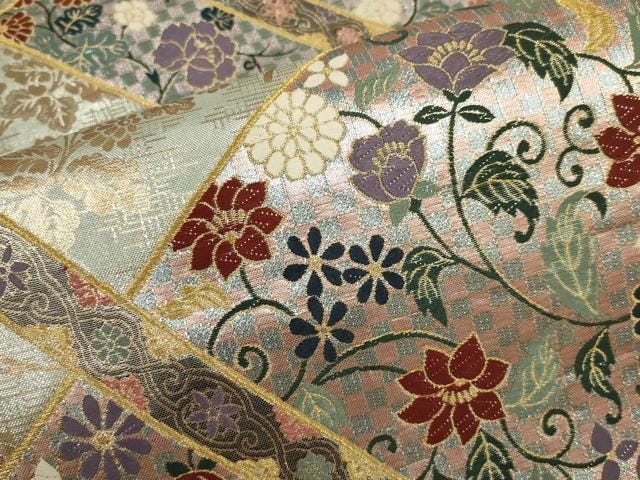
Close-up of a Saga Nishiki six-panel fukuro obi: diamond-framed compartments each containing a distinct floral composition — chrysanthemum, peony, clematis — woven in polychrome silk and metallic thread against alternating pink and silver-green grounds. The panel divisions themselves, bordered in gold, demonstrate the architectural logic of classical motif arrangement.
The Material as Signal
A silk gauze obi, ro (絗) or sha (紗), worn in winter announces a misreading of the material system. These open weaves exist specifically to allow air circulation, and they are strictly summer textiles in the classical calendar: July and August by convention, with a slightly looser application in the warm weeks either side. A heavy brocade obi in August communicates a rigidity so misaligned with the season as to produce discomfort in any onlooker who understands why.
The presence of metallic thread, and its quantity, signals formality in a gradient the Japanese textile tradition has calibrated with precision. Gold thread in large quantities is ceremonial. A slight metallic accent on an otherwise matte-woven obi in figured silk (rinzu) reads as elevated but not rigidly formal. A completely matte-woven obi in a dyed fabric (yuzen-dyed, or in the tsutsugaki resist technique) sits at the casual end of the semi-formal range. The hierarchy descends cleanly from gold to silver to coloured thread to matte, and the wearer positions herself within it with each choice she makes.
The Colour Conversation
The colour of the obi must be read in relation to the colour of the kimono, and this relational reading requires an eye trained to understand not complementarity in the Western colour-wheel sense but a more complex visual conversation: one that takes account of the ground colour, the motif colours, the weight of the pattern, and the season in which the combination is worn.
A heavy, saturated kimono in deep indigo or bottle green requires a lighter or contrasting obi to prevent visual collapse; a pale kimono in ivory or silver-grey can sustain an obi in deep rust or aged gold without the combination overwhelming either piece. The obi is not an accessory in the contemporary fashion sense, not an afterthought, not an accent. It is the second voice in the duet, and its pitch and register must answer the first with intention.
The Making 織りの仕事
To understand what an obi is, it helps to understand how one is made. Or rather, how the great obi are made, the ones that justify the word document.
Nishijin
The Nishijin district of Kyoto has produced complex silk textiles for over five centuries. Its name comes from the western garrison (nishi-jin) that occupied the area during the Ōnin War (1467–1477), before the weavers reclaimed it and built the industry that would define it. The district’s obi are woven on draw looms and, from the late nineteenth century, on Jacquard looms adapted from French models imported after the Meiji Restoration. It is one of the more quietly resonant ironies of Japanese textile history: the Jacquard mechanism, invented in Lyon in 1804, arrived in Nishijin and transformed an industry that had resisted mechanisation for four hundred years. Kyoto and Lyon have been in conversation longer, and more intimately, than most people realise.
The Nishijin obi at its most ambitious employs the tsuzure (綴れ) weave: a tapestry technique in which the weft threads do not run continuously across the full width of the fabric but turn back at the boundaries of each colour area, building up the pattern section by section. The weaver uses the edge of a fingernail (filed to a serrated, comb-like edge) to press the weft threads down into the warp, interlocking each section’s threads precisely with those adjacent. It is slow work of concentrated attention. A skilled tsuzure weaver produces perhaps three centimetres of finished fabric per hour. A single fukuro obi panel (thirty centimetres wide, four metres long) requires more than one hundred and thirty hours of weaving for the patterned sections alone, before the finishing and inspection that follow.
The gold thread used in formal Nishijin obi, kinran thread, is made by cutting gold leaf, or more typically gold foil over lacquered paper, into strips approximately two millimetres wide and winding them helically around a core of white or yellow silk. The resulting thread catches light at a different angle with every shift of the fabric, producing the characteristic shimmer of a brocade obi in motion: an optical property that cannot be replicated by metallic synthetic thread, which reflects more uniformly and therefore reads as flat against the weave rather than alive within it. The difference, once seen, is not subtle.
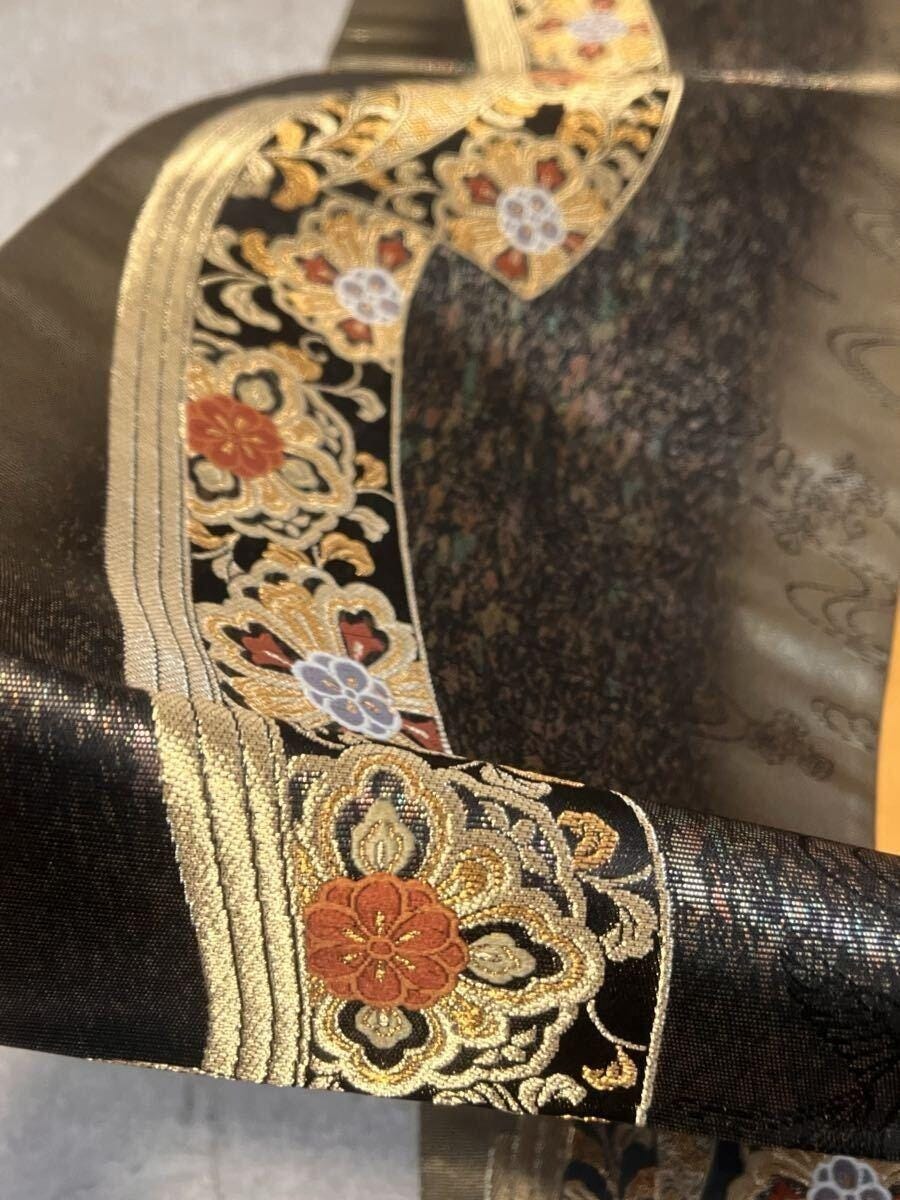
Kinran gold brocade in extreme close-up: the characteristic shimmer of gold foil wound around a silk core, catching workshop light at shifting angles. The black ground throws the metallic thread into relief — karakusa arabesques and stylised floral medallions rendered not as surface decoration but as structure built thread by thread.
Hakata
The Hakata weave (博多織) from Fukuoka in Kyushu operates on an entirely different aesthetic principle from Nishijin’s pursuit of pictorial complexity. Where Nishijin layers weft upon weft to build a surface of depth and narrative, Hakata pursues structural sophistication: a densely woven, firm fabric in which the patterning arises not from supplementary threads but from the interplay of warp and weft count, expressed as subtle relief.
The signature Hakata obi designs are each recognisable to a practised eye as legible variations on a structural theme: the dokko (a Buddhist ritual implement abstracted into geometry), the hanazara (華皿), the flower-offering plate, and the kenjo-hakata (献上博多), the pattern formally presented as tribute to the Edo shogunate in the seventeenth century. They are patterns produced not by adding material to the surface but by the discipline of the weave itself.
A Hakata obi makes a distinctive sound when folded. The Japanese textile tradition has a word for it: kinu-naki (絹鳴き), silk cry, or the voice of silk. The particular crisp, almost papery tone arises from the high thread count and the stiffness of well-sized silk in a densely woven structure, the threads sliding fractionally against one another at the precise frequency that the ear identifies as quality. This sound, the kinu-naki of the Hakata, is not incidental to the object’s identity. It is considered part of it.
Tying 結び
The obi that leaves the loom is, structurally, a long strip of silk. What converts it into its full cultural function is the tying: the musubi (結び), a word that means knot or binding and carries, in the Japanese language, connotations of connection, union, and something brought to completion.
The standard knot for the formal fukuro obi is the otaiko musubi (お太鼓結び): the drum knot. Popularised at the opening celebrations of the Tomioka Hachiman Shrine in Edo in 1817, the otaiko creates the structured square loop at the back of the obi that is the most recognisable silhouette in Japanese dress. The shape is not merely aesthetic: the loop is sized deliberately, its depth and height calibrated to the wearer’s frame. Getting the otaiko proportioned correctly (the loop neither slumping nor rigid, the layers even, the single hanging tail below it precisely aligned) takes practice measured in years, not months.
The tying of the obi is also a system of objects within a system of objects. The obiita, a flat stiffened board, is tucked inside the front section of the obi to keep it smooth across the stomach. The datejime, a thin under-sash worn beneath the obi, holds the kimono layers in place before the obi goes on. The obiage, a thin silk scarf in a colour chosen to complement the obi’s palette, is folded and tucked into the top of the back loop to give the otaiko its lift and structure: a flash of contrasting colour visible above the drum knot’s frame. The obijime, a decorative cord plaited or woven in silk or metallic thread, wraps the body of the tied obi at its centre and fastens at the front: a third layer of signalling, its weight and colour and texture in deliberate conversation with both kimono and obi, readable by those who know the vocabulary.
For young unmarried women at their Coming-of-Age ceremony, the fukura suzume (ふくら雀), the plump sparrow, builds a more elaborate structure at the back, wings spread above the otaiko square, giving the silhouette a volume and exuberance appropriate to the occasion. For children dressed for Shichi-go-san (the autumn shrine visit marking the ages seven, five, and three), the chō-musubi, or butterfly knot, creates a flat, symmetrical shape suited to small bodies and the festive mood of the day. The musubi system is as rich as a script; the knot a woman wears announces, without words, her age, her status, and the occasion she has judged herself to be present at.
A Personal Note 個人的な覚書
I did not arrive at these silks through scholarship. I arrived through a feeling I could not initially name.
Some years ago, before Renaras existed in anything more than a vague instinct, I was handed an obi at a textile fair in Japan and asked to hold it while the dealer rearranged her display. I held it longer than was strictly necessary. There was something in the weight of it (the specific, serious weight of worked silk at that density) that felt like being handed a book in a language I did not yet speak but already somehow recognised. I did not buy it that day. I thought about it for months.
What I understand now, having spent years in the atelier with these materials, is that what I felt in that moment was not sentimentality. It was recognition. The obi is a document (made to be read, made to carry meaning across time, made by hands with specific knowledge working in a tradition with specific grammar), and some part of me already knew that documents were what I was for. Not to collect them. To continue them.
That is, I think, what the atelier is. Not a museum. Not a shop. A continuation. The obi that arrives here still carries its original conversation: its motifs, its season, its ceremony. What we make from it carries that conversation forward into another form, another life, another room. The mottainai (もったいない) logic is not primarily about not wasting. It is about not interrupting. The story was already in progress. We are simply making sure it does not stop here.
The Obi Today 現代の帯
The obi in contemporary life exists in a state of productive contradiction. The kimono tradition, and the obi as its most demanding and most specific element, has contracted sharply in daily practice over the course of the twentieth century and into the twenty-first. The majority of Japanese women who wear kimono do so now for specific occasions: Coming-of-Age Day in January, university graduation ceremonies, friends’ weddings, tea ceremony practice, the New Year visit to the shrine. For most of the rest of the year, the kimono hangs in the tansu, the chest of drawers designed specifically for its flat storage, protected in washi paper from light and moth and the slow damage of time.
The statistics behind this contraction are not comfortable. The Nishijin weaving district, which at its height in the mid-twentieth century employed upward of fifty thousand weavers in its interlocking system of specialist workshops and contracted artisans, has seen employment fall by approximately ninety percent over the decades since. The decline is real, documented, and ongoing. And yet what remains is not diminished in craft. Several of the most respected weaving houses continue to produce obi to the highest technical standard: among them Kondaya Genbei, founded in 1738 and now in its tenth generation, still operating from Kyoto and still weaving to a standard that the founder would recognise. The price of such work reflects what it actually costs: hand-weaving cannot be made economically efficient without ceasing to be hand-weaving.
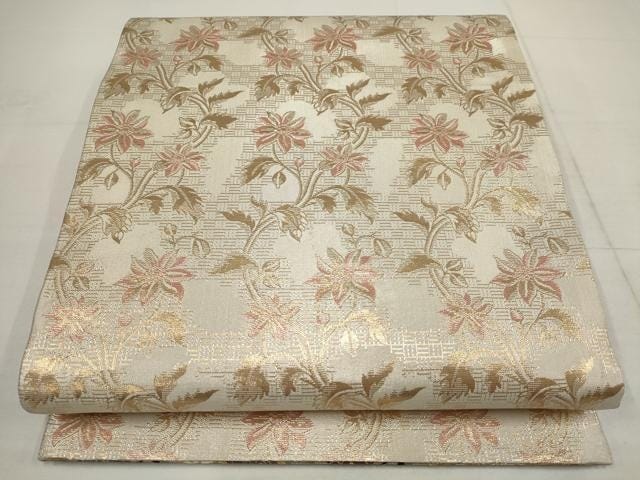
A Saga Nishiki six-panel fukuro obi laid out for examination — the full breadth of the patterned face visible, its diamond compartments each containing a different seasonal flower composition. The alternating grounds of silver-green and rose-pink demonstrate the obi’s compositional logic: variety within structure, each panel a distinct argument within the larger text.
And yet the obi does not sleep quietly. The secondary market for obi (vintage, antique, and occasionally newly commissioned) has grown significantly over the past two decades, driven by collectors and textile enthusiasts outside Japan who recognise in the formal brocade obi one of the most technically accomplished woven objects ever made, and by a younger generation within Japan who are approaching the kimono tradition on their own terms: mixing vintage obi with contemporary or Western dress, tying hanhaba obi in configurations unknown to the classical system, treating the obi not as a constraint but as a material with its own possibilities and its own intelligence.
A new formal fukuro obi from a reputable Nishijin house may cost the equivalent of a month’s rent in central Kyoto. A museum-quality maru obi, hand-woven in tsuzure on gold kinran, may cost considerably more, and belongs properly in a collection. The market for vintage obi, by contrast, ranges from the extraordinarily accessible (a mid-century Nagoya obi in good condition discovered at a Sunday flea market in Tokyo) to the genuinely exceptional, where a signed nineteenth-century Nishijin brocade in intact condition commands attention that transcends the secondary textile market and enters the territory of cultural artefact.
Both ends of this range deserve attention. The humble Nagoya obi on a flea-market table is also a document: of a maker’s skill, a wearer’s life, a city’s particular relationship to silk in a particular decade. The high auction maru obi is not more itself than the everyday obi is itself. Both are arguments, laid flat, waiting to be read.
The Reading Continues 続く読み
The old agricultural calendar, with its seventy-two micro-seasons tracking the world’s tilt through the year in precise increments, marks this present moment as kōgan kaeru (鴻雁北): the wild geese fly north. It falls within the sekki of Seimei, Pure and Clear Light, the window in early April when the air clarifies after the long haze of late winter, the light sharpens, and things become visible that were obscured. The last of the sakura has fallen, and what remains is the clarity that comes after. Above the hills of Kyoto the geese are leaving, a ragged line drawn north across a sky washed clean.
It is, perhaps, the right moment to look again at the obi: to see it not as an artefact of a tradition that has contracted but as a document that has not stopped being written. Every weaver who sits at a Nishijin loom continues the argument. Every woman who ties an otaiko for a ceremony continues the argument. Every collector who unrolls a nineteenth-century maru obi on a clean surface and reads the motifs in the light continues the argument. The hara, bound with the right textile and the right intention, continues the argument.
The field guide ends here. The reading continues.
✦ ✦ ✦
The obi becomes an object again; view the table runner collection.
One silk. One story. One piece. Never repeated.
The Silk Journal · journal.renaras.com