
Two samurai on the silk
An old warrior's guide to telling someone the truth so they can hear it

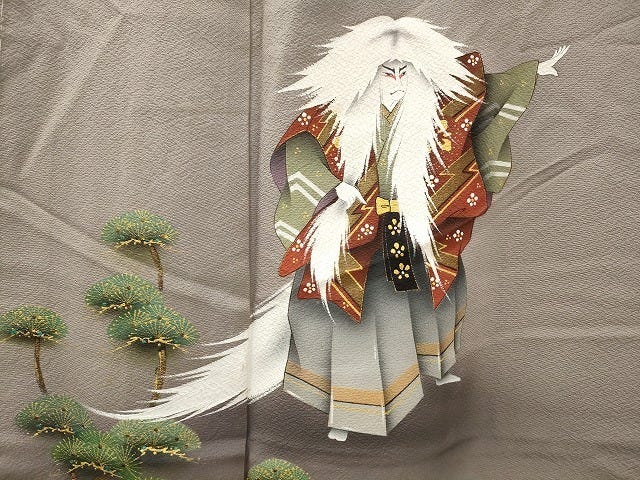
A kimono arrived at the atelier this week with two samurai on it. Not fierce, not posturing. Two figures held in silk, mid-gesture, the way a woven scene holds a moment that has already passed and keeps passing. I sat with it a long while, and it turned my mind, as these things do, to the man who wrote the samurai’s most famous and most misunderstood line. The Way of the Samurai is found in death.
People take this for a love of dying. It is the opposite. Yamamoto Tsunetomo, who set down the sword and took up the stillness of a Zen priest, meant that a person who keeps death close stops wasting the hours. Knowing the end is near makes the present suddenly, almost unbearably, alive.
He was not alone in seeing it. Rilke wrote that death is our friend precisely because it presses us into full and passionate presence with everything that is here, everything natural, everything we love. A samurai in old Japan and a poet in old Europe, arriving by different roads at the same quiet finding: it is the nearness of the end that makes us tender toward what remains.
I mention all this because the same samurai, in the same book, turns from the great matter of death to a smaller and stranger one. How to tell a person a hard truth so that it can actually be received. And once you have felt the first lesson, the second reads differently. If our hours are numbered, then the truths we owe each other are not to be hoarded. But they are also not to be thrown.
There is a particular ache in loving someone and seeing clearly what they could be. You watch them stumble over the same stone they set down themselves last year, and the year before. You see the finer version of them, close enough to touch, and you see them walk past it again. And you say nothing, because to speak feels like a risk to the very thing you are trying to protect.
Changing our own way of moving through the world is hard enough. Changing another person is nearly impossible, and done badly, done from above, it can break the two of you against each other. Yet if an honest bond rests on slowly refining the truths two people are able to tell each other, then holding up a mirror, gently, at the right moment, is not a cruelty. It is a form of love. Perhaps the tenderest we have. Offered the wrong way, the same gift lands like a stone through a window, and the other person shutters themselves so fast that the closing is all you hear.
Our faults, Tsunetomo says, are dyed deep into us, the way indigo sinks past the surface of the cloth and will not lift with a single washing. To offer someone your honest opinion, to help them see what they cannot, he calls the first duty of real service, and also the hardest thing to do well.
Here is the part I keep returning to. He warns against the pleasure of it. Most people believe they are being kind precisely when they say the difficult thing, the distasteful thing, the thing no one else will voice. They mistake the bluntness for courage. But if the truth is not received, if it does not land, then however brave it felt in the mouth, it was worthless. Long before we learned to warn each other not to confuse self-righteousness with morality, an old soldier had already seen it plainly: correcting another from a height is not a gift, only the appearance of one. And shame, he adds, changes no one. It teaches them to hide.
What he offers instead is almost unbearably patient. Before you say anything, judge whether the person is even able to hear it yet. Become close to them first. Earn the trust that makes hard words survivable. Come at the thing sideways, through what they love, and look for the phrasing that will actually reach them rather than the phrasing that pleases you to say. Weigh the moment. A letter may carry it better than a face. The quiet of a leave-taking may hold it better than the middle of a good day. Praise what is true and good in them, and mean it. Speak of your own failures in a way that lets them arrive at their own, without your finger pointing. Do all this, he says, and the person will take your truth the way a thirsty person takes to water. Only then does it become an opinion that corrects a fault.
We think about this at the cutting table more than you might expect. A tear in old silk is not corrected by force. You cannot scold a fibre back into place. You go slowly, you find where it wants to hold, you work with the grain the weaver left, and you mend it so the repair belongs to the cloth rather than fighting it. Done well, the mend is not hidden and it is not ashamed. It becomes part of why the piece is loved. People, I think, are mended much the same way. Not from above. Not with the satisfaction of being right. But close in, with the grain, at the hour they can bear it, the way you would handle something you did not want to lose.
The two samurai are still here, held in the silk, a scene someone wove long before any of us and kept for a day like this one. They will outlast this essay, and me, and the hands that made them. That is rather the point. The nearness of the end is what makes the truth worth telling gently. The thirsty take the water. Everything else runs off and is gone.
The Hagakure was written by Yamamoto Tsunetomo three centuries ago. I came to it, as many do now, through Maria Popova's The Marginalian*