
A kimono is cut the same for everyone. The obi is where the difference was kept.
For most of its life the kimono refused to flatter. No darts, no tailoring to the body, the same flat shape laid against every woman who wore it. Whatever a woman wanted to say about herself, her season, her age, whether she was married, whether she was free, she said in the band of cloth at her waist and in the way it was tied. The kimono was the sentence. The obi was the meaning.
It was not always so wide, or so important. The obi began as a cord, something to hold the dress closed, and for a long time that was all it was. Then, across the Edo period, the weavers and dyers turned their attention to it, and it grew. Longer. Wider. Heavier with pattern. By the height of it a formal obi ran some three and a half metres and a full hand’s width, no longer a fastening but the thing the eye went to first.
Where the bow sat was its own quiet argument. For years it was tied at the front, or at the side, close to the hands that made it. The story goes that the back came into fashion when a Kabuki actor, playing a young girl, walked on stage with his knot tied behind him, and the city copied what it saw on the boards. Perhaps. The plainer truth is that the obi had simply grown too large to carry in front. A band that wide, knotted over the stomach, made a woman into furniture. Moved to the back, the same bulk became a shape she could live inside.
So constraint turned into grace, the way it often does in Japan. The knot went where it had to go, and then someone made it beautiful, and then it became the rule.
The grades of the obi are a hierarchy you wear. Most formal is the maru, made from a single wide cloth folded over its lining, patterned along its whole length and on both faces, weighed down with metal-wrapped thread and foil. It is magnificent, and it is difficult. Its own weight works against the woman tying it, which is why few wear it now: brides and geisha and those whose lives still have room for that much ceremony. The old maru obi is the one collectors want. The gold in it has gone soft with age, less like jewellery now and more like an old tapestry, and the newer ones, for all their pattern, do not have that. Age did something to the thread that the loom could not.
A step down sits the fukuro, the pouch obi, the most formal thing most women actually reach for. It carries its splendour on the front and saves the cost on the back, plainer silk where no one looks, the brocade kept for the part that shows. Worn, you cannot tell it from a maru. It is the same magnificence, made lighter so a person can bear it through an evening.
Then the Nagoya, which is the obi of ordinary days, and which is barely a century old. A seamstress in the city it is named for cut it down at the end of the 1920s, sewing one end folded in half so it could be put on without a fight. The geisha of Tokyo took it up because it was quick, and the fashionable women took it from them, the way fashion has always moved here, down from the demimonde into the household. It was never meant for the highest occasions and it never reached them. But in fine brocade it climbs as far as it can, almost ceremonial, almost.
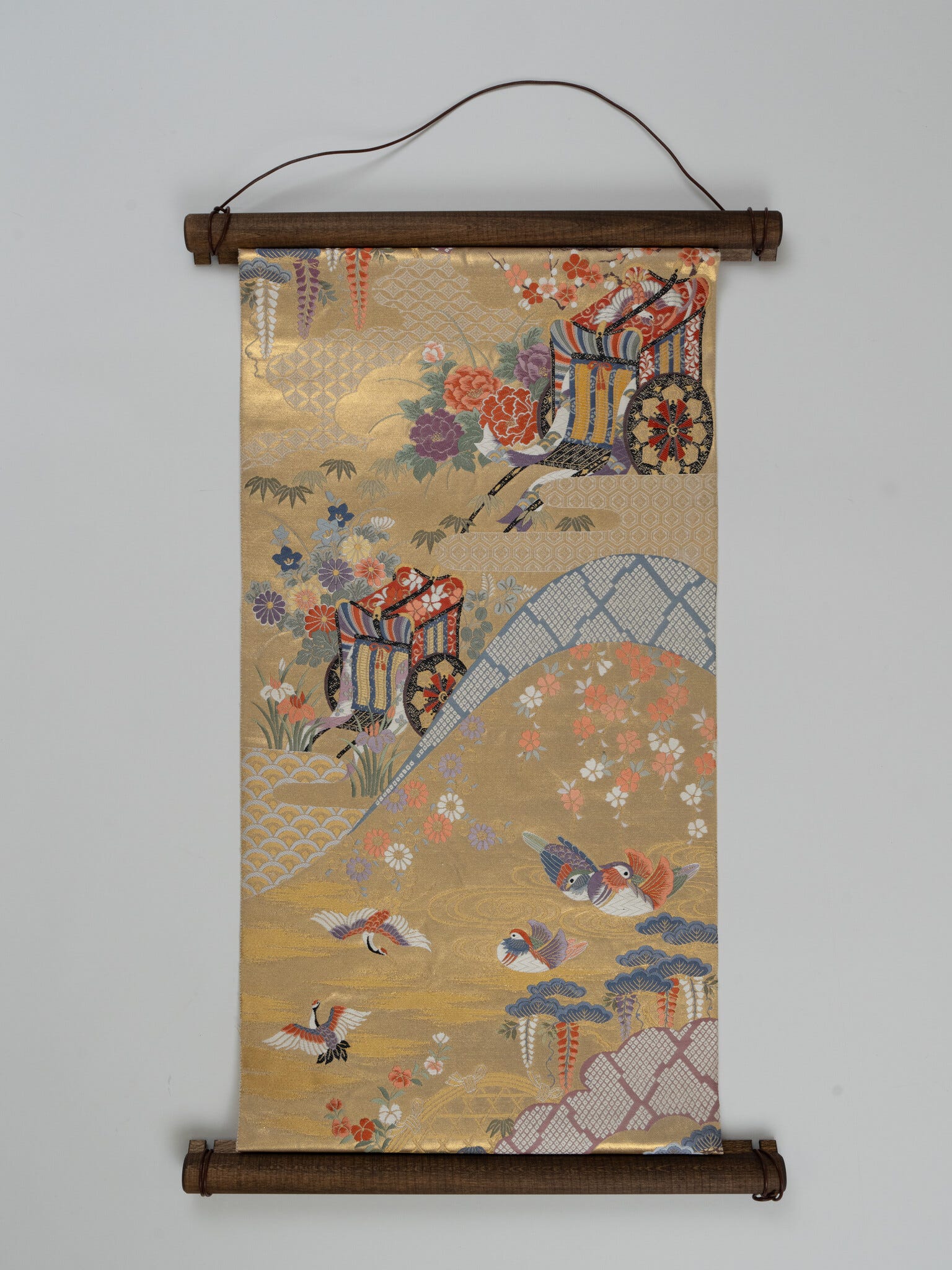
The longest obi belongs to the youngest women who still wear it seriously. A maiko’s darari trails some six metres, its end stamped with the crest of the house she belongs to, the knot left long so it hangs down her back in two tails almost to the floor. It announces her. It also marks her as not yet finished, still in training, still belonging to someone. When she becomes a full geiko the long tails go. Restraint is the privilege of arrival.
Around the knot gathers a small society of objects, each invented to solve a problem and each kept on for its beauty after the problem was solved. The makura, a little pillow, holds the shape of the knot from inside. The obiage, a length of scarf, covers the pillow and is allowed to show at the front, a hand’s width of colour if the woman is young and unmarried, only a glimpse if she is not. To let it show is to say something: the cloth was understood as an undergarment, and a woman who let more of it appear was saying more than the cloth alone. The obijime, a cord drawn through the knot and tied at the front, holds the centre firm and finishes the line. None of these existed before the back-tied knot asked for them. The shape created its own household.
The most worn knot of all is the taiko, a clean box riding low at the back. There is a story about its name, that some geisha tied their obis a new way at the opening of a Tokyo bridge two centuries ago, and the city, watching, called the knot after the bridge and not after the drum it is so often mistaken for. The story may be true. What is certainly true is that the knot outlived whoever first tied it, and that almost every woman in formal dress today wears some descendant of that afternoon on her back without knowing it.
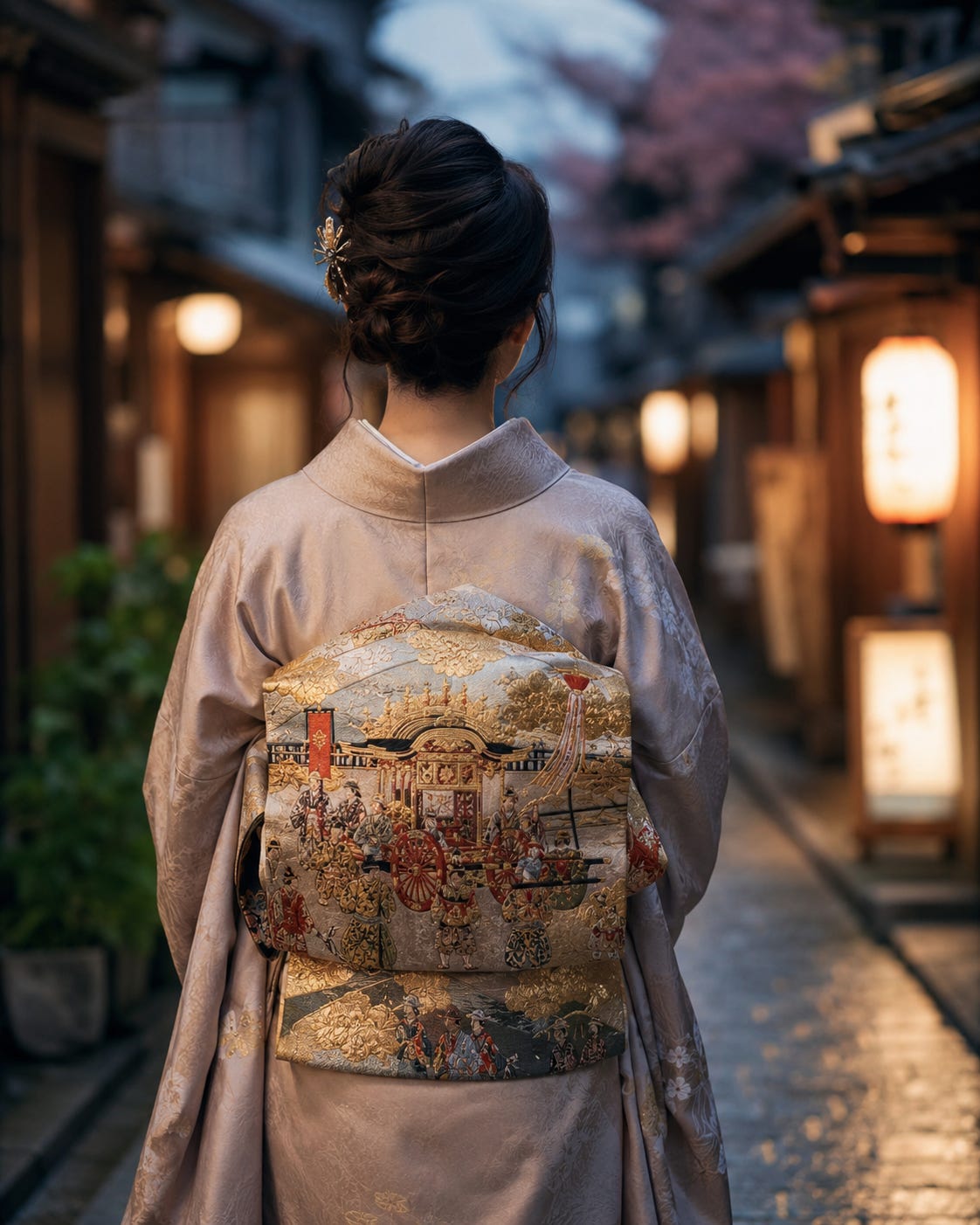
A woman in kimono carries a small archive at her waist. The cut tells you nothing. The knot tells you everything, if you were taught to read it, and most of those who could are gone. What is left is the shape itself, tied behind her where she cannot see it, made to be read by everyone but the one who wears it.
One silk. One story. One piece. Never repeated.
RENARAS