

A cloud is the least permanent thing in the sky. It holds its shape for a breath, then becomes another shape, then nothing. So there is something quietly defiant in weaving one into silk: in taking the most fugitive form in nature and fixing it in threads meant to outlast the weaver. The Japanese did this for centuries, and they did it deliberately. The cloud they wove was not any cloud. It was zuiun, 瑞雲, the auspicious cloud, the cloud that signals the arrival of something sacred.
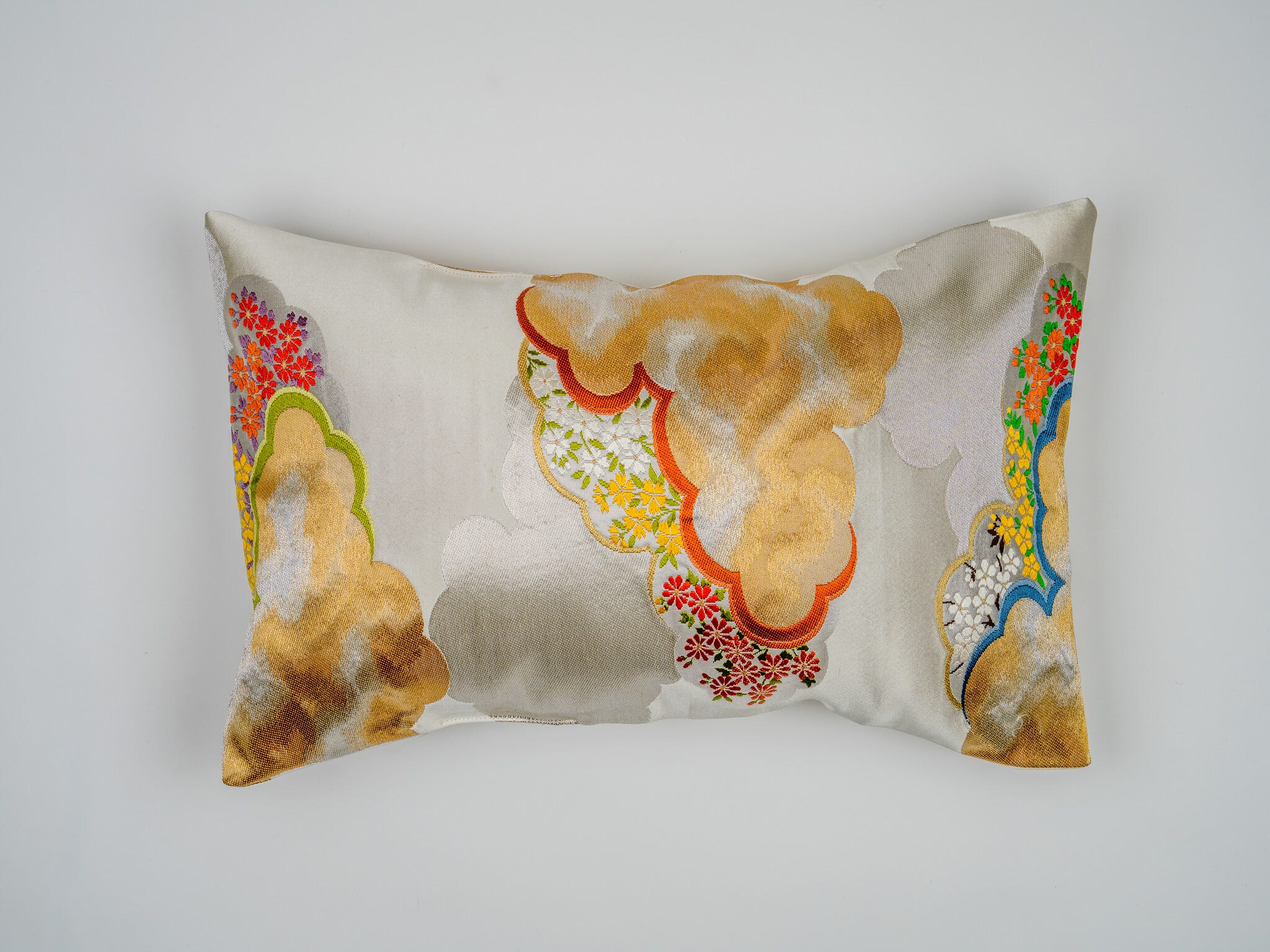
I have a lumbar pillow on the cutting table as I write this. The silk it was cut from carried zuiun across its full length, in white and gold, the clouds curling against a ground so pale it reads as light rather than colour. I have looked at it for a long time. This is what I want to tell you about.
What zuiun is: 瑞雲, the cloud that announces
In the Japanese visual vocabulary, not all clouds mean the same thing. There is kumo (雲), the everyday word for cloud, the ordinary weather of the sky. And then there is zuiun, written with the character 瑞, which carries the sense of an omen, a felicitous sign, a portent of good. Zui is the same character that appears in words for auspicious and propitious things. To call a cloud zuiun is to say it is not merely passing overhead but arriving with meaning.
In Buddhist and Shintō iconography, the auspicious cloud is the vehicle of the divine. Deities descend on it. Bodhisattvas are borne aloft by it. It appears at the threshold between the human and the sacred, the visual signal that something beyond the ordinary is entering the world. When you see zuiun rendered in a temple painting, you are looking at the moment of arrival made visible: the sky opening to let something through.
To weave this onto a ceremonial textile, then, was never decoration. It was invocation. The cloud blessed the wearer. It carried the wish that grace might descend on whatever occasion the silk was made for: a wedding, a coming-of-age, a celebration that mattered enough to commission silk woven in gold.
[Image: Macro detail of the zuiun motif, the gold-wrapped weft threads catching light against the pale ground. Purpose: to let the reader see the cloud as the weaver intended it, not flat, but luminous, the gold doing the work that paint cannot.]
Why gold, and why it changes the silk
The gold in this silk is not dye and not paint. It is kinran, 金襴, the technique of weaving with gold-wrapped thread, in which fine strips of gold-leafed paper are wound around a silk core and then woven into the cloth as a supplementary weft. This is among the most demanding things a weaver can attempt. The gold thread is fragile and unforgiving. It cannot be rushed, and it cannot be corrected. Every centimetre of gold cloud in this pillow represents a passage of weaving slow enough to test anyone’s patience.
What gold does to a cloud is worth dwelling on. A cloud painted in white pigment sits on the surface, inert. A cloud woven in gold moves, because gold is not a colour but a behaviour. It does nothing in flat light and everything in raking light. Turn the silk a few degrees toward a window and the clouds ignite. Turn it back and they recede into the pale ground like weather dissolving. The motif was chosen for its impermanence, and the material was chosen to perform that impermanence. The cloud appears and disappears as you move around it.
There is a Japanese sensibility at work here that has no single English word: the appreciation of a beauty that is conditional, that depends on light and angle and the moment of looking, that you cannot possess all at once. The gold cloud refuses to be seen completely. It gives you a different silk depending on where you stand.
Nishijin 西陣: where the cloud was woven
A silk like this comes from one place above all others: Nishijin, the weaving district in the northwest of Kyoto whose name has been synonymous with the most complex figured silks in Japan for more than five centuries. Nishijin is not a brand or a single workshop. It is a district: a dense concentration of weavers, dyers, gold-thread makers, and designers who between them held the knowledge required to produce textiles of this order.
[Image: Wider view of the full silk before cutting, zuiun running across the length. Purpose: to show scale and repetition, the way the cloud motif was conceived as a continuous field, not an isolated emblem, so the reader understands what was sacrificed and what was preserved in the cut.]
To weave zuiun in kinran on a Nishijin ground is to bring together the most auspicious motif and the most demanding technique in one cloth. These were not silks made for daily wear. They were hare (晴れ) textiles: silk for the formal, the ceremonial, the exceptional day, as opposed to ke, the ordinary. The cloud belonged to the kind of occasion a family prepared for across months and remembered across decades.
The decision at the cutting table
Here is the tension I live with in the atelier, and it is most acute with a silk like this. To make a lumbar pillow from a ceremonial silk woven in gold is to make a cut. The cloud was conceived as a continuous field, repeating across the full bolt. The pillow takes one passage of it and lets the rest go. Something is always sacrificed in this. I do not pretend otherwise.
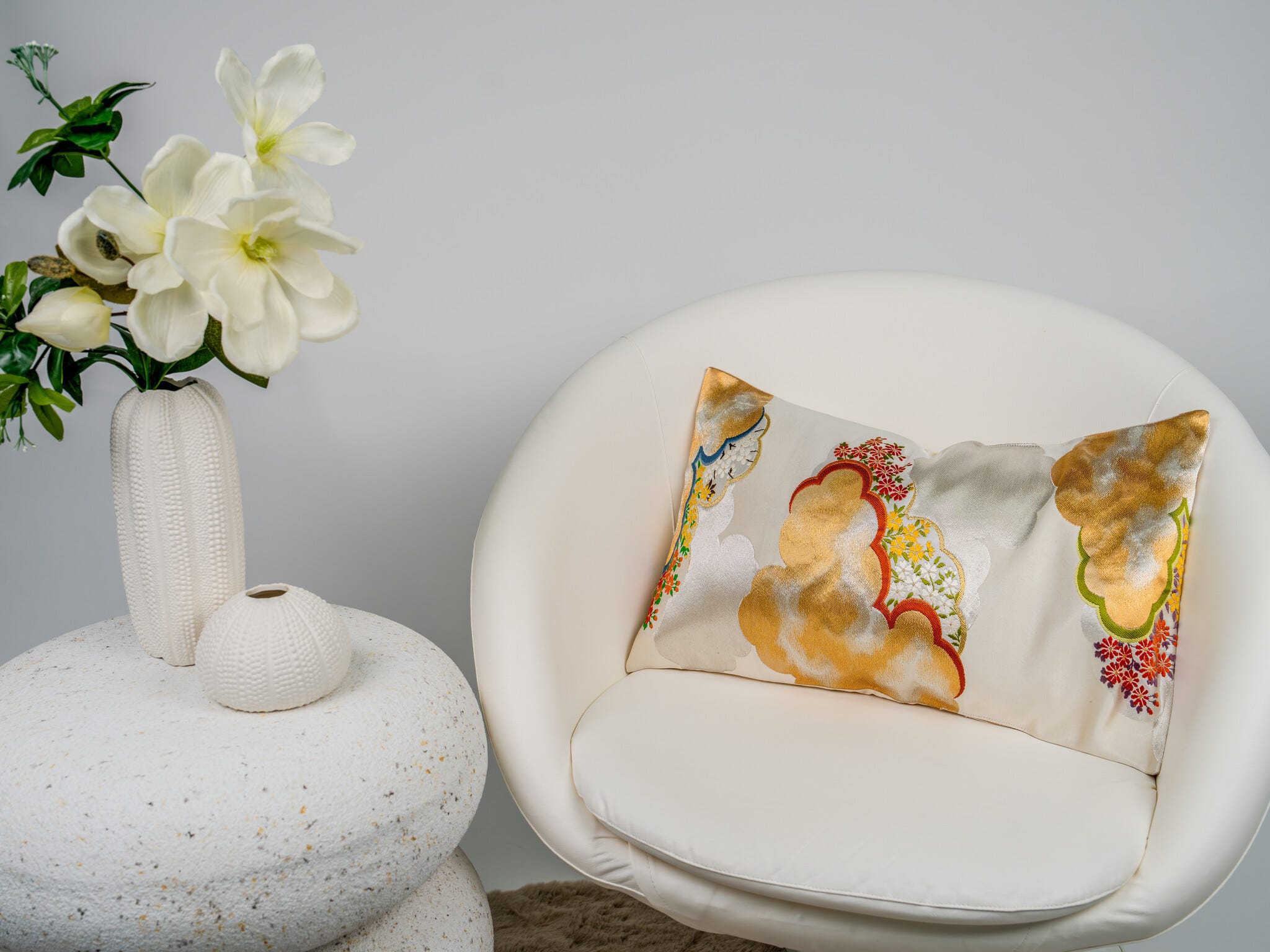
But something is also revealed. On the bolt, folded in a chest, the silk is invisible. It is one piece among the vast dormant stock of ceremonial textile that Japan holds in storage, an entire civilisation’s formal wardrobe folded in the dark, unseen and unworn. The cloud blesses no one when it is folded. To bring it into a room, onto a reading chair, into the slow daily life of a contemporary home, is to let the cloud do again what it was woven to do: to announce, quietly, that this ordinary moment is worth marking. The auspicious cloud was always about the arrival of grace into a particular place. A living room is a particular place.
When this pillow is finished, no metal touches the visible silk. The closure is an envelope pocket, the gold cloud left whole across the face. The cut is made in service of continuation, not consumption. This is the distinction that matters to us, and it is why we describe what we do as continuation rather than repurposing. The silk had a first life. This is its second, and the cloud is still gold.
Living with an auspicious cloud
If you keep a piece like this, keep it where light moves. A zuiun silk in gold is wasted under flat, even illumination. It wants a window, a lamp at an angle, the changing light of a single day passing across it. Place it where someone sits, a reading chair, the head of a bed, a chaise by a tall window, so that the person at rest is the one the cloud descends toward. The motif was made to bless a body. Let it.
And know what you are living with. Not a decorative pattern of clouds, but a wish, woven in gold by hands in Kyoto, for grace to arrive: a wish that survived the decades folded in the dark and is now, in a room in Europe, doing again the only thing it was ever made to do.
You can see the piece this silk became among our Japanese ceremonial silk lumbar pillows, and the auspicious cloud in other forms across the Japanese ceremonial silk textile paintings.
One silk. One story. One piece. Never repeated.
The Silk Journal · journal.renaras.com
Beautiful. Thankyou!
Thank you for sharing your thoughts and understanding of kinran and nishijin and zuiun! I have no knowledge that the gold thread would be so difficult to weave with and so precise.