What Wabi-Sabi Actually Means — and Why the West Gets It Wrong
On the philosophy of imperfection, the beauty of time, and what Japanese silk teaches us about living well.

Here’s the full article, ready to paste into Substack:
What Wabi-Sabi Actually Means — and Why the West Gets It Wrong
On the philosophy of imperfection, the beauty of time, and what Japanese silk teaches us about living well.
There is a moment, if you have ever held a piece of aged Japanese silk, when something unexpected happens.
Your fingers find a thread that has loosened slightly at the edge. A weave that has softened with decades of folding. A colour that has deepened, not faded — the way a face deepens with age rather than simply growing old. And instead of feeling disappointed, you feel something closer to reverence.
That moment — that precise, quiet recognition — is wabi-sabi.
Not the word. Not the aesthetic. The feeling.
What the West Thinks Wabi-Sabi Means
Walk into any Scandinavian-inspired homeware store in Amsterdam, London or Paris and you will find the words wabi-sabi on a candle, a cushion, a coffee table book with a linen cover. It has become shorthand for a certain kind of minimalist, neutral-toned, deliberately imperfect interior. Rough ceramics. Unfinished edges. The carefully curated illusion of not trying too hard.
This is not wabi-sabi.
This is wabi-sabi flattened into an aesthetic — stripped of its philosophical roots, its emotional depth, its centuries of meaning — and sold back to us as a decorating style.
The West fell in love with the surface. It missed the soul entirely.
The Two Words That Western Translations Always Collapse Into One
Wabi (侘び) and sabi (寂び) are two distinct concepts that have been folded together over centuries into a single philosophy. But understanding them separately is essential to understanding what is actually being said.
Wabi originally described the melancholy of solitude — the feeling of being alone in nature, away from society, stripped of comfort and distraction. It carried an ache. A monk in a mountain hermitage. A single candle in an empty room. Over time, wabi evolved to describe the quiet beauty found within that simplicity — the profound contentment that arrives not despite the absence of luxury, but because of it.
Sabi describes the beauty of time passing. The patina that age leaves on objects. The rust on a temple gate. The silver that appears in silk after fifty years of careful folding. Sabi is not decay — it is becoming. It is the visible record of time lived honestly.
Together, wabi-sabi describes a way of perceiving the world in which impermanence, incompleteness and imperfection are not problems to be solved. They are the very source of beauty.
This is not a decorating philosophy. It is an entire cosmology.
Why the West Struggles to Truly Understand It
The difficulty is not intellectual. It is cultural.
Western aesthetics, rooted in Greek ideals of proportion and harmony, have always reached toward perfection. We restore antiques. We polish silver. We fill cracks. We frame imperfection as something to be overcome — or at best, tolerated with good humour.
Japanese aesthetics move in precisely the opposite direction.
Mono no aware (物の哀れ) — the bittersweet awareness of impermanence — sits at the heart of Japanese culture in a way that has no real Western equivalent. The cherry blossom, sakura, is not beautiful despite the fact that it falls within a week. It is beautiful because it falls. The Japanese do not merely accept transience. They have built an entire emotional vocabulary around the ache and the wonder of it.
Kintsugi (金継ぎ) — the art of repairing broken pottery with gold — is perhaps the most famous expression of this. The crack is not hidden. It is illuminated. The repair becomes the most beautiful part of the object.
When a European interior designer places a rough ceramic bowl on a marble shelf and calls it wabi-sabi, they are reaching toward something real. But they are reaching from a cultural framework that still, at its core, believes the marble shelf is better than the bowl.
In Japan, the bowl is the point.
What Japanese Silk Understands That We Have Forgotten
At Renaras, we work with objects that have lived.
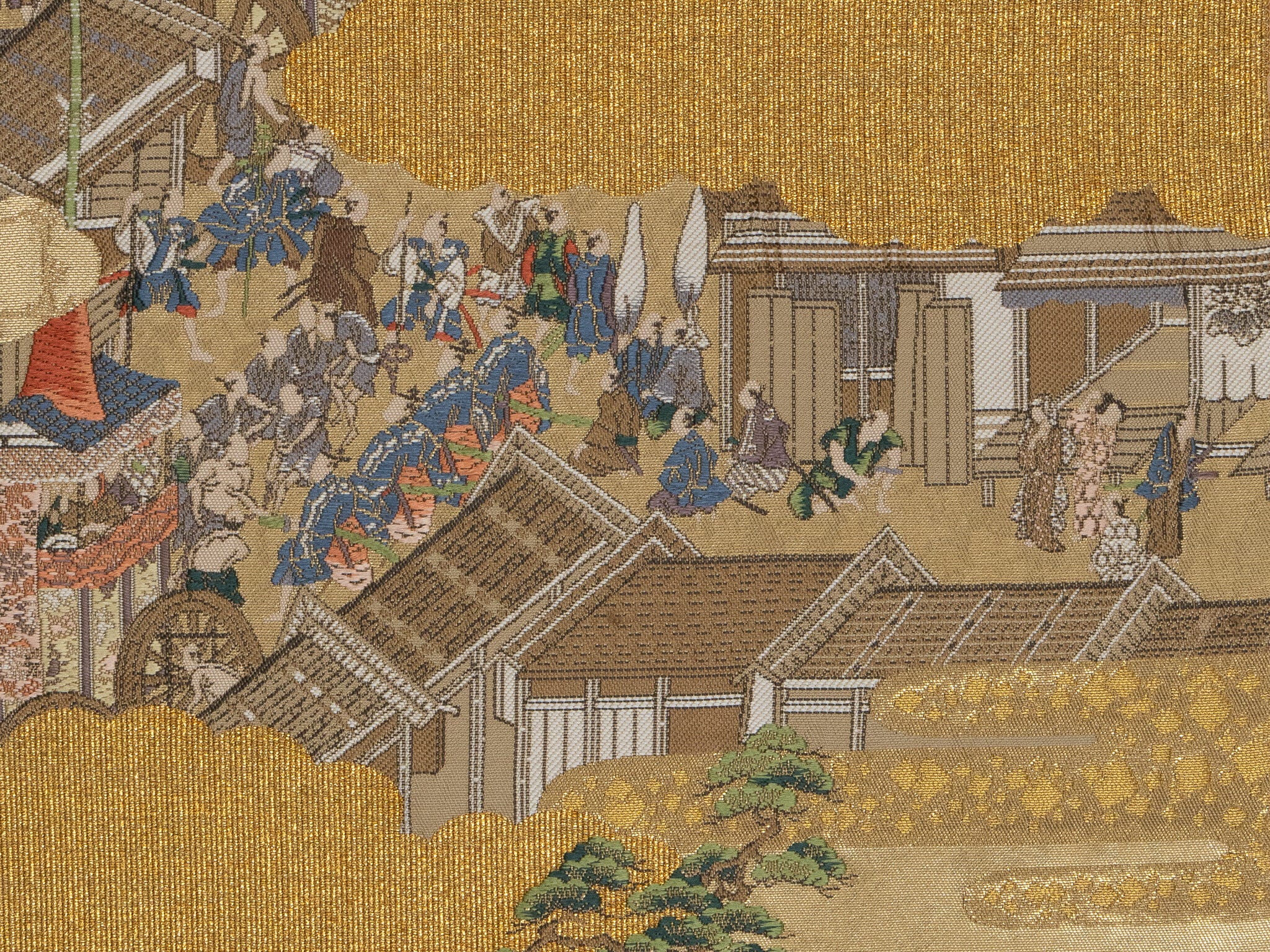
A Fukuro Obi that wrapped itself around a bride in the Showa era carries in its threads not just silk and gold — it carries ma (間), the Japanese concept of the meaningful space between things. The pause. The breath. The silence that makes the music possible.
When we place a vintage silk table runner — rescued from a tansu chest in Kyoto, authenticated, one of a kind — across a European dining table, something alchemical happens. The silk does not simply decorate the table. It changes the quality of time at that table. Dinner becomes slower. The light catches differently. Conversation deepens.
This is not romanticism. This is what wabi-sabi actually does in a space.
Our Aki-No-Mori silk runner — its name meaning Autumn Forest (秋の森) — carries within its weave the precise colour of Japanese maples in November. Not a reproduction of that colour. The actual pigment of aged silk that has absorbed light for decades. No dye house in the world can manufacture what time manufactures for free.
Our lumbar pillows, born from Obi silk that once cinched ceremonial robes, carry the memory of the body that wore them. The slight variations in the weave. The places where the thread has softened. These are not flaws. In the language of wabi-sabi, these are the most precious parts of the object.
The Three Things Wabi-Sabi Is Actually Asking of Us
If we take wabi-sabi seriously — not as an aesthetic but as a philosophy — it asks three genuinely difficult things of a Western sensibility:
First: Accept impermanence without grief. Mujo (無常) — the Buddhist concept of impermanence — is not a sad idea in Japan. It is a liberating one. Nothing lasts. Therefore everything, right now, is precious. The vintage silk in your hands will not exist in this form forever. That is not a reason to protect it behind glass. It is a reason to use it. To let it live in your home. To let it be touched by light and hands and time.
Second: Find beauty in what is incomplete. Japanese aesthetics have a deep affinity for the suggestion of things rather than their full expression. A poem that ends before its conclusion. A garden that implies more than it shows. An object that is not quite symmetrical. The West tends to read incompleteness as failure. Wabi-sabi reads it as an invitation — to bring your own imagination, your own emotion, your own presence to complete what the object began.
Third: Let time be visible. This is perhaps the hardest for a culture obsessed with newness. In Japan, an object that shows its age is not lesser. It is more. The silk that has deepened over fifty years is more beautiful than the silk that was woven last month. The heirloom is not a compromise when you cannot afford the new. The heirloom is the pinnacle.
Coming Home to Wabi-Sabi
There is a Japanese concept — furusato (故郷) — that is usually translated as hometown or homeland. But its deeper meaning is closer to the place where the soul feels it belongs. The place that feels like recognition rather than arrival.
Many of our customers — in Amsterdam, in London, in Paris — describe something like furusato when they first hold a piece of Renaras silk. A recognition. A homecoming. Not to Japan, which most of them have never visited. But to a way of relating to objects and time and beauty that they had always felt but never had the language for.
Wabi-sabi gives them the language.
And the silk gives them a way to live inside it.
At Renaras, every piece we offer is authenticated, one of a ki
nd, and accompanied by a certificate of provenance. Each object has lived. Each object remembers. Explore the collection at renaras.com
Follow The Silk Journal on Pinterest: pinterest.com/renaras_atelier Follow us on Instagram: @renarascom