The Wardrobe That Holds $220 Billion Worth of Forgotten Silk
Japan is sitting on the world's greatest untouched luxury textile reserve. Almost no one is talking about it. Until now.
There is a wardrobe somewhere in Kyoto — cedar-lined, the way the old ones are — that has not been opened in eleven years.
Inside it: three kimonos. Two ceremonial Obi. One Fukuro silk panel so precisely woven that the individual threads are invisible to the naked eye, the surface appearing instead as a single, breathing field of colour and memory. The family who owns the wardrobe cannot tell you when it was last opened. The grandmother who wore the kimono to her daughter’s wedding passed away in 2019. The daughter lives in Tokyo now. She wears suits.
This wardrobe is not unusual.
There are millions of them.
The Number That Changes Everything
Let us begin with a figure so large it requires a moment of stillness before it lands properly.
Kimonos and ceremonial Obi currently sitting unused in wardrobes across Japan are estimated to hold a collective value of more than ¥300 trillion — that is $220 billion USD in dormant, silent, extraordinary textile wealth.
Not worn out. Not damaged. Not faded. Simply sleeping — in cedar-lined storage, in estate collections, in the homes of families who inherited the finest silk their culture ever produced and have no clear pathway to give it renewed purpose.
This is not a niche statistic from an obscure textile journal. This is one of the most significant — and most invisible — cultural and material crises of our time. A slow-motion disappearance of craft heritage that took centuries to accumulate and is dissolving within a generation.
And almost nobody in the luxury world is paying attention.
At Renaras, it is all we think about.
Mottainai: The Word That Contains the Whole Story
The Japanese language has a gift for finding single words that hold entire philosophies inside them.
Mottainai (もったいない) is one of those words. Its literal translation — “what a waste” — does not quite capture the weight of it. Mottainai carries an emotional charge, a kind of grief for the potential in a thing that has not been honoured. It is the feeling of watching something extraordinary go to waste when it did not have to. When it should not have.
It is precisely the word for what is happening to Japan’s silk.
The kimono — once a daily garment, worn across every class and occasion, the defining textile achievement of Japanese civilisation — has become an object of ceremony only. It is purchased for a single occasion: a Coming-of-Age ceremony, a wedding, a graduation. Worn once. Photographed. Folded with care. And then stored — often for decades, often forever — in a wardrobe that is subsequently opened only to confirm the kimono is still there.
As fewer Japanese learn kitsuke — the traditional art of wearing kimono — the barrier to wearing rises. The garments grow more foreign to the bodies that inherited them. The families age. The children inherit objects they cannot identify, cannot wear, cannot sell through any existing channel that recognises their value. And so the silk waits. And waits. Until it doesn’t.
This is mottainai at a civilizational scale.
What Is Actually Being Lost
It is important to understand what kind of silk we are talking about — because the numbers alone do not convey the quality of what is disappearing.
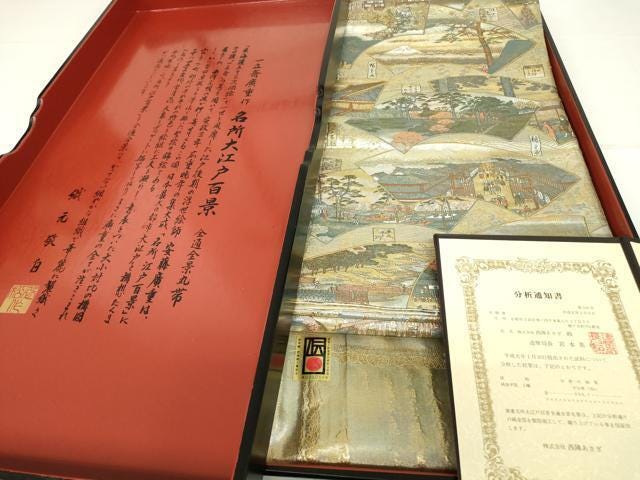
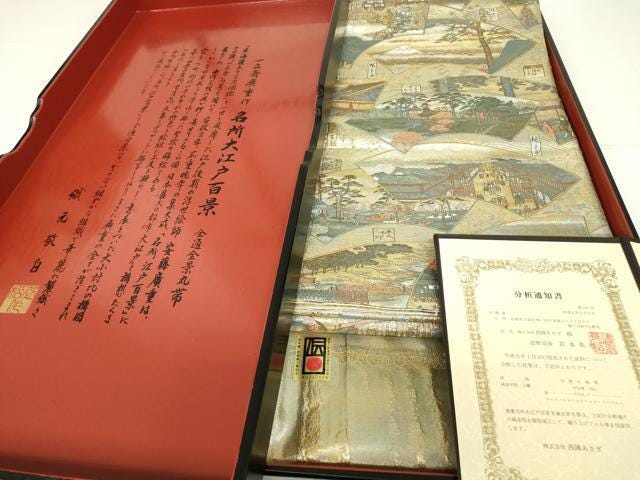
A single Fukuro Obi — the ceremonial belt worn with the most formal grades of kimono — can represent more than two hundred hours of weaving. The patterns are not printed. They are not embroidered after the fact. They are woven into the structure of the silk itself, thread by thread, using a nishiki technique that requires the weaver to hold the entire composition in memory across weeks of continuous work. The resulting textile has a three-dimensional depth that catches light differently from every angle, that changes character between morning and candlelight, that feels under the hand like nothing a contemporary loom can produce.
A Maru Obi — the grandest ceremonial belt, now rarely produced — is reversible, woven in pattern on both faces simultaneously, a feat of structural precision that modern textile engineers study with genuine bewilderment.
Tsumugi silk — the handspun, handwoven fabric that produces the distinctive slubby richness of the finest vintage Japanese textiles — cannot be authentically reproduced at industrial scale. The irregular, tactile character of Tsumugi comes from the handspun thread itself; machine-spun silk produces a surface that is technically smoother and experientially emptier.
These techniques are not merely old. Some of them are actively disappearing. The craftspeople who held them in their hands are aging. Their students are fewer with each decade. The knowledge that produced the silk sitting in those Japanese wardrobes is becoming rarer than the silk itself.
What is sleeping in those cedar-lined wardrobes is not simply textile. It is the accumulated knowledge of a civilisation’s most refined craft tradition, stored in physical form, waiting for someone to recognise that it is irreplaceable.
How Renaras Came to Exist
We did not set out to build a luxury brand.
We set out to solve a problem — the specific, urgent, beautiful problem of extraordinary Japanese silk sitting unseen in dormant wardrobes while the knowledge that produced it quietly fades from the world.
The Renaras model begins with a question that the luxury industry has not seriously asked: what if the finest available silk is not the silk being produced today, but the silk that already exists — waiting to be seen?
The answer led us to Japan’s estate collections. To verified sourcing networks that identify, authenticate, and preserve vintage ceremonial textiles before they are lost to clearing, recycling, or simple neglect. To a process of careful acquisition, documentation, and transformation that gives each piece of silk a second life equal in quality and beauty to its first.
We rescue. We authenticate. We transform.
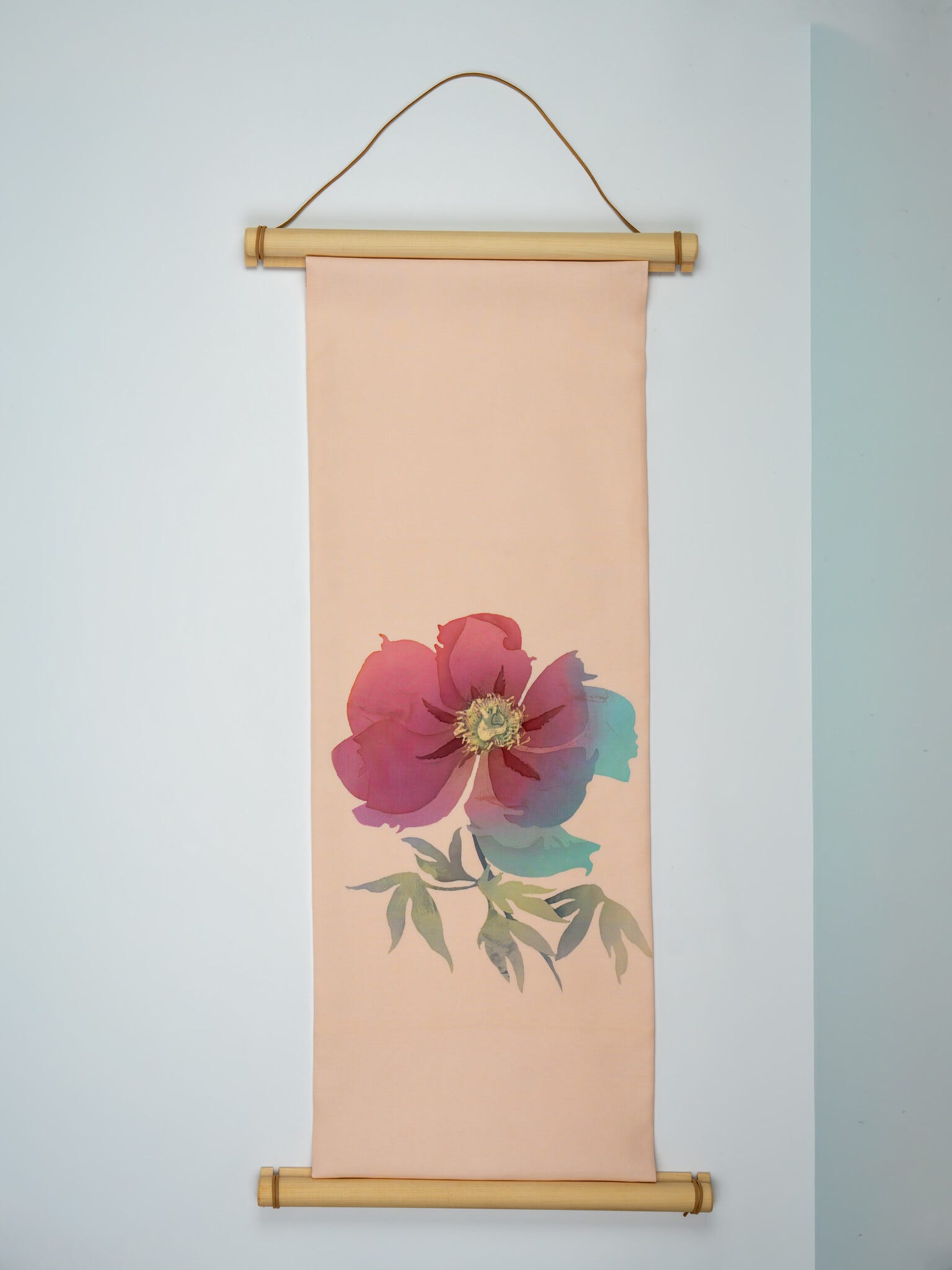
A Fukuro Obi woven for a woman’s wedding in 1962 becomes a wall tapestry that hangs in a contemporary interior, seen daily, admired by every person who enters the room. A Tsumugi silk panel that spent forty years in darkness becomes a luxury table runner at the centre of a dining table where it earns its keep every evening. A hand-dyed ceremonial cloth becomes a Fukusa — Japan’s most refined tradition of presentation, offered to the contemporary gift-giver as a gesture that carries genuine cultural depth.
The silk was already magnificent. It required no improvement. It required only a context in which its magnificence could be seen.
The Renaras Promise: What Every Piece Carries
Every piece that leaves Renaras carries something that no mass-produced luxury brand can offer.
Not just provenance — though every piece does arrive with a Certificate of Textile Origin documenting its authenticated source, estimated period of production, and Obi type or garment classification.
Not just quality — though the quality of vintage Japanese ceremonial silk is, by definition, beyond what contemporary production can replicate.
What every Renaras piece carries is a story that is true. A history that is documented. A singularity that is absolute — because we do not reproduce, we do not restock, and we do not approximate. When a piece sells, it passes from our hands to yours permanently. That exchange is irreversible. And that irreversibility is precisely what gives it meaning.
Read the full Renaras Promise →
The Pieces Themselves
Let us speak, briefly and specifically, about what this actually looks like in a home.
The Woven Dynasty Collection — vintage Japanese silk wall art and tapestries — is where the most formally complex pieces find their highest expression. These are ceremonial Obi and silk panels that were designed to be seen, that carry their meaning in their surface, and that deserve a wall rather than a wardrobe.
The Golden Dynasty Silk Tapestry — gold-thread Fukuro Obi, imperial motif, Meiji-era construction — hangs as what it is: a singular object of Japanese ceremonial history, given a wall commensurate with its quality. There is no reproduction of this piece. There is no second edition. There is one, and it exists now.
Explore the Woven Dynasty Collection →
Table Couture — luxury Japanese silk table runners and placemats — takes the extraordinary surface quality of vintage Tsumugi and ceremonial silk and places it at the centre of daily life. Not locked in a wardrobe. Not preserved behind glass. On the table, where silk belongs: felt under fingertips, caught by candlelight, seen by every person you choose to seat beside you.
The Bengara-Ume runner — Tsumugi silk in Bengara iron-oxide rust, with precision Kasuri-woven plum blossom and hemp leaf motifs — is a piece that changes the register of a dining room. The Kurenai-Shijira — Shijira-ori three-dimensional puckered weave in Kurenai crimson — is the only table runner you will ever own whose surface changes appearance between breakfast and dinner without moving an inch.
The Silk Lumbar Collection — Japanese silk lumbar pillows sourced from antique Obi textiles — brings the same principle to the domestic sanctuary. A cushion that holds two hundred hours of weaving in its face. A resting place made from silk that was intended for ceremony and has arrived, without apology, at your sofa.
Furoshiki — hand-dyed vintage silk wrapping cloths — reconnects the act of giving to the Japanese tradition that understood something the contemporary world has largely forgotten: that how you present a gift is as meaningful as the gift itself. A Renaras Furoshiki does not end in a bin. It becomes the second gift inside the first.
Sustainable Luxury Is Not a Trend
The luxury industry has recently discovered sustainability as a marketing category. Brands that built their identities on excess are now pivoting to responsibility with the urgency of the recently converted.
Renaras does not need to pivot.
Sustainability is not something we adopted. It is the structural reason we exist. Every piece we sell removes an extraordinary textile from the waste stream that would otherwise claim it. Every Certificate of Textile Origin we issue creates a permanent record of provenance that increases the piece’s cultural and material value over time. Every purchase enables the next rescue.
We do not produce new silk. We do not commission reproduction weaving. We do not apply contemporary dyes to vintage fabric and call the result heritage. We work exclusively with what already exists — which means our entire environmental footprint is not the footprint of production, but the footprint of preservation.
This is what sustainable luxury looks like when it is structural rather than cosmetic. Not a percentage of profits donated. Not a capsule collection in recycled polyester. The entire business model, from source to sale, built around giving the world’s finest existing textiles a life worth living.
The Interior That Refuses the Ordinary
There is a particular kind of home — and a particular kind of person who makes it — that Renaras exists to serve.
It is not defined by size or budget. It is defined by a certain quality of attention. The attention that notices the difference between a surface and a story. That understands that an interior composed of objects with genuine histories feels categorically different from one composed of objects manufactured to look as though they have histories. That knows, instinctively, that the silk on the wall is either real or it isn’t, and that the difference between real and imitation is not visible — it is felt.
If you have read this far, you probably live in, or are building toward, that kind of home.
The pieces are here. They were woven in Japan, by hands whose names we may not know, for occasions whose photographs exist in albums we will never see. They have waited — in wardrobes, in collections, in the patient darkness of storage — for someone to recognise their value.
We recognised it. And we brought them here, to you.
Begin Here
Every piece in the Renaras collection is one of a kind. When it sells, it is gone — permanently, irreversibly, without restock. This is not a sales tactic. It is the nature of what we sell.
If something in this article has moved you — toward an object, toward an idea, toward a different understanding of what luxury can mean when it is grounded in genuine heritage — we invite you to begin.
Explore the full Renaras collection →
Discover the Woven Dynasty — Vintage Japanese Silk Wall Art →
Shop Table Couture — Luxury Silk Table Runners →
Ancient silk. Living purpose. New legacy.
— Renaras
About Renaras
Renaras is a sustainable luxury brand specialising in vintage Japanese silk wall art, luxury silk table runners, Japanese silk lumbar pillows, Furoshiki wrapping textiles, and ceremonial Japanese home decor. Every piece is sourced from verified Japanese estate collections, transformed at the highest level of craft finishing, and accompanied by a Certificate of Textile Origin. We do not reproduce. We do not restock. We rescue.
Follow Renaras · renaras.com · The Inner Circle newsletter — new acquisitions announced here first.