

It is called sekimori-ishi (関守石), the barrier keeper’s stone. The name reaches back to the sekisho (関所), the checkpoints on the old roads where travellers were stopped, questioned, allowed through or turned away. But this stone questions no one. It carries no authority except the cord tied around it, and the willingness of the person who finds it in their path.
By tradition it belongs to the tea garden, the roji (露地), the dew path that leads guests toward the tea house. The custom is usually traced to the sixteenth century, to the world of Sen no Rikyū. Before the guests arrive, the host walks the garden and sets the stone down where a path should not be taken that day. It does not say forbidden. It says: not this way, not now. Anyone could lift it. It weighs almost nothing. The whole boundary is a request. It holds because the request is honoured.
The stone alone is only a stone. The cord is what makes it speak.
It is tied by hand, crossed over the top, finished with a loop that rises like a small handle, as if the stone were meant to be carried, which it is. In the tea garden the cord is often hemp palm, dyed black or left dark, so that the binding reads clearly against grey stone and green moss. But the gesture is older and larger than the garden. The knot descends from the shimenawa (注連縄), the ropes of rice straw hung at Shinto shrines to mark where the ordinary world ends and something else begins. The great twisted rope joining the wedded rocks at Ise. The plaited cord above a shrine gate. Straw for the warmth of the harvest and the everyday. Purified hemp for the solemn rites, hemp cleansed, as the tradition has it, of every impurity. A fibre with a vocabulary. When the cord circles the stone, a little of that vocabulary comes with it, and a rock from a riverbed becomes a threshold.
I spent years believing a boundary had to be a wall. Something high, defended, explained at length, patrolled at night. Walls are exhausting. They must be maintained, justified, apologised for. And they tell the other person nothing except that you are afraid.
The stone proposes a different grammar. A boundary can be small. It can be quiet. It can be set down in advance, before anyone arrives, so that no one has to be refused to their face. It does not argue its case. It trusts the person who reads it, and that trust is what makes it hard to violate. It is easier to climb a wall than to step over a stone that was placed with care.
And the stone protects in both directions. Beyond it lies something not ready to be seen: moss that bruises underfoot, a corner of the garden resting, a room where someone is still becoming whoever they will be when they come out. The stone guards that. But it also guards the visitor, who might otherwise wander somewhere they were never meant to stand, and feel the shame of it afterwards. A boundary set gently is a kindness to both sides of the line. I did not learn this from a garden. I learned it slowly, the expensive way, by watching what happened to the people I refused loudly and the people I refused softly.
There is a discipline on the other side too, harder to acquire: learning to see other people’s stones. They are rarely labelled. A shortened answer. A door left ajar rather than open. A path that was welcoming last month and is quietly closed today. The stone asks us not to take these as rejection. A closed path is not a closed person. It only means: not this way, not now.
The stones are still placed. In tea gardens, in temple precincts, at the turn of a ryokan corridor, outside Kyoto restaurants after the last seating. And the craft has moved indoors: makers now bind beach stones with straw and purified hemp in the old shrine manner, so that the threshold can sit on a shelf or a desk, a boundary the size of a hand, guarding nothing but a margin of quiet in the middle of a working day.
At dusk, when the guests have gone, the host walks the path alone, bends, and lifts the stone away by its loop of cord. The path is open again. The moss kept its silence. Nothing was ever forbidden. Something was asked, and honoured, and then, without ceremony, returned.
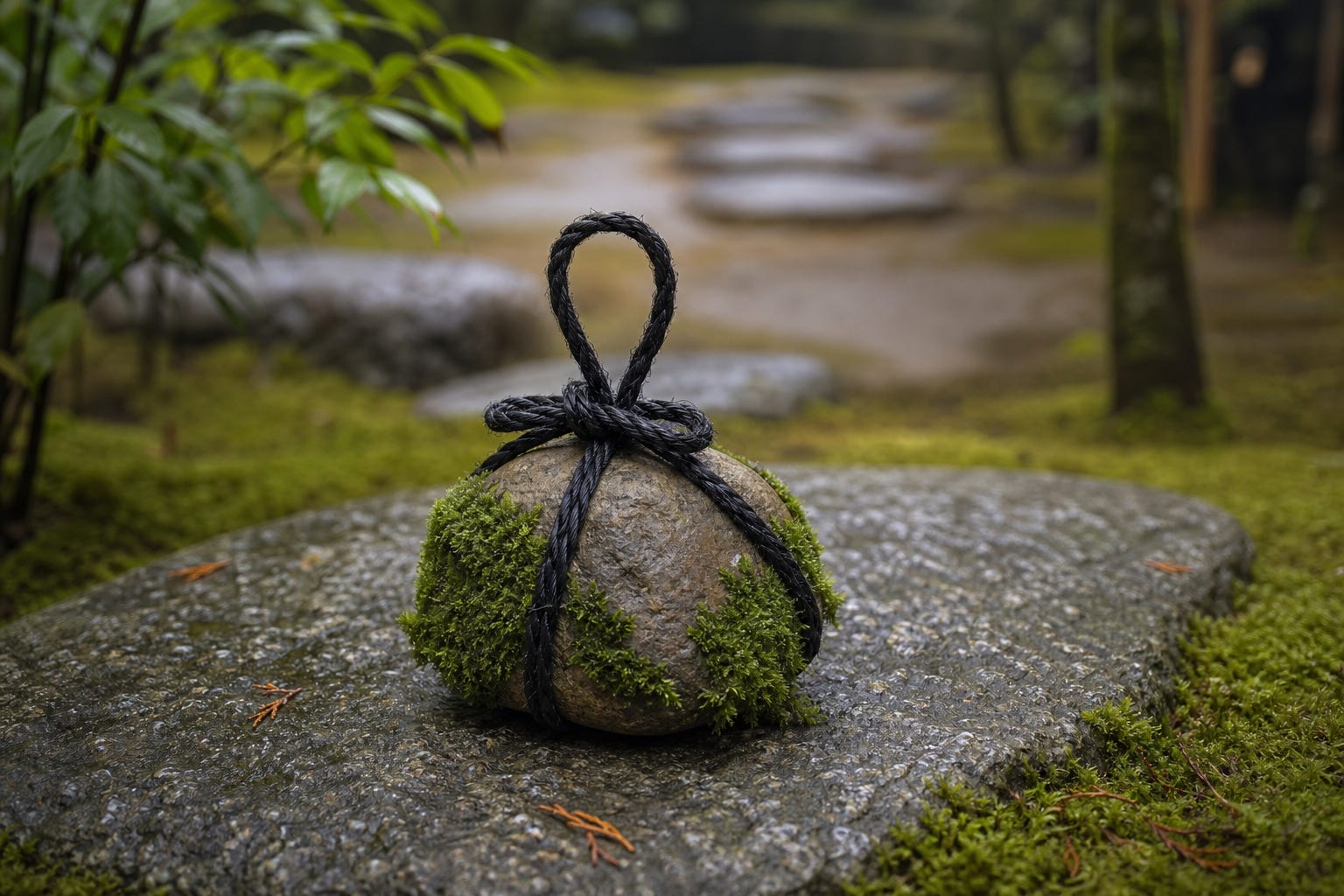
"The stone alone is only a stone. The cord is what makes it speak." And attentiveness is what allows it to be read—and hopefully respected. Makes good sense that this would have started in the tearoom path, where the irregular arrangement of flagstones demands paying attention to the ground.
Interesting