Most Western writing about Japanese gardens focuses on what they look like. This is understandable — they are extraordinarily beautiful — but it misses something fundamental. A Japanese garden is designed as much for the ear as for the eye.
Consider the shishiodoshi, the “deer scarer.” A bamboo tube, pivoted on a fulcrum, slowly fills with water. When the weight tips it forward, it empties, swings back, and strikes a stone with a single, hollow clack. Then silence. Then the slow filling begins again.
The sound is not decoration. It is architecture. The clack defines the silence around it the way a single object on a white wall defines the wall. Without the sound, the silence is merely absence. With it, the silence becomes something you actively hear.
Even more extraordinary is the suikinkutsu — a buried earthenware jar, inverted, with a small hole at the top through which water drips from a stone basin above. The drops fall into a shallow pool inside the jar and produce a resonance that is metallic, bell-like, and entirely unexpected from the earth beneath your feet. You have to lean in to hear it. This is the point. The garden is asking you to pay closer attention than you normally would.
What this has to do with silk
I think about the shishiodoshi and the suikinkutsu when I think about what a piece of vintage silk does inside a room.
A room full of modern furniture and contemporary materials operates at a certain frequency. Everything is precise, current, intentional. It looks good. But it can lack what the Japanese garden provides through sound: a point of contrast that makes you suddenly aware of everything around it.
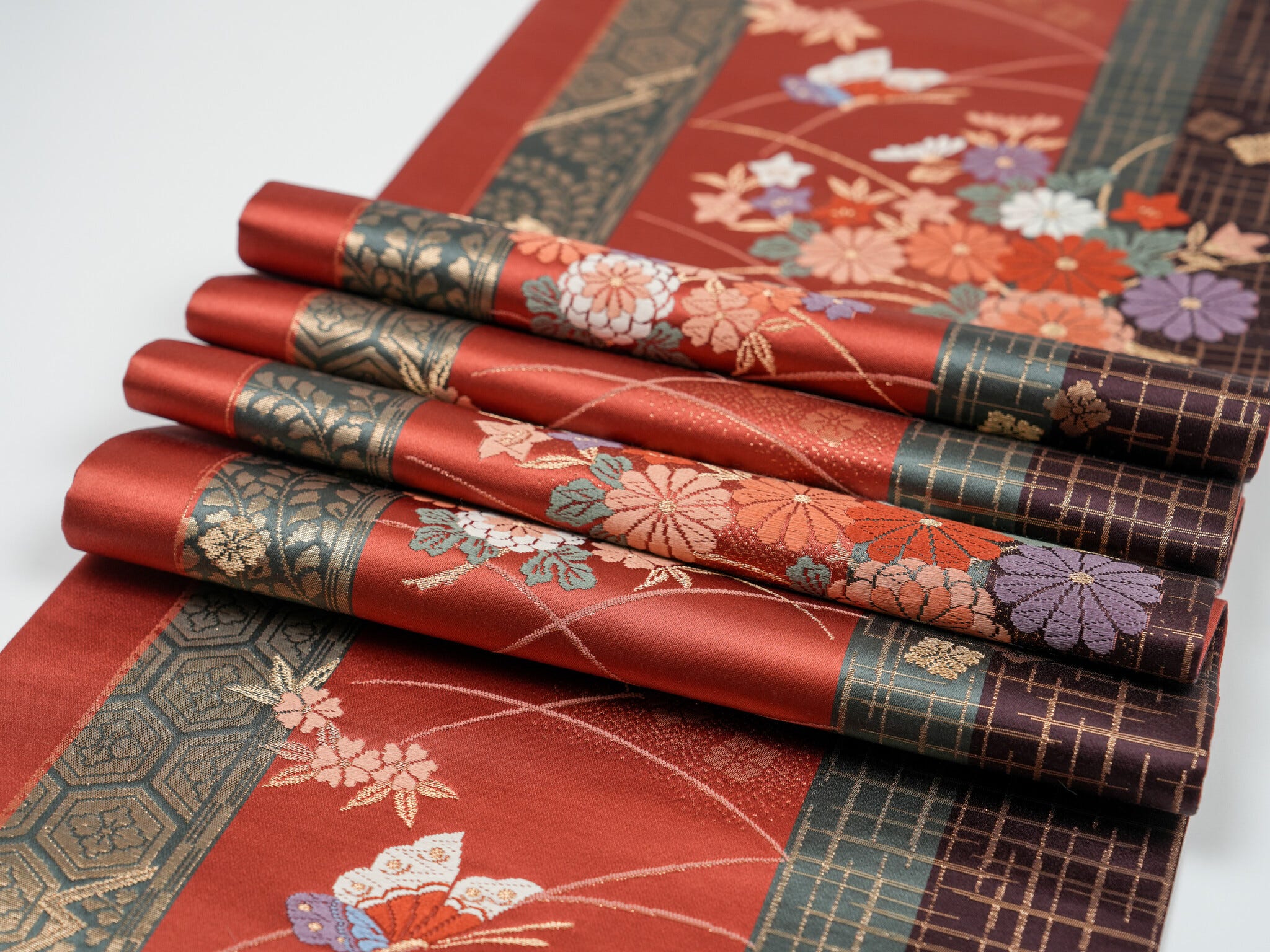
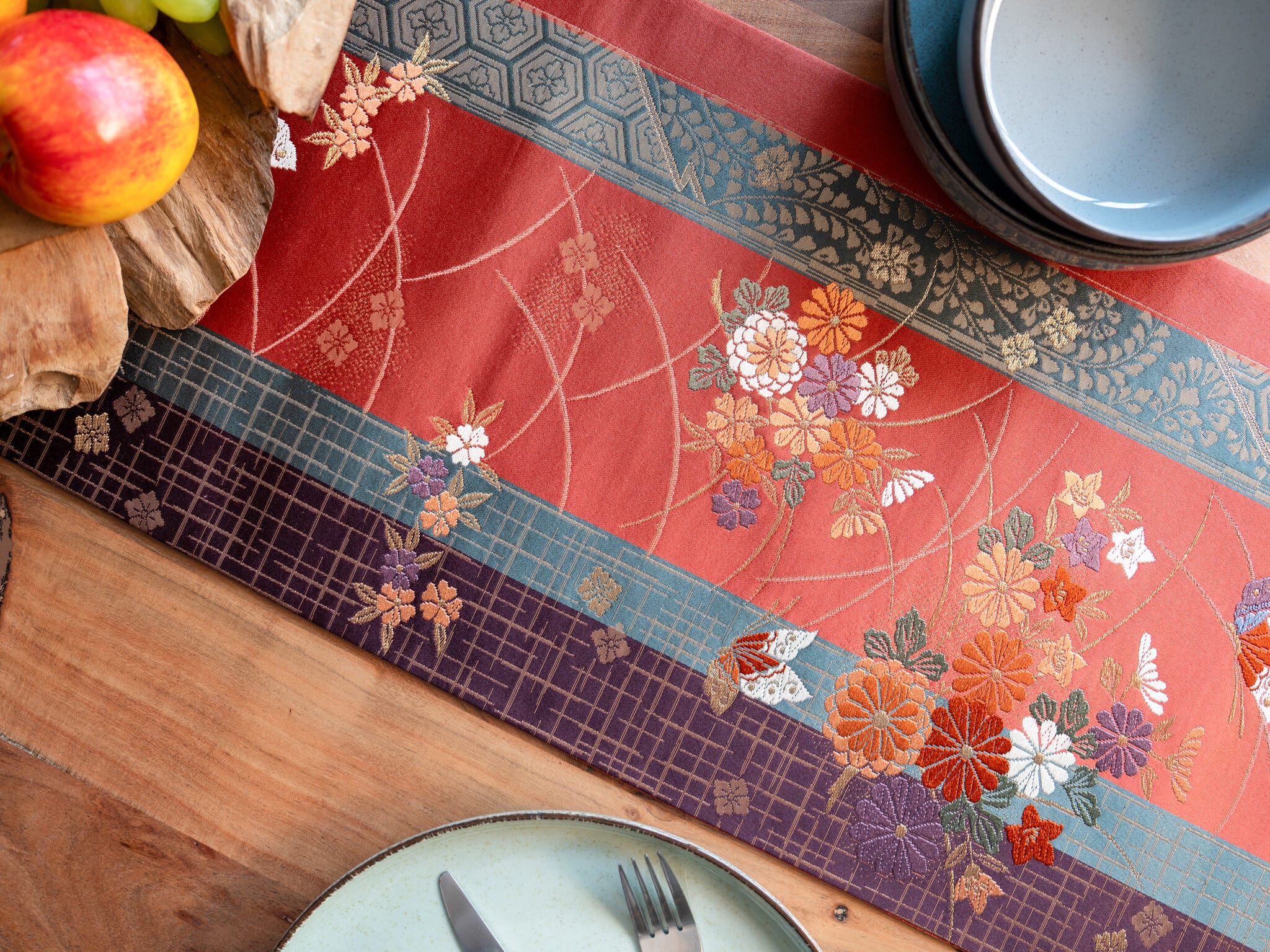
A single piece of vintage Nishijin silk — a table runner, a wall panel — introduces a different frequency into the room. Not louder. Older. Denser. The surface of a Fukuro obi woven with gold-thread chrysanthemums and geometric tortoiseshell patterning interacts with light in a way that modern textiles do not. It catches morning light differently from afternoon light. It shifts in candlelight. Like the suikinkutsu, it asks you to lean in.
The Imperial Garden table runner and placemat set — vintage Fukuro obi silk, brick-red ground, with a visual language drawn from the imperial palace gardens of Kyoto — is the piece that prompted these thoughts. Its surface carries stylised garden imagery: chrysanthemums, maple, the geometric patterns that reference protective tortoiseshell motifs. Laid across a dining table, it does not shout. It hums. It introduces into the room a presence that is quiet enough to ignore and rich enough to reward any attention you give it.
This is the lesson of the Japanese garden, translated into textile: the most powerful element in a composed space is often the one that asks you to come closer.
Discover The Imperial Garden Collection at Renaras