

There is a garment that most people who have never worn a kimono have never heard of. It is the nagajuban, the underrobe worn beneath the kimono, next to the skin, invisible to everyone except the wearer and those closest to her.
It is silk. Always silk. And it is almost always white.
Not the white of erasure or blankness. The white of Shinto ceremony, shiro, which in Japanese aesthetic philosophy is not an absence of colour but its most refined expression: the colour that contains all others, the colour of purity before particularity. The white of snow on Mount Fuji. The white of the paper on which the most serious texts are written. The white of the unadorned interior of a great tea house.
The nagajuban is usually the most personal garment in a Japanese woman’s wardrobe. Chosen with care, often gifted, sometimes embroidered on the inside hem in a colour that will never be seen by the world: a small private luxury, a colour held close to the body alone.
Silk and the sleeping body
Silk is composed primarily of fibroin, a protein structurally similar to the proteins of human skin. Against the body, silk does not merely feel soft. It communicates with the skin in a way that synthetic fibres cannot: it breathes, it regulates, it responds. A silk sleeping surface is not simply luxurious. It is, in a biological sense, the closest material we have to a second skin.
The nagajuban understood this. Worn next to the body beneath layers of ceremony and brocade, it was the one garment that existed entirely for the wearer’s comfort: the layer of pure sensation beneath all the ritual display.
We are proposing something simple: that this principle, translated into a sleeping surface, is one of the most quietly transformative things you can bring into a bedroom.
White in the Japanese home
Japanese interior design uses white not as neutral but as active. The engawa, the transitional space between inside and outside, is often white paper and pale wood. The tokonoma, the alcove of honour, is frequently a white plastered wall on which a single hanging scroll or arrangement is placed, the white functioning as a stage for the singular thing.
The concept of ura-omote, the hidden face and the visible face, is relevant here. The nagajuban is the ura, the hidden layer. The kimono is the omote, the visible surface. Japanese aesthetics have always understood that what is worn next to the skin is a statement about one’s relationship with oneself, independent of the world’s gaze.
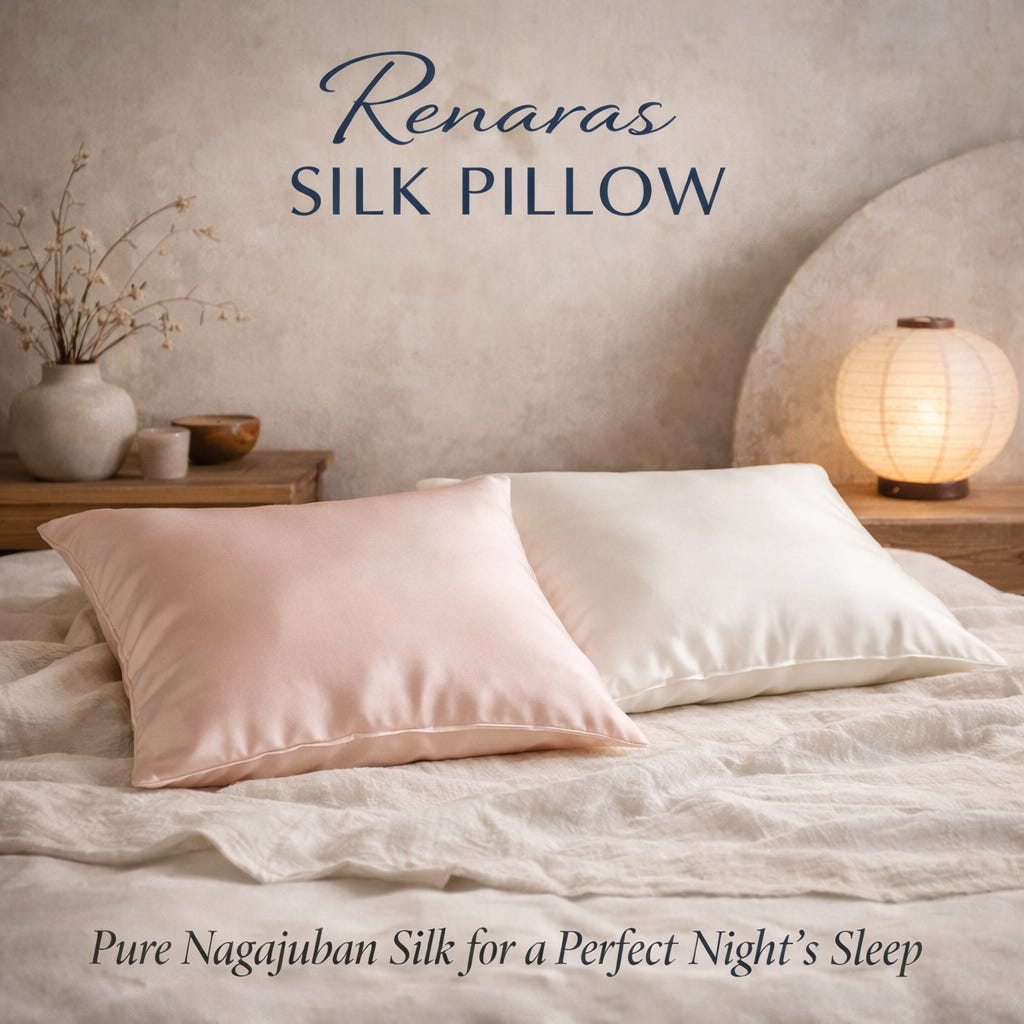
A white silk pillow cover made from a vintage nagajuban carries this entire history on its surface. It is white, but not simply white. It is the white of a garment that understood its purpose was intimacy. The white of Shinto ceremony translated into the domestic.
The unrepeatable night
Every pillow cover we make from nagajuban silk is one of a kind. The nagajuban from which it comes was made for a specific person, in a specific decade, by a specific workshop. What we are offering is its second life: as the first thing a sleeping face touches, as the quiet luxury of a bedroom that knows the difference between decor and experience.
There are objects that are beautiful to look at. And there are objects that are beautiful to live with, that change the quality of daily experience in ways that accumulate slowly into something irreplaceable. A silk sleeping surface is the latter kind. It exists entirely for you, and for the particular quality of rest it makes possible.
This is what genuine luxury has always been, before it was confused with visibility. Not the most expensive thing in the room. The best possible experience of the room.
Nagajuban silk pillow covers will soon be available at renaras.com. Each piece is one of a kind.
Private gifting consultations available — contact@renaras.com
— The Silk Journal by Renaras · journal.renaras.com