

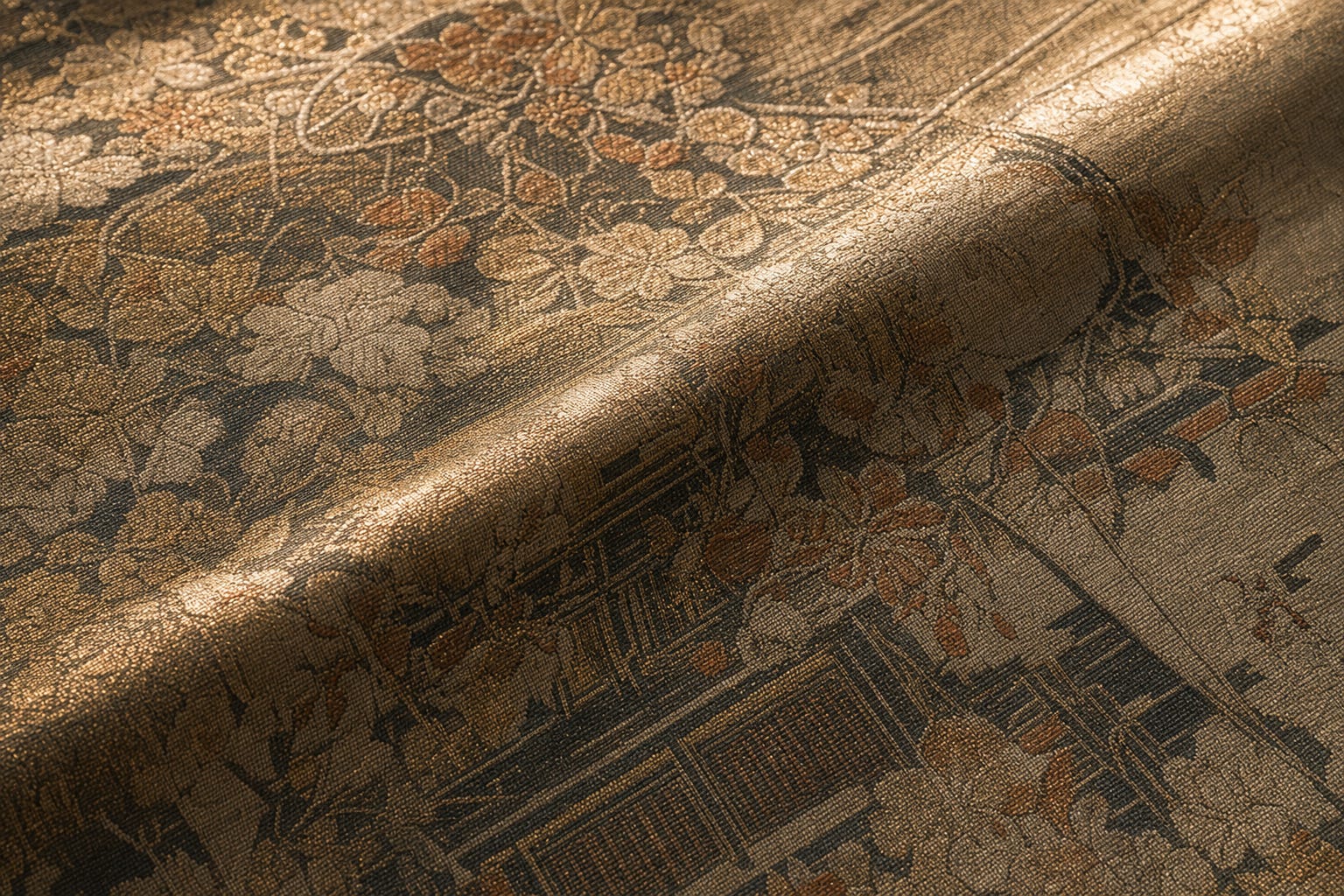
There is a piece of fukuro obi on the cutting table that has been folded in the same place for sixty years.
I can show you the fold. Run your finger along the silk three hand-widths from one end and you will feel it before you see it: a slight ridge in the cloth, where the weft threads have been compressed since the early 1960s by the weight of the fabric resting on itself in a paulownia chest. The ridge does not disappear when you flatten the silk. It catches light differently than the surrounding ground: slightly duller, slightly warmer, slightly more present. It is the cloth’s record of the time it has spent waiting.
A buyer who does not know what to look for will read this fold-line as damage. A buyer who does will read it as the thing that proves the cloth has lived.
I have been thinking, this past week, about a song lyric and an obi fold and how they are saying the same thing.
I. Anthem
Leonard Cohen released The Future in 1992. He was fifty-eight years old, almost three decades into his career, and the album opened with a song called “Anthem” that he had been writing for the better part of a decade. There is a song everyone reaches for at this point, and it is the right one. Leonard Cohen, in “Anthem”: “There is a crack, a crack in everything.” He lets the thought rest there, and so will I. The crack is not the flaw in the thing. The crack is the way in.
Cohen said in interviews afterwards that he had laboured over the song for years, throwing away versions, returning to it, almost giving up. He could not get the lyric to release what he wanted it to release. When it finally arrived, he said, the line about the crack was what unlocked everything else. “That’s the closest thing I could describe to a credo,” he told Stina Lundberg Dabrowski in 2001. “That’s the background of the whole record.”
He did not invent the thought. He was, as he often was, condensing centuries of older thinking into thirteen syllables. The lineage runs through Lurianic Kabbalah, the sixteenth-century mystical doctrine of shevirat ha-kelim, the “shattering of the vessels,” in which the divine light could not enter creation until the original containers broke; the sparks of that light are now scattered throughout the broken world, and the human task is to gather them. Cohen was deeply read in this material; he had spent years on Mount Baldy as a Buddhist monk and decades before that in the Jewish mystical tradition. The crack, in the song, is not a metaphor he invented. It is a metaphor he inherited and pressed into a single rhyming couplet that a hundred million people would eventually know by heart.
What is striking about the lyric is what it refuses to do. It does not say the crack does not matter or the crack will heal. It does not say love the crack despite its being a crack. It says: the crack is the conduit. The light enters precisely because the surface has broken. There is no other way for it to come in.
This is not a Western thought, in any common sense of Western. It runs against the entire Platonic and Christian inheritance, which has taught us for two thousand years that the unbroken form is the truer one and the broken form a fall from it. Cohen, drawing on a mystical tradition that always sat slightly outside the mainstream, names the older idea: that brokenness is a precondition of presence rather than the aftermath of failure.
It is also, though Cohen, as far as I can tell, never said so, almost word-for-word the central insight of the Japanese aesthetic of wabi-sabi.
II. Wabi-sabi, properly
Wabi-sabi (侘寂) has been so thoroughly diluted in Western design discourse over the past fifteen years that the word now means almost nothing. It has been used to sell distressed coffee tables and rough-glazed ceramic mugs and beige throw pillows on Pinterest. It has been treated as a synonym for rustic or imperfect or Japandi, none of which it is. The actual tradition is older, stricter, and more demanding than any of these.
Wabi, in its early use, meant the loneliness of living in nature: the spare, austere life of a monk in a mountain hermitage, far from the elaborate ceremonies of the imperial court. Sabi meant the patina of age, the dignity that accrues to a thing through the passage of time. The two terms coalesced into a single aesthetic philosophy through a sequence of fifteenth- and sixteenth-century tea masters: Murata Jukō, Takeno Jōō, and most decisively Sen no Rikyū, who codified the wabi-cha tea ceremony in the late sixteenth century and was eventually ordered to commit seppuku by the warlord Toyotomi Hideyoshi for reasons that historians still debate.
Rikyū’s project was austere. He rejected the gold and lacquer of the imperial tea ceremony in favour of rough Korean farmhouse bowls. He used bamboo dippers cut by hand, with the irregularities of the bamboo left visible. He preferred a tea room of two tatami mats, barely large enough to admit two people, with rough plaster walls, exposed wooden beams, and a single hanging scroll. The aesthetic is sometimes mistaken for poverty. It is not poverty. It is the deliberate choice of the imperfect surface, the asymmetric shape, the weathered material, on the understanding that these qualities are what make a beautiful object truly beautiful.
The deeper philosophical claim is precisely Cohen’s. The unbroken bowl is sterile. The surface that has not yet aged is mute. Beauty requires the trace of time, the trace of use, the trace of the hand. The crack is not a flaw in the object; the crack is what makes the object speak.
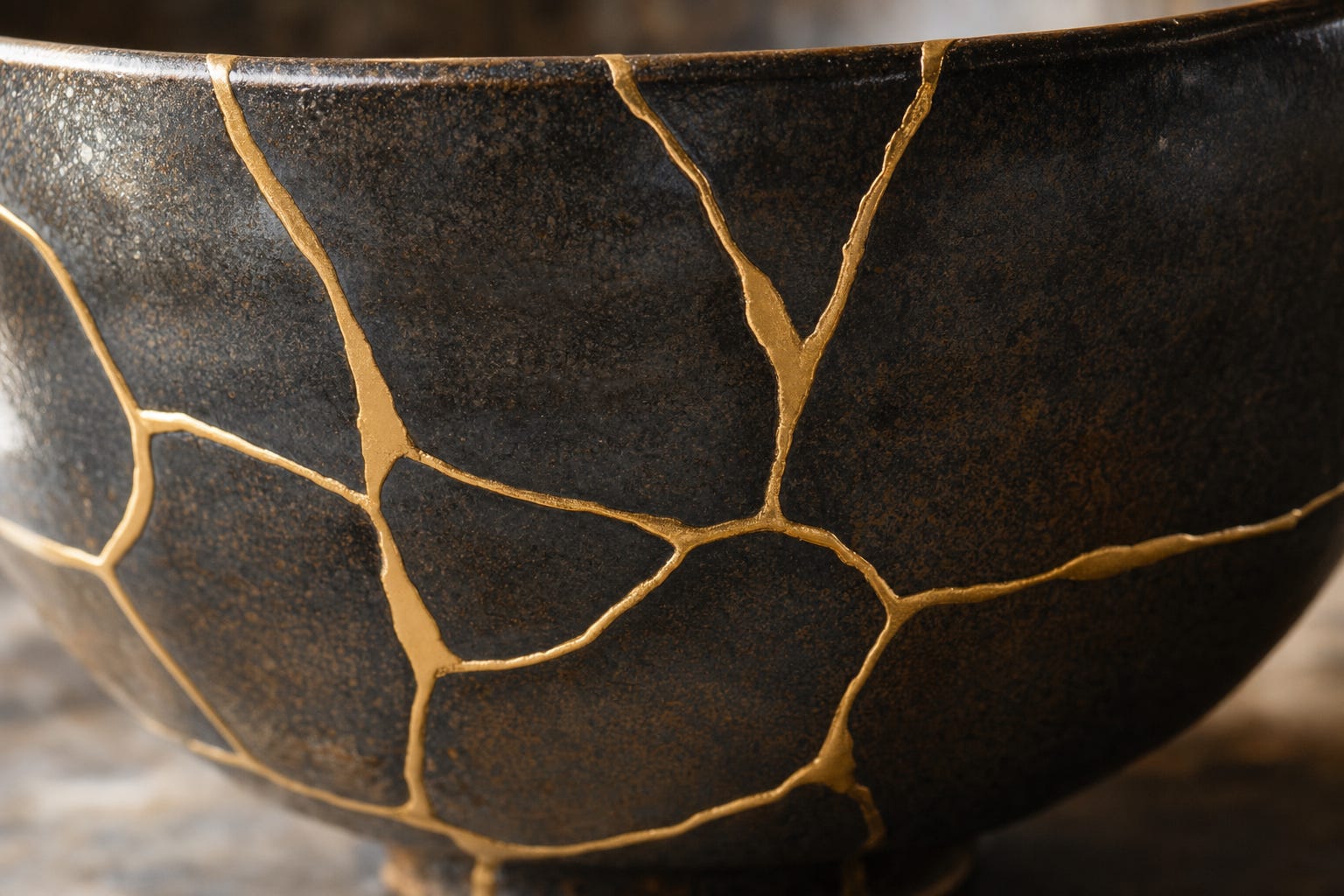
Nowhere is this more literal than in kintsugi (金継ぎ), the Japanese art of repairing broken ceramics with lacquer mixed with powdered gold. The tradition is at least four hundred years old, possibly older. When a tea bowl breaks, the kintsugi master does not glue it invisibly back together. He takes the lacquer, mixes in gold, and seams the breaks so that the cracks become the most visible part of the object. The repaired bowl is more valuable than the unbroken one was. The breakage is part of its biography. The gold seams are how the bowl tells you what has happened to it. They are, quite literally, where the light gets in.
A kintsugi bowl in a Japanese collection in 2026 is not a metaphor for Cohen’s lyric. It is the lyric, made physical, four centuries before Cohen recorded it.
III. The cloth that has been waiting
A piece of ceremonial Japanese silk, sixty years old, is a wabi-sabi object by every strict definition of the term.
Consider what it carries. The fold-line I described at the start of this essay, the slight permanent ridge in the cloth where the weight of the fabric has compressed the weft for six decades, is sabi in its most precise sense. The patina of age, registered in the silk’s own substance, not added to it from outside.
The hand-woven irregularities are wabi in its most precise sense. A Nishijin karaori obi from 1962 will show, if you look closely, dozens of small imperfections that machine weaving could never produce. A passage where the weaver’s tension at the loom shifted by a millimetre. A repeat where the supplementary weft threads sit slightly proud of their neighbours. A dye lot where the mordant bath was a half-degree warmer in the morning than in the afternoon and the colour took accordingly. These are the marks of the body that was at the loom, recorded in the cloth, millimetre by millimetre, like a seismograph of the weeks she sat there.
Western collectors who are new to Japanese textiles often try to mentally edit these qualities out. They want to see the obi as a perfect specimen, with the fold-lines as flaws to be photoshopped away and the weave irregularities as evidence of inferior quality. They have not yet been taught that the silk’s grammar is the opposite. The fold is not damage. The irregularity is not error. The silk has spent sixty years acquiring the very qualities the wabi-sabi tradition prizes most highly. The cloth is not a degraded version of what it was when it left the loom. It is a more complete version of itself.
This is, I think, the single most important shift in perception that ceremonial silk asks of the contemporary collector. The unfaded silk in the museum case is the silk in mid-life. The silk on my cutting table, folded, slightly creased, with the dye chemistry shifted by six decades of darkness in a chest, is the silk having lived a little. The crack is not what diminishes it. The crack is what proves it.
IV. The contemporary interior, properly understood
We are living, in 2026, through a moment in which Western interior design is rediscovering, half-articulately, often without the vocabulary, exactly this insight.
The trend pieces of the past two years have named it variously. “Warm minimalism.” “Meaning-rich maximalism.” “Quiet luxury.” “Slow design.” What they all describe, when stripped of their marketing skin, is the return of surfaces that show their making. The plaster wall that records the trowel. The reclaimed timber with the nail holes still visible. The bouclé that pills slightly with use rather than smoothing back to factory finish. The handmade tile that varies imperceptibly bowl-to-bowl. The hand-thrown ceramic vase whose foot is visibly uneven. These are the dominant materials of premium interior design in the second half of this decade, and they have a single thing in common: they all carry the trace of their making, and they would all be ruined by the appearance of perfect mechanical regularity.
What Western design is rediscovering, in other words, is wabi-sabi. Without ever quite naming it, and often without realising what tradition it is borrowing from, the contemporary luxury interior has converged on the idea that the beautiful surface is the imperfect one, and that the perfect surface is, to use a word the trend pieces never quite use, sterile.
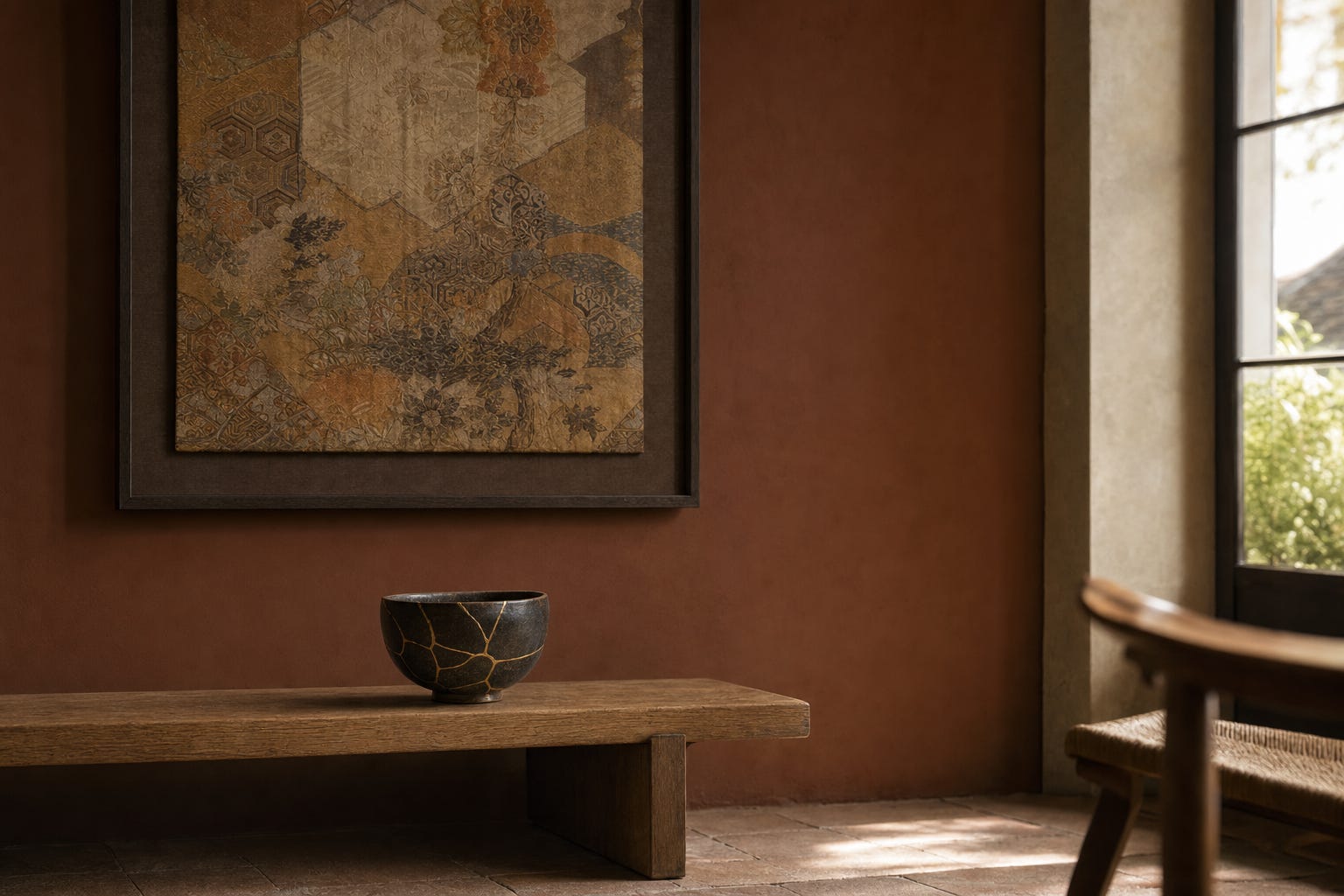
This convergence is what makes ceremonial Japanese silk, in 2026, more contextually appropriate than it has been in fifty years. The white-box minimalism of the 2010s would have struggled with an obi panel: the cloth’s complexity, its visible age, its intensity of colour, its evidence of human labour, would have read as too much for the room. The 2026 interior asks for exactly those qualities. The wall painted in a deep clay colour wants the obi panel above the dining table. The room with the plaster walls and the reclaimed oak floor wants the lumbar pillow whose silk has folded along the same line for half a century.
The silk and the room are speaking the same dialect. Both are saying that beauty requires the trace of time and the trace of the hand. Both are saying that the perfect surface is the dead surface. Both are saying (though only one of them has the four-hundred-year-old vocabulary to put it this way) that the crack is what makes the object speak.
V. The honoured crack
I want to return to the obi I described at the beginning.
The fold-line, three hand-widths from one end. We have a decision to make about it, in the atelier, every time we plan a cut. The contemporary instinct, the instinct of the marketplace, of the consumer trained on perfection, is to cut around it. To position the framed panel or the lumbar pillow such that the fold falls on the back, or the seam, or the discarded margin. To pretend the cloth is sixty years younger than it is.
We do not, generally, do this. We cut so that the fold-line is preserved in the visible face of the finished piece. The client receives an obi panel or a lumbar pillow with a slight ridge running through it: perceptible to the hand, visible at certain angles to the eye, ignorable if you choose to ignore it but rewarding if you choose to attend.
We do this because the fold is the silk’s autobiography. To remove it would be to remove the proof that the cloth has been folded for sixty years in a Japanese chest. The motif might survive the edit; the meaning would not. A piece of ceremonial silk that shows no sign of having lived through six decades has been, in the deepest sense, lied about.
This is, I think, what Cohen meant when he told us to give up the perfect offering. The unbroken silk, the unmarked cloth, the surface that has not yet acquired its patina: these are the perfect offerings the song asks us to forget. They are the products of a culture that confuses sterility with quality. The bell that still can ring is the bell that has been rung: the cloth that has been folded, the bowl that has been broken, the wall that has been touched by the maker’s trowel. These objects, by being imperfect, are the only objects through which something can pass.
When a client lives with a piece of ceremonial silk that carries its visible age, what they receive over time is precisely the experience Cohen described. The cloth changes its appearance through the day as the light moves. The fold-line catches a different shadow at four in the afternoon than it does at ten in the morning. The colours that the dye baths produced sixty years ago shift slightly with humidity and temperature. The room becomes, over months, a place in which something is always quietly happening: a slow, patient communication between the cloth and the light. The light gets in. The cracks are how.
VI. What we are doing
The Renaras atelier, when it cuts and constructs and frames a piece of ceremonial silk for a contemporary European interior, is doing something that has a longer pedigree than the marketplace usually acknowledges. We are practising wabi-sabi as a working method: the wabi-sabi of Sen no Rikyū’s tea house, of the kintsugi master’s gold-seamed bowl, of the four-hundred-year tradition that has known what Cohen condensed into thirteen syllables in 1992.
We do not hide the fold-lines. We do not edit out the weave irregularities. We do not present the silk as if it were younger than it is. We present it as it is: sixty years old, full of the trace of the body that wove it and the body that folded it and the chest that held it, with the cracks and the creases and the imperfections that are, by the strict definition of the tradition, what makes it beautiful.
A client who lives with such a piece is receiving more than a textile. They are receiving an education in a way of seeing: a way that the contemporary interior conversation is groping toward without yet having the words. The silk teaches the room. The room teaches the eye. The eye learns, slowly, to find the broken thing more beautiful than the perfect thing, because the perfect thing has nothing to give and the broken thing, having lived, has everything.
Everything cracks. The break is how the light gets in. The Japanese have known this about silk for seven hundred years. Cohen named it for us in 1992. The atelier, in the small hours of a Tuesday morning in Amsterdam, is learning it again from a piece of cloth that has been folded for six decades and is finally ready to be opened.
· · ·
To live with silk this way, discover the lumbar pillow collection.
The Silk Journal · Renaras · journal.renaras.com
One silk. One story. One piece. Never repeated.
I like the gentle way you handled the Cohen quotation, never letting on to the next line until the very end. Leonard would be proud.