

We wanted to write you a proper letter.
Not a manifesto. Not a trend forecast. Just an honest account of where Renaras stands at the opening of 2026, the Year of the Horse in the Chinese zodiac, and what we are working toward.
The horse, in Japanese tradition, is a messenger of the kami. It carries things between worlds. It shows up in shrine paintings, in festival processions, in the wooden ema tablets where people write their prayers and hang them on hooks for the gods to read. The horse moves. It connects. It does not sit still.
We like that as a metaphor for this year.
What we have been doing.
Over the past months we have been deep inside the sourcing work that most of our audience never sees. Estate collections in Japan. Authentication. The slow, careful work of identifying textiles worth recovering, not just for their beauty, which is often remarkable, but for the craft knowledge encoded in their weave.
A Fukuro obi woven in Nishijin in the 1960s marks a specific moment in the history of Japanese silk production: a period when the old techniques were still fully alive, when the looms still carried ten thousand warp threads, when gold leaf was still pressed by hand onto washi paper before being cut into strips and woven into cloth. That knowledge is becoming rarer than the textiles it produced. When we recover a piece, we preserve both.
What is coming
This year we are expanding in three directions.
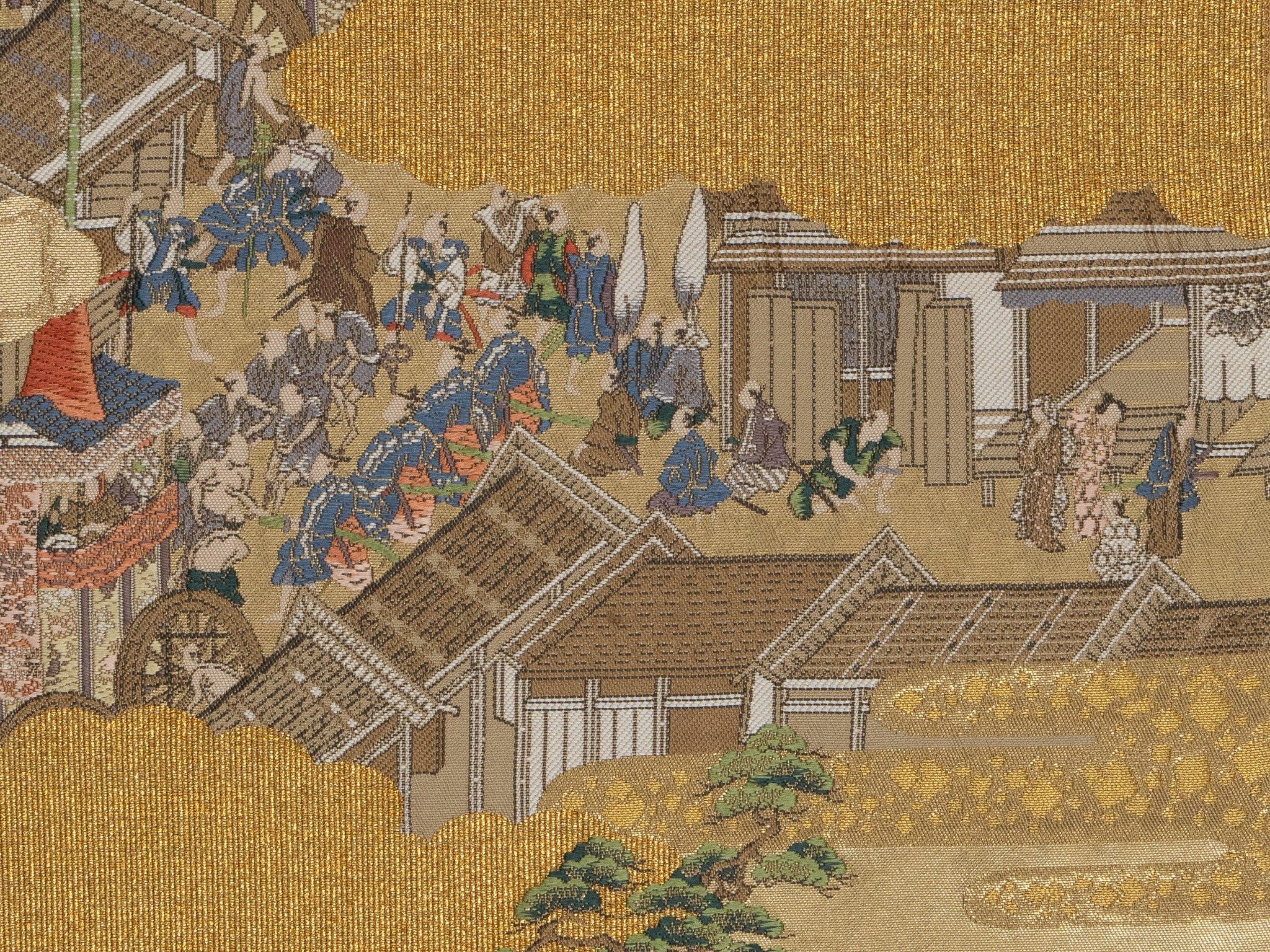
First, the Woven Dynasty wall art collection is growing. We have new pieces arriving from Kyoto Prefecture: large-format ceremonial silks that deserve walls, not wardrobes. Gold-ground Fukuro obi. Imperial-motif panels. Pieces that change the room they enter.
Second, we are developing a nagajuban silk pillow cover: the white silk underrobe, worn next to the skin beneath the kimono, made into a sleeping surface. More on this soon.
Third, the Patchin handles and furoshiki programme is expanding. We want to make furoshiki carrying a normal part of European daily life, not a curiosity. That means making the handles beautiful enough that people reach for them without thinking.
A thank you
We are a small operation. The people reading this, and we know how few of you there are, for now, are the beginning of something. Every subscription, every visit, every piece that finds a home matters to us concretely, not abstractly.
We will keep writing here about the silk, the craft, the culture, and the rooms where these things end up. We will try to be honest about what we know and careful about what we do not.
Thank you for being here.
— Renaras