

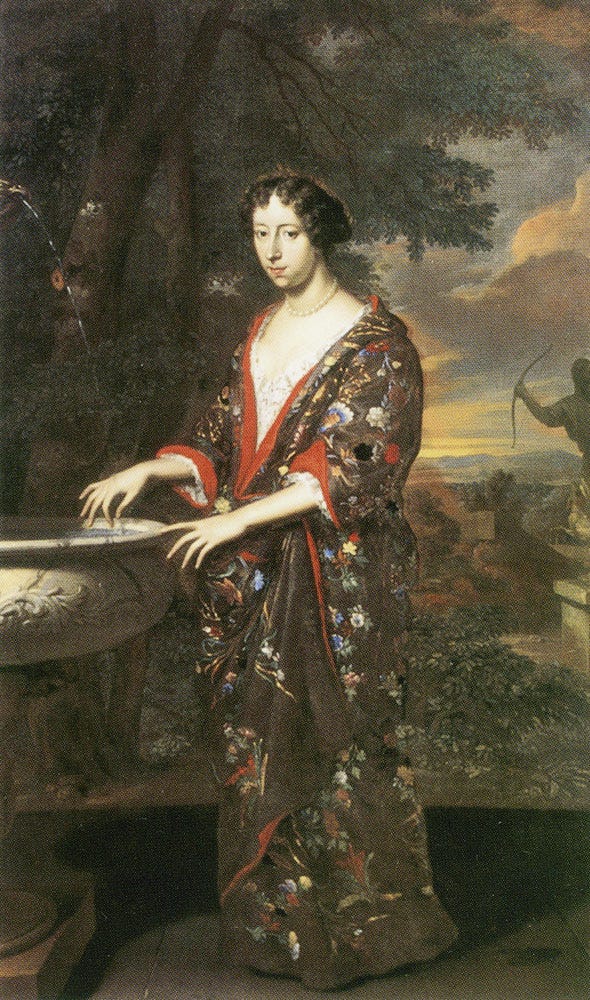
She is twenty-six years old, standing in a garden that does not exist, beside a fountain that probably does. The painter is Gerard Hoet. The year is 1678. Her name, on the day the portrait was begun, is Anna Elisabeth van Reede; by the time the paint is fully dry she will have married into the Van Tuyll van Serooskerken family and become the lady of Slot Zuylen, which is where the painting still hangs. She has four years left. She does not know this.
What she is wearing, what Hoet has taken such care to render, is a long silk robe, dark ground, scattered with polychrome flowers in fine embroidery, lined in a deep red that flares at the neckline and along the inner sleeve. The garment is not a Dutch dress. It is not, exactly, a kimono either. It is what the Republic in 1678 called a Japonse rok, a Japanese gown, and Anna Elisabeth chose to be painted in it. That choice is where the story of Japanese silk in Amsterdam begins, and it is the same story that puts a fukuro obi on a wall in the Jordaan in 2026.
Slot Zuylen joined that conversation in 1678. We are still in it.
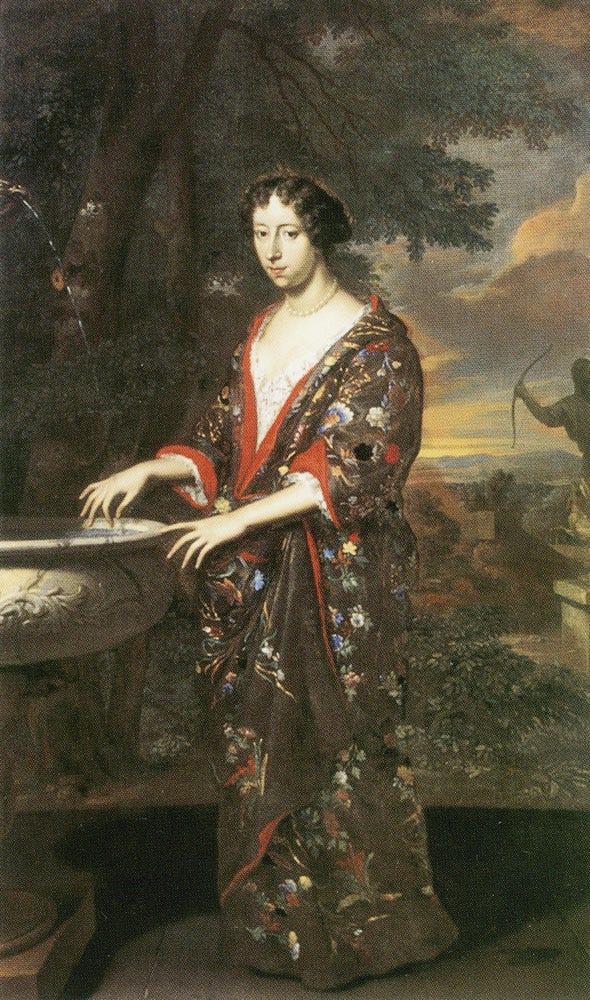
Portrait of Anna van Reede c. 1678 200 x 119 cm, oil on canvas, Slot Zuylen, Oud-Zuylen
What She Is Wearing
The garment in the Hoet portrait is the most legible piece of seventeenth-century global trade in the entire Dutch visual record. It arrived in the Republic by one of three routes, and Anna Elisabeth’s gown could be any of them.
The first and most prized was direct. From 1641 onwards, after the Portuguese post at Hirado closed and all European-Japanese trade consolidated on the artificial island of Dejima in Nagasaki Bay, the Dutch East India Company, the VOC, was the only European entity permitted to trade with Tokugawa Japan. Each year the company’s senior merchants made the formal journey to Edo to pay respects to the shogun, and each year the shogun sent gifts back. Among the most coveted were padded silk robes, generous in cut, made from kosode (小袖), the small-sleeved garment that would later become the kimono, and worn at home by men of high rank. The Dutch called them keizersrokken, emperor’s robes, and brought them back as proof they had stood, as no other Europeans could, in the presence of the Japanese court.
Supply was tiny. A handful of robes per year, perhaps a few dozen, distributed among directors, ambassadors, and significant patrons. Demand in the Republic exceeded supply almost immediately. By the 1660s the VOC was placing orders with Japanese workshops for robes made specifically for export: lighter, looser, cut for European bodies and European houses. By 1684 the company was commissioning Indian workshops on the Coromandel Coast and in Bengal to produce the same garment in chintz and silk, the Indian supply chain being larger and more reliable. Dutch silk weavers in Amsterdam and Haarlem had their own versions for the lower end of the market within a generation. By the time Anna Elisabeth sat for Hoet, the Japonse rok was an entire ecosystem (Japanese, Indo-Japanese, Indian, Dutch) and a wealthy sitter could be wearing any layer of it.
The garment said the same thing across all four versions. To own a Japonse rok in 1678 was to own evidence that you had been reached by Asia. Not just touched by it commercially (anyone with money bought spices, porcelain, lacquer) but reached, intellectually, by a culture most of your contemporaries would never see. The gown was worn indoors, in studies and salons and parlours, by people who wanted to be painted in the rooms where they actually lived. It was the seventeenth-century equivalent of hanging a piece of ceremonial Japanese silk on your wall in 2026: a quiet, expensive declaration that your room is in conversation with somewhere further away than your street.
The Visual Genealogy
Hoet’s painting of Anna Elisabeth belongs to a small, coherent body of Dutch portraits made roughly between 1660 and 1690, in which the Japonse rok is neither incidental costume nor exotic prop but the visible centre of the sitter’s self-presentation. Three other paintings, taken alongside the Hoet, give the convention its proper shape.
The most famous is Vermeer’s, painted around 1669 (nearly a decade before Hoet) and known as The Geographer. The figure at the desk, half-turned toward the window, wears a long blue-grey robe belted at the waist over a white shirt. Wide sleeves, wrap front, falling well below the knee, no Western tailoring at the shoulders or chest. Vermeer painted the same garment on the figure in The Astronomer the same year. The two paintings are pendants, likely the same model, the same robe. Vermeer is showing us the Japonse rok as the working dress of the European intellectual: what a man of learning puts on at his own desk, in his own room, when he has set his public role aside.
Eleven years later, Jan Verkolje painted Antonie van Leeuwenhoek, the Delft draper who built the first usable microscopes and first described, for human eyes, the existence of bacteria, protozoa, and the cells of his own blood. The portrait hangs in the Rijksmuseum. Van Leeuwenhoek wears a russet-brown silk robe with a quiet floral motif, lined and faced like Anna Elisabeth’s. He is fifty years old, at the height of his international reputation, in regular correspondence with the Royal Society in London. Verkolje paints him not in the formal black of a Delft burgher but in the Japonse rok of a working scholar, because by 1680 this is what a working scholar wore, and the portrait needs to tell you immediately what kind of mind you are looking at.
Three years on, in 1683, Caspar Netscher painted the Amsterdam merchant Steven Wolters in another version of the same garment, heavier, gold-figured, more conspicuously costly. Wolters is not a scholar. He is a man of commerce, and on his shoulders the gown is a different kind of statement: not the dress of the working mind, but the costume of the man whose ships brought the silk home. The same garment, the same decade, three radically different sitters: a noblewoman at her country estate, a draper-scientist in his Delft study, an Amsterdam merchant in his counting-house. It belongs to all of them, and through them, it belongs to the Republic.
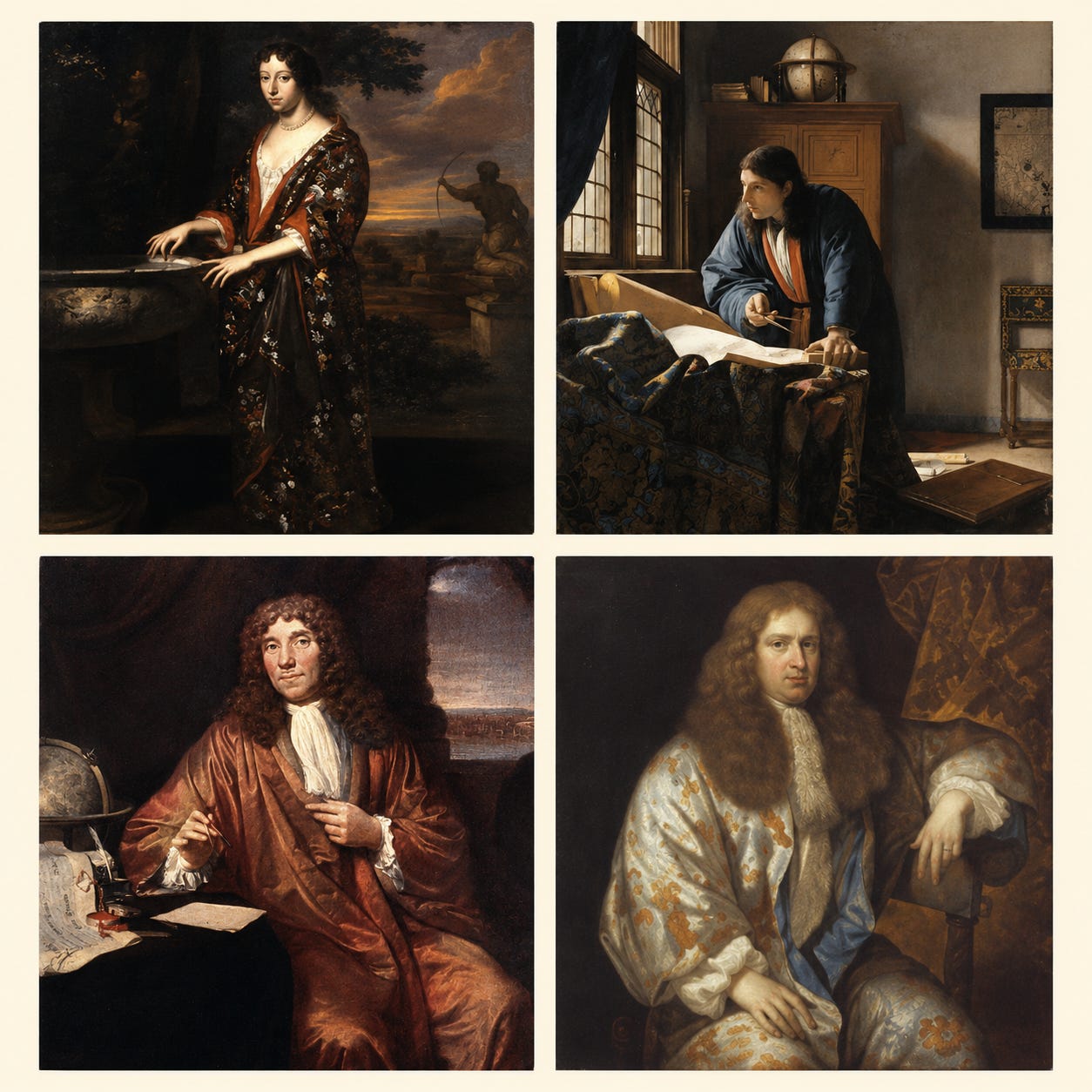
Place these four paintings next to each other and something becomes clear: the social and intellectual breadth of the Japonse rok is unusually wide. This was not a court fashion confined to a narrow stratum, the way ostrich-feather hats were confined to the Spanish gentry. It was not a learned curiosity in a single antiquarian’s cabinet. It was the chosen dress of an emergent class of Dutch men and women (aristocrats, merchants, scholars, scientists) who understood themselves to be living in a world that had opened. The garment let them occupy that opening inside their own houses, in their own bodies. It was a way of being European in a way that European dress did not yet know how to be.
A Continuation, Not a Revival
The temptation, when an Amsterdam atelier in 2026 cuts a sixty-year-old fukuro obi into a silk textile painting and has it framed for a house in De Pijp, is to call this a revival. Something stopped; something is starting again. But the Hoet, the Vermeer, the Verkolje, the Netscher, taken together, argue otherwise. The Dutch domestic conversation with Japanese silk never stopped. It changed register.
The Japonse rok faded from portraiture in the early eighteenth century not because Dutch sitters lost interest in Japanese silk, but because the garment had been so widely copied, in cheaper materials and looser construction, that it could no longer carry the social weight it had carried in 1678. Then, after the Meiji Restoration of 1868, Japan opened to the world on entirely new terms, and Japanese textiles arrived in Europe again in industrial quantities. Breitner’s series of paintings of Geesje Kwak in a kimono, made in his Amsterdam studio between 1893 and 1896, sits at one end of that second wave. Whistler’s portraits of his mistress in similar costume sit at another. The conversation, by then, was global; the Dutch strand ran deeper than most, because it traced back through Hoet to the keizersrokken and to Dejima.
Renaras is the third turn. The silk we work with is not new. The youngest pieces we cut are sixty years old; the oldest are pushing a century. They were woven in the post-war revival of Nishijin and Kiryu, dyed in workshops whose lineage runs to the Edo guilds, and worn, once, perhaps twice, in their original ceremonial form, by women who have since died and whose families had no remaining use for the cloth. We take these silks and redesign them for the rooms they are going to live in now: Amsterdam apartments, Antwerp townhouses, Rotterdam lofts. The move from obi to silk textile painting, from kosode to lumbar pillow, from nagajuban to framed silk painting is a craft decision made in a physical workspace, with a pair of shears and a clear sense of what the original weaver put into the cloth and what the cloth still has left to give.
The Netherlands has been here before. The cloth comes from Japan. It is transformed for Dutch domestic use. It hangs, or lies, or is sat upon, in rooms whose owners want to be in conversation with somewhere further than their own city. The only thing that has changed is which decade the silk is from, and in what form it now lives.
The Painting Again
Look at the Hoet once more.
Anna Elisabeth stands at the edge of a stone fountain. Her left hand rests in the water. Her right rests on the bowl. Behind her, a wooded park opens toward a sunset sky and a distant statue of Diana: bow drawn, half-turned on her plinth. The setting is half real, half composed: the country estate she would inherit, arranged around the iconography of a woman who is simultaneously chaste, learned, and presiding. The gown she chose for the portrait is the strongest visual claim in the entire painting. It is not what she would have worn to a state dinner. It is what she wore at Slot Zuylen on an ordinary afternoon, in her own rooms, as the person she actually was.
She chose to be painted in the most intimate thing she owned. And the most intimate thing she owned was Japanese.
There is a small, persistent weight in this, given she had four years left. The Japonse rok is the cloth she lived inside, in rooms she did not live in long enough. The portrait outlasted her. The garment did not: silk of that age does not survive without intervention, and the gown will have been cut down over time, re-trimmed, eventually unpicked for its embroidery, eventually gone. The cloth is lost. The portrait remains.
Three hundred and forty-eight years later, in an atelier on the other side of Amsterdam from the one Hoet knew, we are cutting silks that will outlive whoever hangs them next. They have already outlived their first wearers. They will outlive us. The cloth passes through: the ones who wove it, the ones who first wore it, the ones who folded it into a chest for sixty years, the ones who open it again, the ones who hang it on a wall in a city far from the loom. None of us owns these silks. We carry them forward.
The fountain in the portrait (water moving through stone, briefly held, given back) was not an accident.
· · ·
The obi-as-silk-textile-painting lives on; discover the silk textile paintings collection.
The Silk Journal · Renaras · journal.renaras.com
One silk. One story. One piece. Never repeated.