

I keep a furoshiki on the hook by my door. It is not particularly old — maybe forty years, cotton, indigo-dyed somewhere in the Kansai region. I use it for the market. I use it to wrap wine when I go to someone’s house for dinner. Last week I used it to carry three books and a bag of apricots home from the Saturday market, and that evening I untied it, shook it out, and laid it flat on the kitchen table while I cooked.
It has no zipper. No clasp. No brand. It has a knot, and it has me, and between the two of us we have been solving the same carrying problem for about five years now.
The Japanese have been solving it for over a thousand.
Born in a Bathhouse
Furoshiki — 風呂敷 — means, literally, “bath spread.” In the public bathhouses of Nara-period Japan, eighth century, bathers spread a cloth on the wooden floor to stand on, then bundled their clothes inside it. Practical. Hygienic. Done.
But the cloth didn’t stay in the bathhouse. By the Edo period it had become the universal carrier of Japanese daily life. Merchants used it for bolts of silk. Street vendors bundled their wares. Mothers packed rice and lacquerware for temple visits. It was as unremarkable and as necessary as a good pair of sandals.
The interesting part is that it was also, quietly, an art. The pattern on your furoshiki said something about who you were. Merchant families wove their house crests into the fabric. Auspicious motifs — cranes, pine — wrapped bridal gifts. The cloth that carried the gift was understood to be part of the gift. To receive something wrapped in fine fabric was to receive two things at once.
There is an old story, told in the textile districts of Kyoto, of a merchant named Seibei who carried nothing but a single square of crimson silk. He would arrive at the homes of the wealthy and unfold his cloth upon their floors — out came porcelain, lacquerware, jade combs — as though the fabric were a portal. When he left, he folded everything back inside it: his profits, his lunch, his tools.
“What sorcery is this?” the children would ask.
“No sorcery. Only the wisdom of one cloth.”
What the furoshiki asks of you
You cannot grab a furoshiki the way you grab a tote bag. You have to make it. The knot requires a small decision — this configuration, for this load, for this shape. It takes perhaps forty seconds. Forty seconds in which you are simply attending to cloth and geometry, and briefly, without drama, present.
We have engineered these pauses out of daily life so thoroughly that we no longer notice they are gone. The pre-made, the pre-packaged, the instantly available — the entire architecture of modern consumption is built to eliminate the gap between wanting and having. What it actually eliminates is the only part of the process that makes anything feel real.
Forty seconds. Cloth. A knot. The furoshiki insists on this, gently.
Enter the Patchin
The patchin: giving the cloth a spine.
What the furoshiki asks of you
You cannot grab a furoshiki the way you grab a tote bag. You have to make it. The knot requires a small decision — this configuration, for this load, for this shape. It takes perhaps forty seconds. Forty seconds in which you are simply attending to cloth and geometry, and briefly, without drama, present.
We have engineered these pauses out of daily life so thoroughly that we no longer notice they are gone. The pre-made, the pre-packaged, the instantly available — the entire architecture of modern consumption is built to eliminate the gap between wanting and having. What it actually eliminates is the only part of the process that makes anything feel real.
Forty seconds. Cloth. A knot. The furoshiki insists on this, gently.
The patchin: giving the cloth a spine
The furoshiki has one practical limitation that knot-tying alone never fully solved: over distance, the bundled cloth can shift in the hand. The corners bunch. The grip loosens.
Japanese craftspeople solved this the way they solve most problems — with shaped wood and patience.
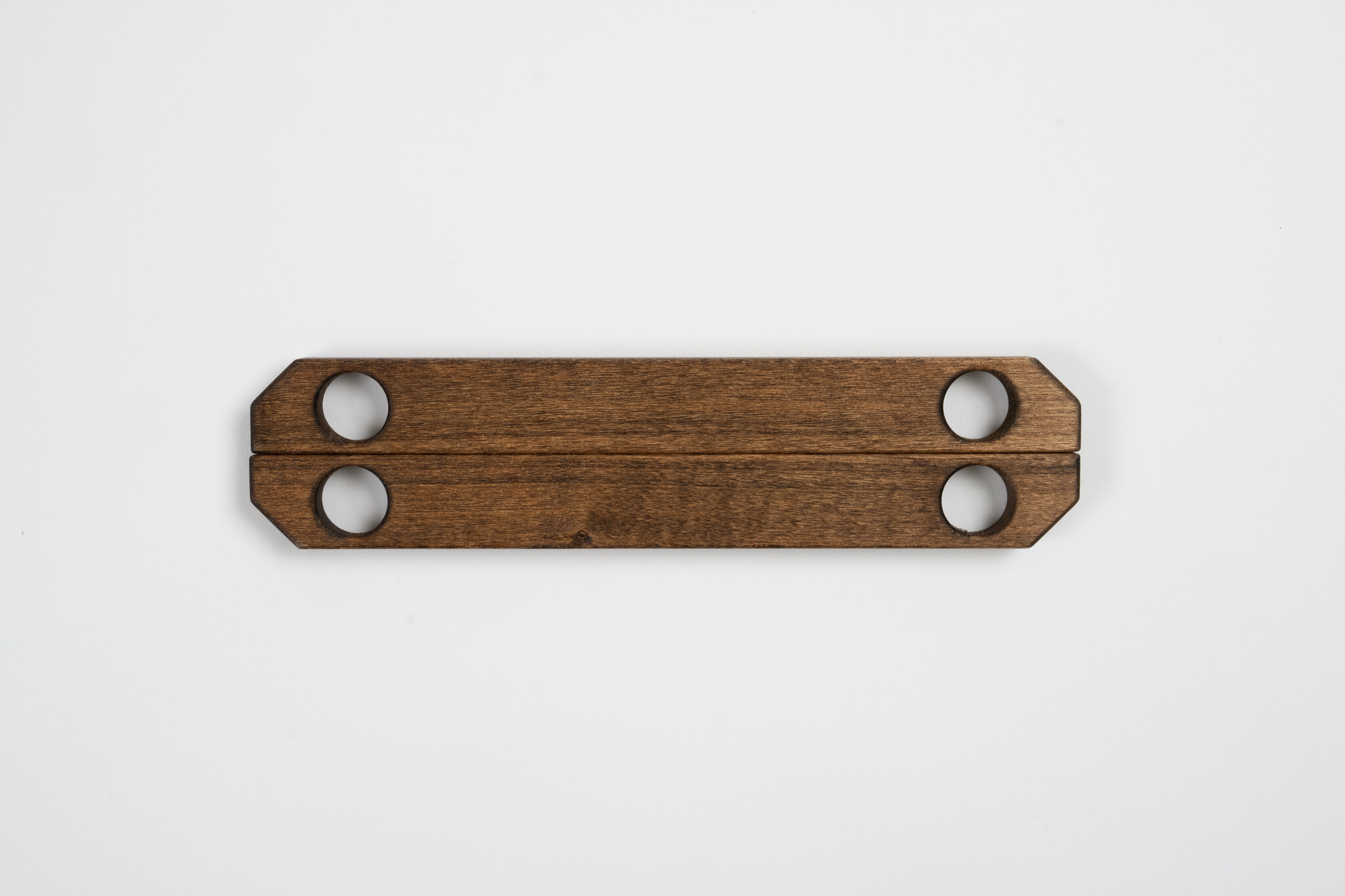
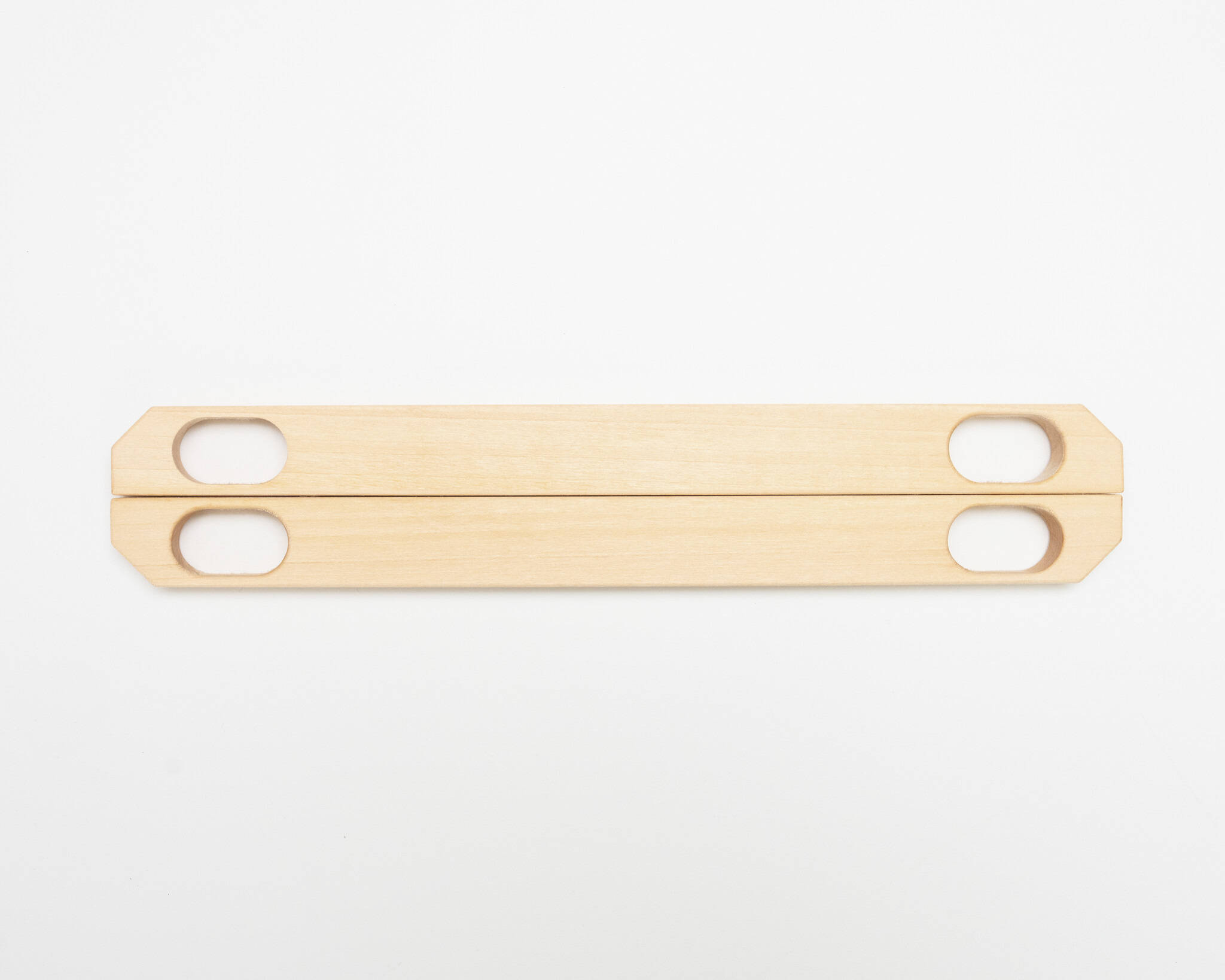
A patchin is a pair of slender wooden handles, smooth and arched, that transform a wrapped cloth into a fully structured bag. No hardware. No glue. Just wood and textile, held together by a knot and the natural tension of the fabric.
Renaras makes patchins in this tradition — hand-selected hardwood, finished in two tones. The Light finish has a morning quality: pale grain, linen rooms, low sun. The Dark finish belongs to evenings: deeper grain, quiet weight. Each set is proportioned so that the corners of a furoshiki thread through the circular openings and knot cleanly, holding everything in place with nothing more than tension and intention.
It is, in the best possible way, almost absurdly simple.
Two Sizes, One Philosophy
The Long Patchin is for those who live expansively — medium to large furoshiki, a generously proportioned tote, deep enough for a weekend market haul, graceful enough for an afternoon at a gallery.
The Short Patchin yields a more compact silhouette, closer to a handbag than a tote. Something that rests in the crook of the arm.
Both come in Light and Dark. Both express the same conviction: the things we carry every day deserve thought.
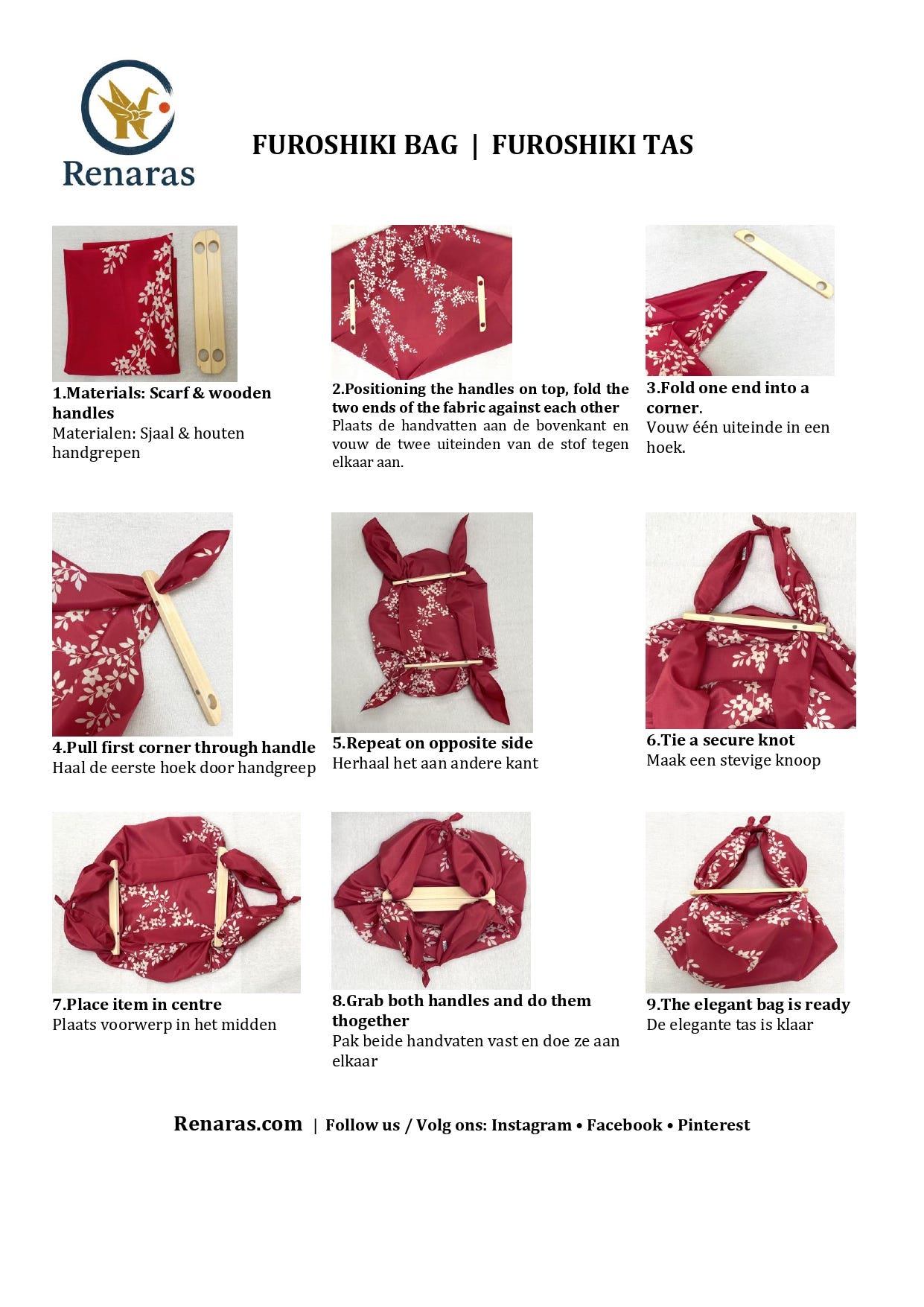
How to make a furoshiki bag
You need a silk scarf or furoshiki cloth and one set of Renaras Patchin handles. That is it.
1. Lay your cloth flat. Place both handles at the top edge, handles facing upward.
2. Fold the two far ends toward each other so they meet in the centre, beneath the handles.
3. Take one end and fold it into a pointed corner.
4. Pull that corner through the hole in the nearest handle.
5. Repeat on the opposite side.
6. Tie each corner into a secure knot, pulling snug.
7. Place your items in the centre of the cloth.
8. Bring both handles together — the fabric gathers naturally beneath.
9. Done.
Five minutes. You will carry this for years.
The most sustainable bag you already own
One cloth of quality silk or cotton can replace thousands of paper and plastic bags across a lifetime. No petroleum nylon. No factory of zippers and clasps. Only skilled hands and fine textile.
The same cloth that carries your vegetables on Tuesday wraps a bottle of wine on Friday. It cushions a gift. Becomes a picnic blanket, a scarf against autumn wind. Knotted through patchin handles, it is a bag. Removed, it is cloth again — ready for whatever comes next.
To carry a furoshiki is to carry a philosophy: that how we hold our things says something about how we hold the world.
Shop the Renaras Patchin Handles: Long Furoshiki Bag Handles (Patchin) · Short Furoshiki Bag Handles (Patchin)
Follow Renaras on Instagram · Facebook · Pinterest · renaras.com
Shop the Renaras Patchin Handles: Long Furoshiki Bag Handles (Patchin) Short Furoshiki Bag Handles (Patchin)
Follow Renaras on Instagram · Facebook · Pinterest · renaras.com