

There is a particular quality of silence that belongs only to rooms where nothing is trying too hard.
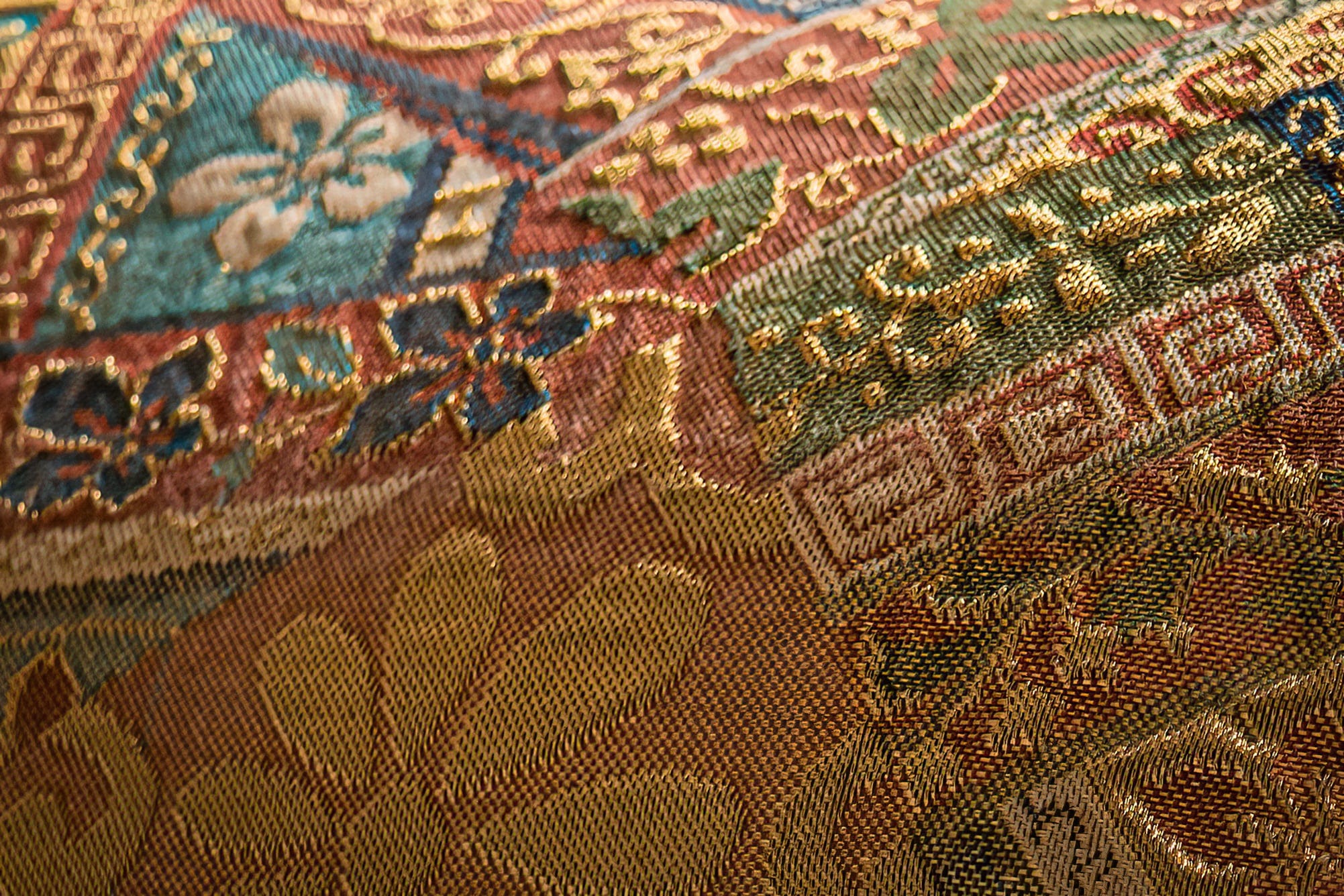
I became aware of this on a Tuesday morning last winter, in the atelier, when I was standing before a length of obi silk I had just unrolled — gold kinran, Nishijin-ori (西陣織), woven sometime in the 1960s, still carrying the precise geometry of a brocade that took a master weaver weeks to set up on the loom. I had not yet decided what it would become. I stood with it for a long time. The light from the north-facing window fell across it without warmth, which is the best kind of light for reading textile: it does not flatter, it reveals.
What struck me was not the silk itself, though it was extraordinary. What struck me was the quality of attention the silk demanded. In its presence, everything else in the room — the table, the scissors, the half-drunk coffee, the hum of the city outside — receded. Not disappeared. Receded. There was a kind of architectural shift in the room, a reorganisation of what mattered, and the silk was at its centre.
I have been thinking about that shift ever since. About what it means that a single object can do that. About why so few objects in contemporary life manage it. About what we have sacrificed, without quite noticing, in a culture that has optimised the home for abundance rather than presence.
I. The Noise We Have Learned to Call Comfort
At some point in the last three decades — I cannot name the exact year; it crept in like damp — the dominant model of the domestic interior shifted from arrangement to accumulation. This is not a polemic against ownership. It is an observation about density. The homes that appear most frequently in the feeds we scroll are distinguished not by the presence of extraordinary things but by the sheer quantity of considered things: the gallery wall arranged with surgical precision, the shelf that holds nineteen objects where twelve would have been enough, the flat surface that cannot be empty because emptiness, apparently, reads as absence.
We have confused fullness with richness. This is an easy mistake to make in a culture that has removed the friction from acquiring things. When anything can arrive at the door in forty-eight hours, the cost of an object is no longer only its price — it is also its opportunity cost, its relationship to everything else in the room. But that cost has become invisible. We do not feel it the way our grandparents felt it, standing in a shop, holding something, deciding.
The result is rooms that are visually exhausting in ways their inhabitants have often stopped noticing. We adapt to our environments. We stop seeing the corner of the bedroom where things accumulate. We stop noticing the three cushions on the sofa that are there because they came with the sofa, not because anyone chose them. We navigate around the object rather than arriving at it. The room becomes a background, and then we wonder why we feel so little when we are in it.
This is not a new observation. Every few years, a wave of counter-culture rises — minimalism, slow living, hygge, lagom, the annual Kondoist revelation — and proposes, in various registers of severity and warmth, that less is more. The argument is always structurally correct. But it tends to land as deprivation rather than transformation, because it focuses on what to remove without adequately addressing what should remain and why.
Curated restraint is not minimalism. It is not a number of objects. It is a quality of relationship between the person and the things they have chosen to live with. And that quality of relationship depends, more than we have been encouraged to admit, on singularity.
II. What Singularity Does to a Room
In 1974, the psychologist Mihaly Csikszentmihalyi — who would later become famous for his theory of flow — published a study with Eugene Rochberg-Halton on the objects people consider significant in their homes. They interviewed hundreds of families, asking them to identify the things they cared most about and to explain why. The answers were not what the researchers expected. People did not point to their most expensive objects. They pointed to objects with stories: the grandmother’s ring, the photograph from a particular afternoon, the chair that survived the fire. They pointed to objects that were, in some meaningful sense, irreplaceable.
What made an object feel significant was not its beauty or its cost. It was the impossibility of its substitution. This is so obvious, stated plainly, that it risks sounding trivial. But its implications for how we furnish our lives are substantial and largely unexamined.
A mass-produced object, however beautifully designed, carries within it the knowledge of its own replaceability. If it breaks, you order another. If you tire of it, you replace it. This is not a moral failing — it is simply the nature of the object. But that replaceability creates a particular kind of psychic distance between the person and the thing. You do not mourn a broken IKEA shelf the way you mourn a broken heirloom. The object was always, in some sense, temporary. You both knew it.
A singular object — one that cannot be remade, cannot be replaced, carries in its surface the specific history of its own making — occupies a different register in the room. It creates what the psychologists might call heightened object salience: the eye returns to it. It generates not just aesthetic pleasure but a low-level cognitive engagement, a pull. The room does not need as many things when one of them pulls like that.
This is what I mean by the architecture of silence. Not the absence of objects but the presence of objects that generate their own gravitational field. A room with one such object can sustain a quality of attention that a room full of pleasant, replaceable things cannot.
III. The Dormant Civilisation in the Chest
Japan holds an estimated ¥300 trillion — roughly €1.8 trillion — worth of dormant silk in storage. This figure, cited in textile conservation studies and periodically surfacing in discussions of Japan’s cultural inheritance crisis, represents the accumulated ceremonial wardrobe of a civilisation: obi woven for weddings that have long since passed, furisode (振り覆) worn once for a coming-of-age ceremony and folded away, uchikake (打掛) made for brides who are now grandmothers. These silks were woven in the Nishijin district of Kyoto, sometimes taking months to produce a single obi. They were dyed with kusaki-zome (草木染) — botanical dyeing using plants whose precise preparation was a craft in itself, knowledge passed within families over generations.
They sit in tansu chests, in climate-controlled storage facilities, in attics. They are not displayed. They are not used. They are, in the truest sense of the word mottainai (もったいない), wasted — though the Japanese concept carries more grief than the English word suggests. Mottainai is not simply a criticism of waste. It is a form of mourning: the sorrow of a thing not fully experienced, a potential not realised, a life not fully lived.
When I source these silks — travelling through networks of Japanese dealers, examining each piece under proper light, feeling the weft threads between my fingers for the irregularities that confirm hand-weaving — I am not engaged in salvage. I am engaged in retrieval. There is a difference. Salvage implies something broken, something damaged beyond its original purpose, something reduced. Retrieval implies that the thing retains its full self, needs only to be brought back into contact with human attention.
The silk is not diminished by its decades in the chest. In some cases it is improved: the dyes have settled, the fibres have relaxed, the hand of the cloth has become something that new silk cannot replicate. What it lacks is only a context in which to be seen. What it lacks is a room, and an eye.
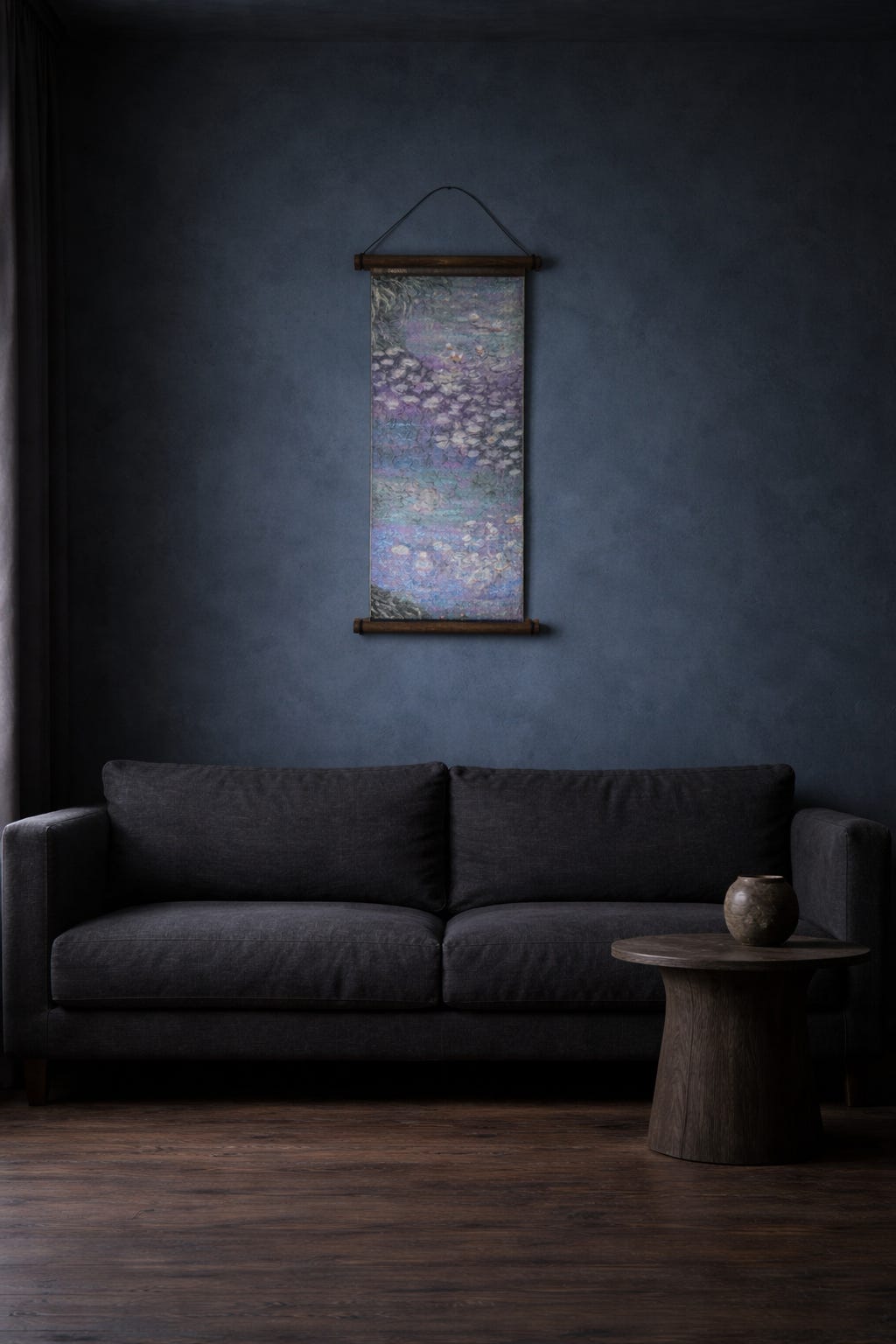
This is the editorial logic of the Renaras atelier: not to produce new things from old materials, but to design a new relationship between these silks and the contemporary world they have outlived and re-entered. The wall tapestry is not a repurposed obi. It is a decision about what to preserve, how to frame it, how to position it so that what it carries — the specific character of this weave, this dye, this hand — is legible in a contemporary room.
IV. The Psychological Shift: From Consumer to Custodian
There is a moment that several people who have acquired Renaras pieces have described to me, in different words, that amounts to the same experience: they stop thinking of the object as something they bought and start thinking of it as something they are looking after.
This is not a small shift. It represents a fundamental reorientation of the person’s relationship to the domestic object — away from consumption and toward custodianship. The distinction matters because custodianship is generative in ways that consumption is not. A custodian notices things: the way the light hits the silk differently in winter than in summer, the particular angle from which a woven motif becomes three-dimensional. A custodian develops a relationship over time. A consumer finishes the transaction on the day of purchase.
The psychological literature on ownership and attachment is consistent on this point: we value things more when we perceive ourselves as their caretakers rather than their possessors. This is one reason why objects with histories — heirlooms, antiques, pieces with provenance — consistently generate stronger emotional attachment than equivalent new objects. We are not just owning them. We are taking our turn with them.
Vintage Japanese ceremonial silk, with its specific and documentable history, makes this dynamic unusually explicit. An obi woven in Nishijin in 1963 has been somewhere for sixty years before it arrives in a room in Amsterdam or Copenhagen or Edinburgh. It has a biography. When it enters a new room, it brings that biography with it — not as a burden, but as a presence. The room is different when it contains something with a life behind it.
Curated restraint, in this context, is not an aesthetic principle. It is an ethical one. It is a decision to acquire fewer things and to hold them more carefully. To give objects the space and attention they require to be fully present. To understand that a room can be generous without being full.
V. What Restraint Actually Requires
This is where the conversation tends to stall, because curated restraint is harder than it sounds and easier to describe than to practise. It requires not just the willingness to own fewer things, but the capacity to make slower decisions — and that capacity runs directly against the grain of a culture that has refined the mechanics of impulse acquisition to something approaching art.
The shops that retail mass home objects understand desire architecture well. They arrange objects so that each one suggests the next. They create a grammar of compatibility that keeps you reaching. They price things at the exact point where the consideration feels brief. They rely on a particular quality of attention — broad, distracted, mildly excited — that moves through objects quickly and rarely arrives at any of them.
Curated restraint requires the opposite quality of attention: slow, particular, willing to wait. It requires the ability to sit with the question of whether you need something before you resolve it. This is a discipline that has to be practised, not because desire is wrong, but because desire, in the context of readily available objects, is an unreliable guide to what will genuinely enrich a space.
The objects that generate sustained presence — the things that continue to be interesting, that reward repeated looking, that change rather than fade — are almost always objects that were chosen slowly. They were chosen because something in the person recognised something in the object: not just a colour that matched or a size that fit, but a quality that felt worth living with for a long time. That recognition is the thing the culture of fast acquisition has trained us to skip past.
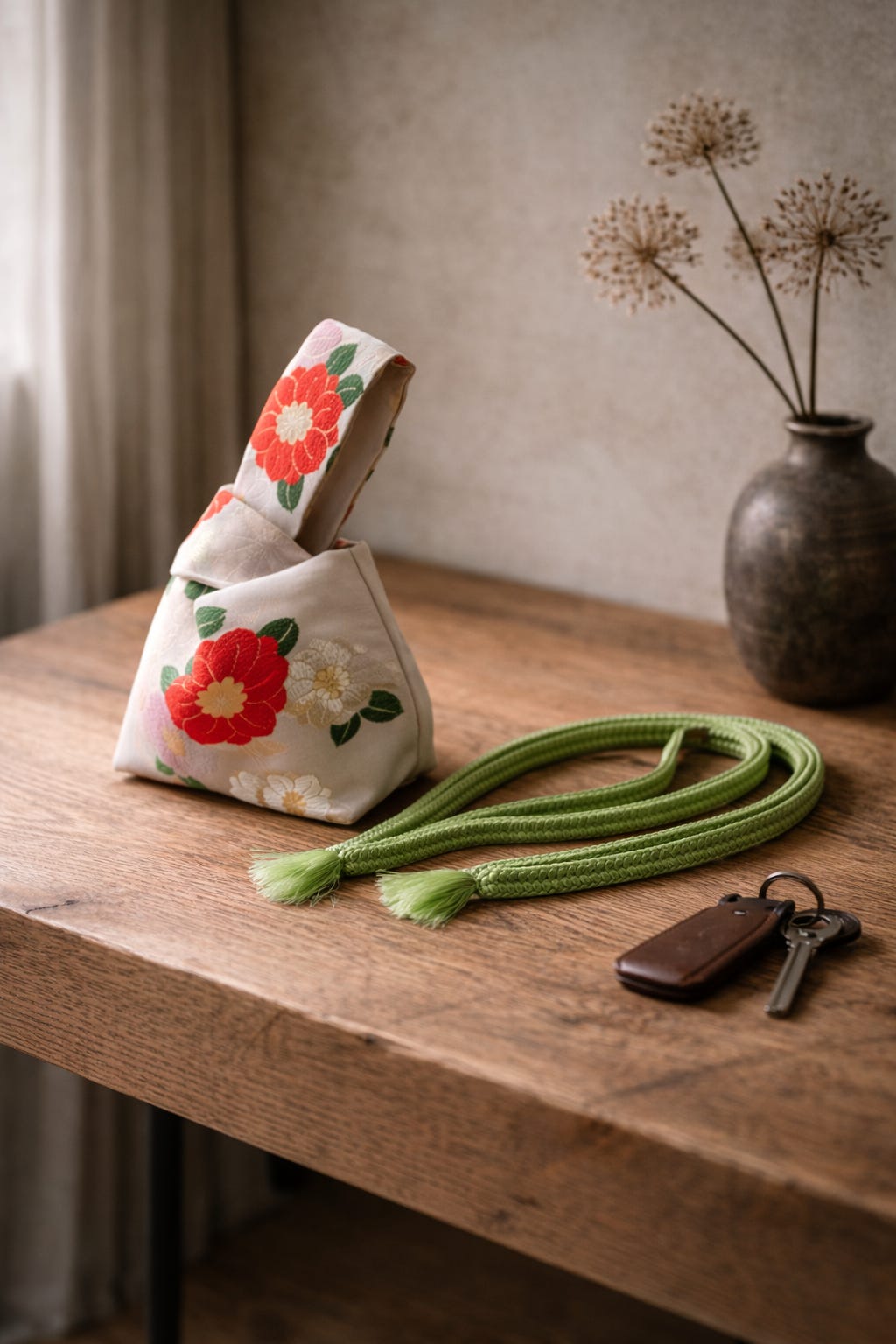
I am not suggesting that the acquisition of a wall tapestry or a patchin bag is an act of resistance. That would be overstatement. But I do think there is something instructive in the experience of choosing an object that cannot be replaced — that exists in one version, in one place, and will not be there next week if you wait. That specificity of scarcity is not a sales technique. It is a reintroduction to a quality of attention we have been drifting away from.
When something cannot be replicated, the decision to acquire it is complete in itself. There is no version two, no alternative colourway, no ‘also viewed.’ You chose this one or you did not. The finality of that is unusual enough, in the current commercial environment, to feel almost startling. And in that startlement is the beginning of the shift: from consumer to custodian, from accumulation to attention.
VI. The Room That Knows What It Contains
The rooms I find most beautiful are not the ones with the most expensive objects or the most sophisticated palette or the most precise adherence to a stylistic programme. They are the rooms where something is clearly known. Where the person who lives there has made decisions rather than accumulations. Where the space itself communicates a point of view.
This is ma (間) — the Japanese concept of negative space, of the interval, of what happens in the pause. Ma is not simply emptiness. It is the emptiness that makes what is present more present. The wall that holds a single tapestry of deep-dyed silk says something very different from the same wall covered in prints. It says: I chose this. I gave it this much room. I trust it to be enough.
This trust is the hardest thing to recover once it has been trained out of us. We have been taught, by the relentless logic of the retail environment and the image feed, that one is not enough — that if one beautiful thing is good, seven are better, that a room is not dressed until every surface is occupied. But rooms do not work that way, and people do not work that way. We have a finite capacity for attention. A room that asks for more than we have leaves us tired rather than nourished.
The room that knows what it contains gives attention back. It creates the conditions for the quality of notice that is, in its small domestic way, a form of presence — the experience of being in a place rather than moving through it. When you live with a piece of silk that took months to weave and decades to reach you, the room accumulates a texture that purely contemporary furnishing cannot produce. Not because old things are inherently better than new ones. Because this thing has been somewhere, done something, and what it has witnessed is now in the room with you.
VII. One Silk
In the atelier, the moment I resist most is the moment before the first cut. The silk is still whole. Whatever it was — a wedding obi, a furisode for a ceremony in 1967, a nagajuban worn close to the skin through the ordinary days of a life — it retains the shape of its original purpose. Once the blade enters the fabric, that shape is gone. The transformation is irreversible.
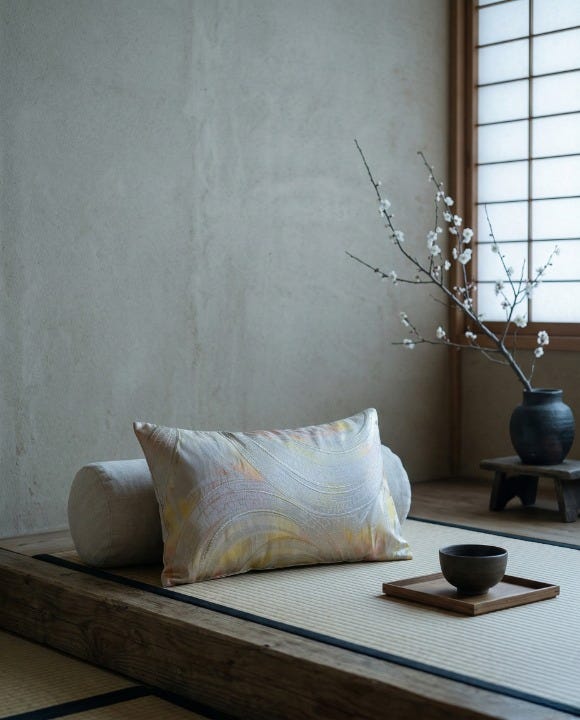
I stay with that moment because the irreversibility is the point. The object that will exist after the cutting will be one thing, in one place, for one person or one room, and it will never be made again. This is not a selling proposition. It is a material fact. The silk that becomes a wall tapestry in a room in Edinburgh cannot simultaneously become a lumbar pillow for a room in Milan. It chose, when the blade entered the weave, its singular future.
There is a version of this article that argues, more neatly than I am willing to, that one-of-a-kind objects are good for us because they slow us down, make us deliberate, reconnect us to provenance and history and craft. That argument is broadly true. But it undersells what actually happens in the room, which is stranger and more private than any of those nouns suggest.
What happens is that the object and the person begin, over time, to know each other. The person learns what the silk looks like when the morning light is flat and when it is brilliant. They learn which angle reveals the brocaded motif and which flattens it. The silk — and I am aware this is a step toward the metaphysical, but I will take it — becomes familiar in the way that another person becomes familiar: through accumulated shared mornings, through the small notices of a life lived alongside.
Curated restraint, at its deepest, is not an interior design philosophy. It is a practice of relationship. The decision to live with fewer things, chosen carefully and held for a long time, is a decision to be more present to what you have — and by extension, perhaps, to be more present, full stop. The contemporary home, with all its conveniences and its pleasures and its relentless options, is extraordinarily good at filling time. It is less reliable at making room.
The architecture of silence is not built from bare walls and empty floors. It is built from the decision to give one extraordinary thing the space to be fully itself — and then to be in that space with it, slowly, over a long time.
—
Every piece in the Renaras atelier begins as a silk with a history and becomes, after the cutting and the construction and the decisions about proportion and frame and form, something singular: a wall tapestry, a lumbar pillow, a patchin bag, a table runner. Each carries the complete biography of the textile it was made from. None can be remade. When you encounter one, you are not encountering a product. You are encountering a decision about what to preserve, and a room that now knows what it contains.
View the current collection at view the wall art collection. Read more at journal.renaras.com