
Six Ways to Use Ceremonial Silk in 2026’s Interior Trends
How vintage Japanese textiles anchor this year’s shift toward warmth, craft, and "meaning-rich maximalism"

The design magazines have their phrases for it. “Meaning-rich maximalism.” “Warm minimalism.” “Elevated English cottage.” What they are circling, in their separate ways, is the same plain thing: the decade of stark rooms is ending. White walls are taking colour again. The glass coffee table is giving way to oak. People want to be moved by the rooms they live in.
I think about this when a piece arrives at the Amsterdam atelier, especially the ceremonial silks that would have struggled to find a home five years ago. A nagajuban patterned all over with stylised cranes on deep indigo. An obi of a chromatic intensity that would have swamped any pale Scandinavian room: vermilion ground, gold cloud forms, pine in oxidised silver. These were always beautiful. What has changed is not the cloth. It is the room willing to receive it.
The year’s trends read almost as though they were written for old Japanese silk. Not because the design press reads the Journal, though I like to imagine the odd editor does. It is that two separate streams, the European conversation about interiors and the Japanese aesthetic tradition, have arrived at the same bank of the same river: a wish for materials that feel true, colours that hold a room down rather than let it float, objects that bring their own histories in with them.
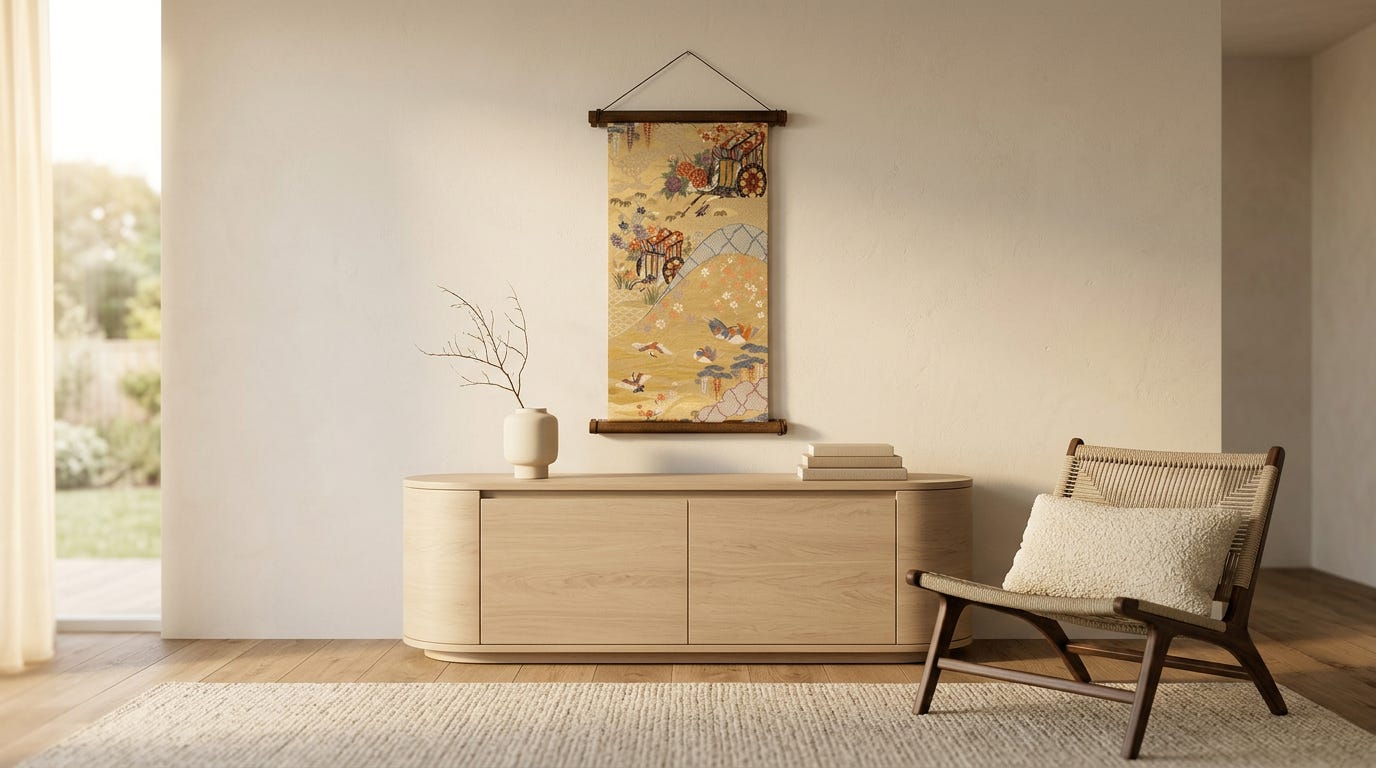
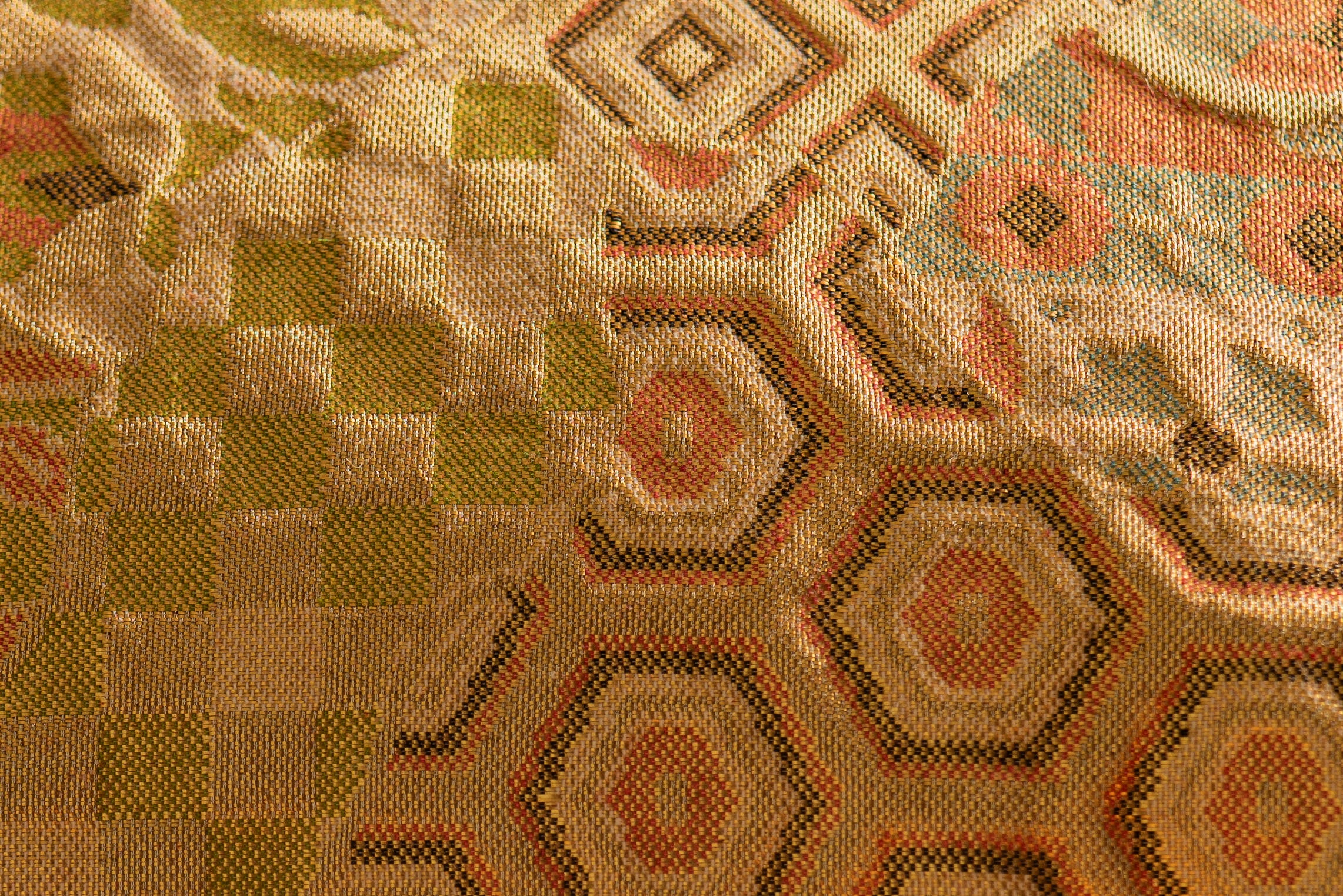
The first and strongest current is the return of materials you want to put a hand on. Sculpted texture, handmade tile, reclaimed timber with the grain left loud, plaster that asks to be touched. The trade has tired of the smooth and the synthetic. Ceremonial silk was tactile before tactile was a brief. Run a hand across Nishijin brocade and you feel the small irregularities of a hand-thrown weft, the faint changes in thickness that tell you a person sat at a loom for this. The surface is not flat. It has hills and shadows. An obi woven in karaori has nearly the relief of carving, the raised threads catching light differently as you move past them or as the afternoon turns. A framed obi reads unlike a painting not only for its motifs but for its body: light passes through the fibre instead of bouncing off a flat coat of paint. In a room that prizes the made thing, silk like this is not exotic. It is foundational.
Then there is the softening of minimalism. The stark white wall has been replaced by gentle beige, muted blue, soft green, the honeyed and caramel and deep brown of warm wood. Still edited, no longer cold. The silks that belong here are the ones the Japanese call jimi: quiet, sophisticated colours that keep away from bright primaries. An indigo nagajuban aged to the shade of a late shadow. A beige-grey obi carrying the faintest pattern of bamboo, the sort of thing a contemporary palette would name “greige” or “mushroom.” Restraint, which minimalism asks for, with the warmth this year wants. Jimi is not dull. A fukuro obi I mounted as a lumbar pillow last month looks, at a glance, like a single oatmeal field. Look longer and it gives up its secrets: several silk weights, more than one weave structure, plum blossoms that show themselves only when the light comes in at the right angle. Quiet enough to settle a spare room. Deep enough to repay a second look, and a third.
The third current is maximalism grown up. Richer, more personal, intention in place of clutter, the home as a kind of autobiography written in objects. Here ceremonial silk does something almost nothing else can. Every piece is already meaningful, and not in the brochure sense of a pillow that “tells a story.” An uchikake was woven for one woman’s wedding, kept folded in a tansu for decades, and is only now becoming a silk textile painting above a sofa in another country. A room that holds such a silk is already in conversation with botanical dyeing, with the long care of post-war textile keeping, with mottainai, the refusal to let a good thing go to waste. These are not borrowed signifiers. They are the actual content of the object. The hunger for meaning-rich rooms is, in part, a hunger for things that do not need significance applied to them, because they walked in already carrying it.
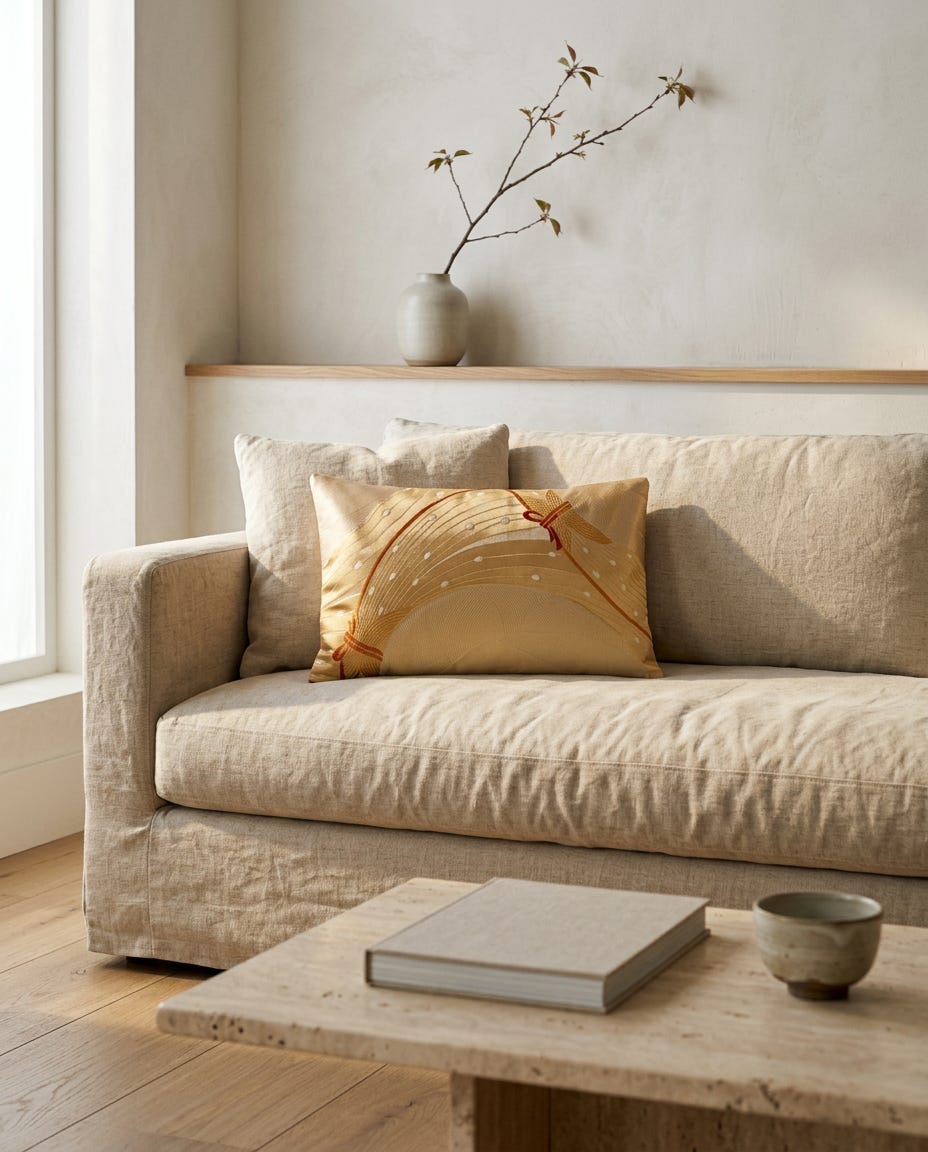
Fourth, the year has turned away from the sharp corner. Curves, full volumes, rounded edges, furniture that is more sculptural and more forgiving of a body. Silk, released from the flat rectangle it was woven into, takes to this beautifully. Made into a lumbar pillow, an obi gathers and drapes and shows parts of its weave that stayed hidden while it was held flat for formal wear. The same cloth that looked architectural in a frame turns sensual on a cushion, or under the weight of someone leaning back into it. We have been letting silk behave more like silk: table runners that pool a little at the ends, panels allowed a gentle billow rather than pinned rigid, the occasional throw that takes the shape of whatever it lands on. It suits the material. It happens also to suit the year.
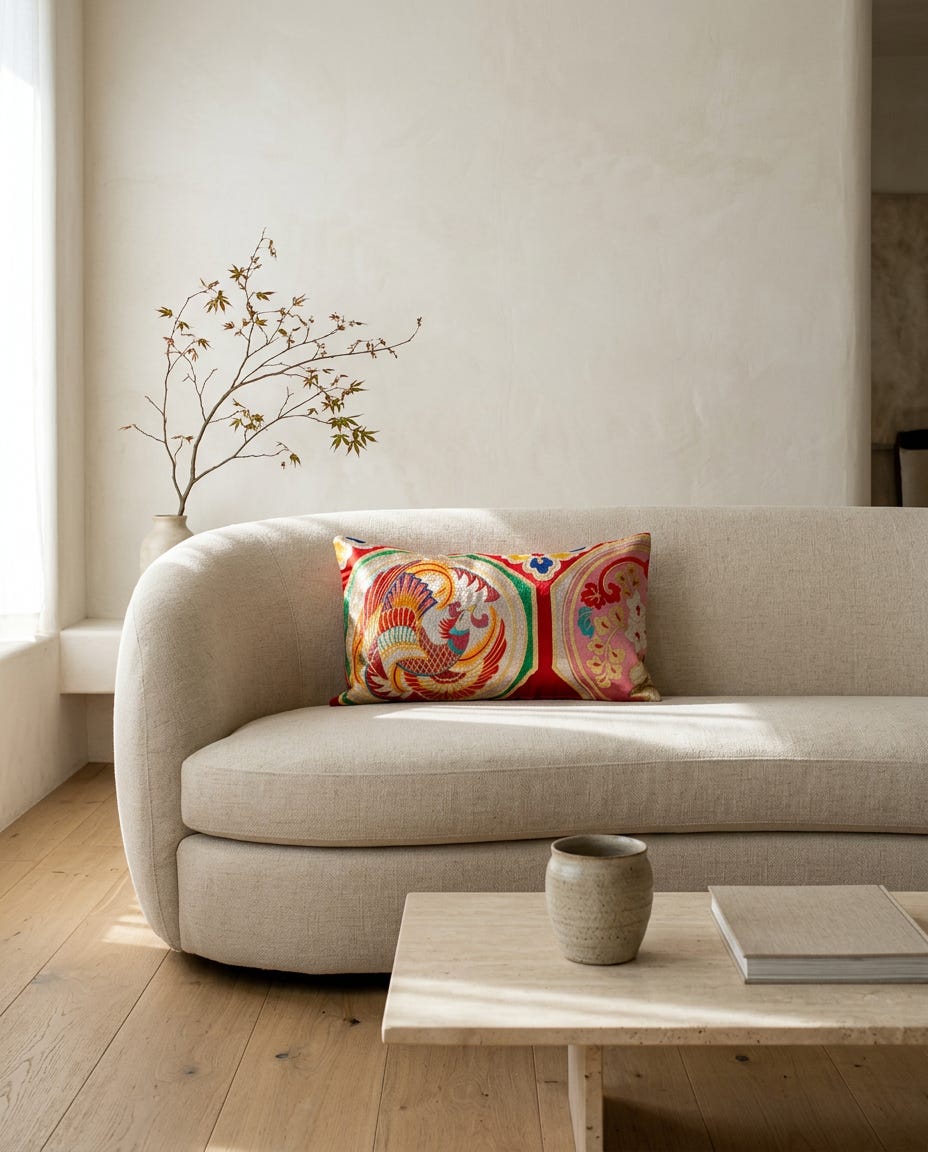
Fifth is colour drawn back to the earth. Deep brown, terracotta, clay, moss, rust, in place of cool grey and hard white. Bold without being harsh. This is where old silk shows its hand most plainly. The colours in vintage Japanese textiles come from kusaki-zome, plant dyeing, and they are exactly these saturated earth tones. Madder for the deep reds and rusts. Indigo across its whole reach, from the palest sky to something close to black. Gardenia and turmeric for the gold and orange. Sappanwood for the complicated purples that read as aubergine or wine. Not a paint shop's guess at natural colour. The thing itself. A wall in what the magazines call terracotta sits easily beside an obi whose ground was dyed with madder and an iron mordant. The two are relations. Both take their authority from the ground underfoot, and so they speak the same language even when the exact notes differ, a language people have been using for thousands of years.
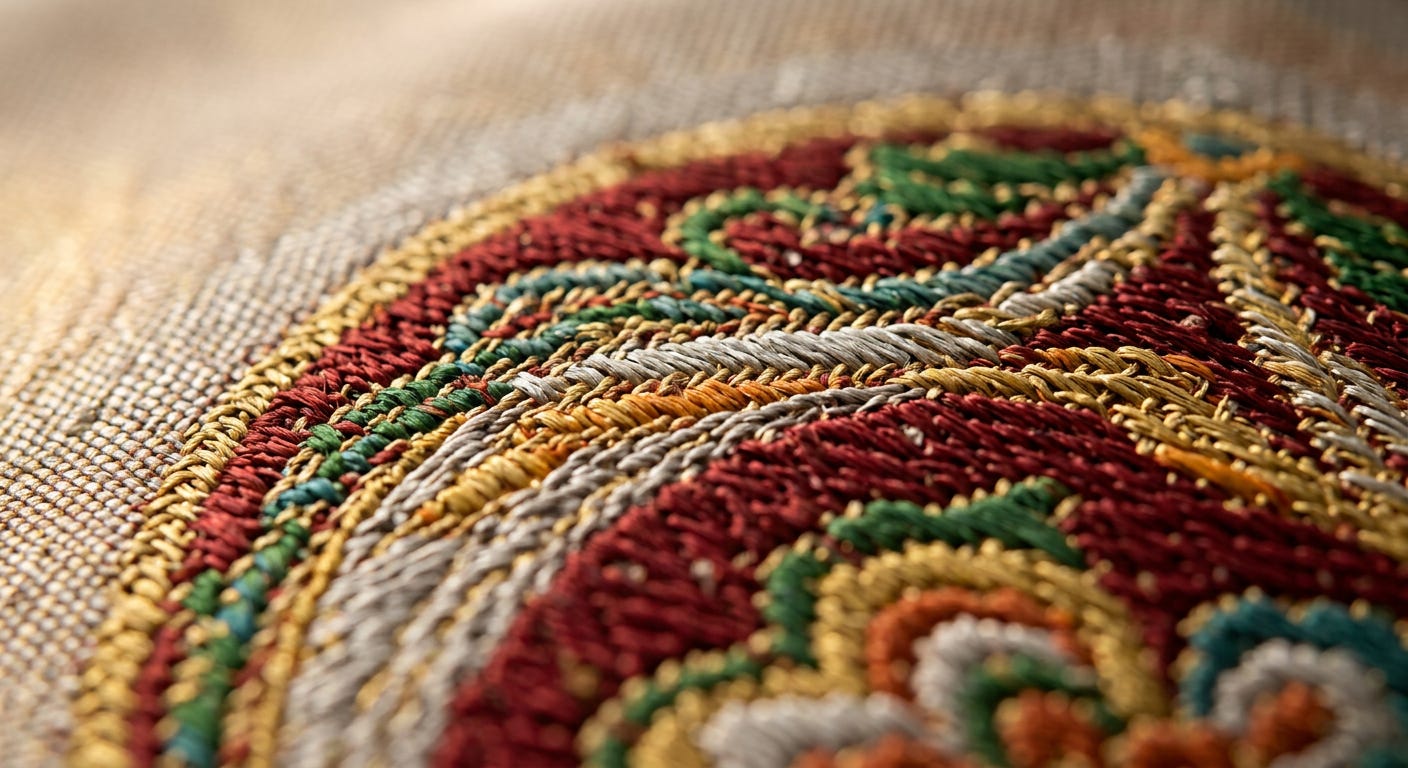
Sixth, and last, the year has fallen for the evidence of the hand. Threaded channels in wood, handmade qualities, the offcut and the natural variation, the mark a hand actually leaves. Machine cloth, however lovely, is perfectly even: every thread where it was told to go, every repeat identical. Hand-woven silk carries the small irregularities that prove a person was there. A passage where the weaver’s tension eased. A repeat sitting a hair higher than the one before. A dye lot a shade off from its neighbour because the bath ran a degree warmer that morning. In Nishijin silk these are not faults to be excused. They are the very thing this year has learned to love. A room that admires handmade pots, timber with its nail holes left in, plaster that shows the trowel, is a room that will recognise the loom in a length of old silk.
None of this is about making ceremonial silk “go with” the trends. It is about noticing that the trends have moved toward what this silk has always been: respect for real materials, reverence for craft, ease with irregularity and with saturated colour, comfort in the company of objects that hold their own meaning. The white rooms of the past decade asked an object to earn its place by making as few claims as possible. This year’s rooms ask the opposite, that an object earn its place through richness, through depth of provenance. A 1960s uchikake made into a silk textile painting need not apologise for its colour or its complexity or its plain evidence of labour. Those are the qualities now being asked for. The trends have caught up to the cloth, not the cloth to the trends.
In practice it means that a piece which felt like too much for a pale interior five years ago may be the very thing a warm room wants now. The context shifted. The silk did not. It was only waiting for a design culture grown ready to take it as it is.
· · ·
The softened minimalism begins with a lumbar pillow; discover the collection.
The Silk Journal · Renaras · journal.renaras.com — One silk. One story. One piece. Never repeated.