

A framed obi and a bag made from the same obi are not two versions of the same object. They are two different questions asked of the same silk.
I have mounted enough obi as wall pieces to know exactly what a frame does. It stills the textile. It asks the silk to behave like a painting — to hold its pattern flat, to present its motifs at the viewer’s eye level, to accept the authority of right angles. A great obi withstands this beautifully. The composition was, after all, designed to be read along a woman’s back in a single vertical register, so the wall application honours the original intention more than people assume.
But something happens when the same silk becomes a bag — carried on a shoulder, set down on a café chair, opened and closed through the ordinary transactions of a day — that the wall can never reveal.
What the frame conceals
A framed textile suppresses weight. The silk is stretched, mounted, made rigid. You read the pattern; you do not feel the cloth. You cannot know, from looking, whether the obi is a stiff maru woven for winter formality or a lighter fukuro meant for the shoulder seasons. You cannot feel the particular density of a karaori panel whose supplementary weft threads give the fabric an almost architectural body, nor the surprising lightness of a hand-woven tsumugi that seems to hold air inside itself.
A bag restores all of this. The moment you lift one, the silk tells you its own weight. You begin to understand, without anyone explaining it, why certain obi were reserved for certain seasons. The body is a more honest instrument than the eye.
The cut that cannot be undone
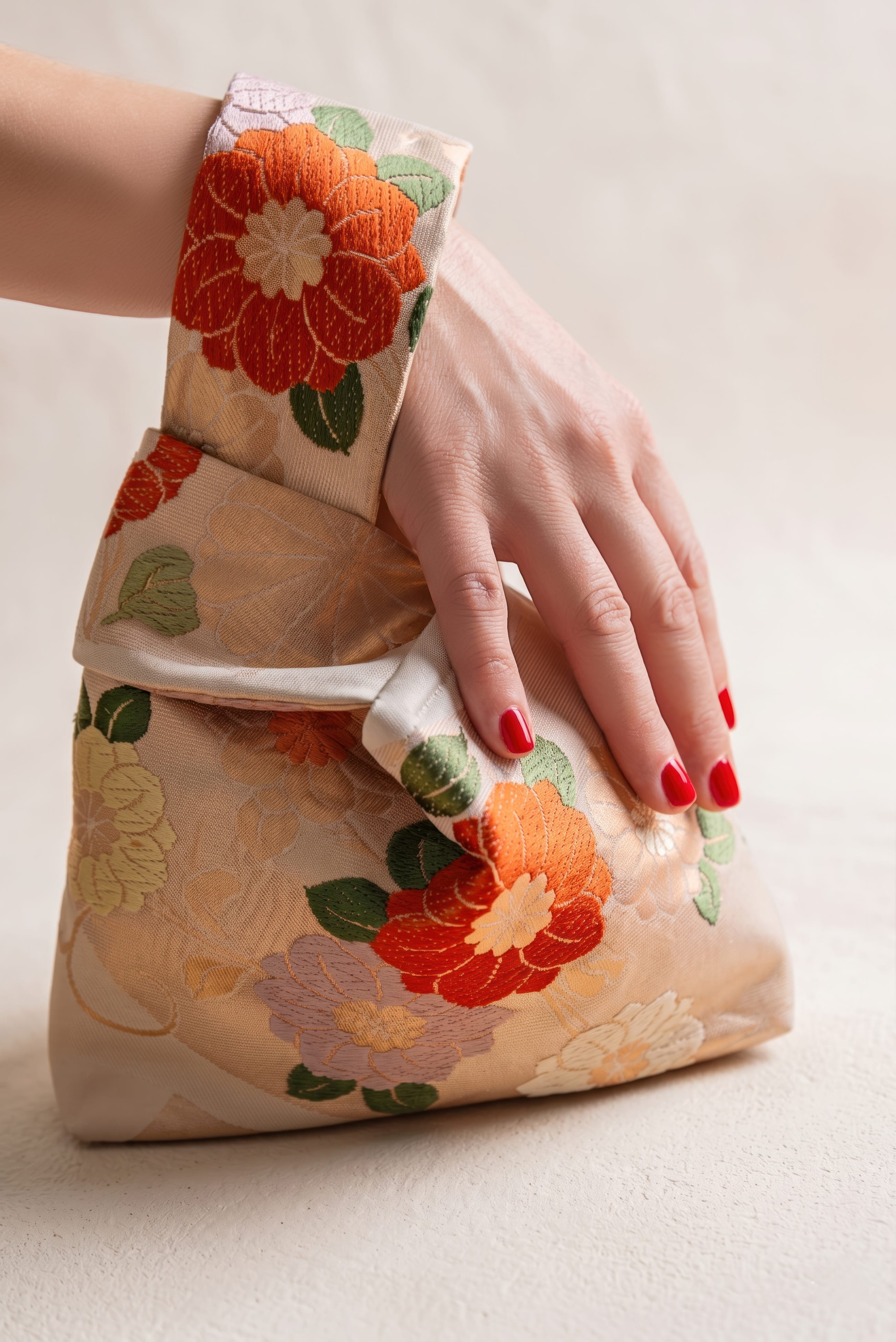
There is a decision at the centre of every bag Renaras makes, and it is worth naming directly. To construct a bag from an obi, the textile must be cut. This is not a casual sentence. A sixty-year-old ceremonial silk that has survived wars, household moves, and the slow attrition of the postwar generation is being put to the blade in the atelier so that it can live a second life.
We do not do this lightly. The cut is planned around the motif — around where a crane’s wing reaches its fullest extension, where a pine branch turns, where the kumo clouds open onto ground colour. What the bag preserves is rarely a rectangle of the original; it is a composition re-centred around the dimensions of a functional object. What is sacrificed is the reading of the pattern as continuous narrative across the length of the obi. What is gained is the silk’s release into movement.
A wall piece asks you to stand still and look. A bag asks the silk to travel with you. Neither is a lesser form.
What the body teaches
The first time you carry a bag made from ceremonial silk, you notice that you move differently. Not dramatically — it is not a costume — but measurably. You set the bag down with more care than you would a canvas tote. You are conscious of where you place it at the restaurant. You notice which coats it reads against and which swallow it. You discover, gradually, that the silk has opinions about light: a vermillion obi in overcast Amsterdam reads quieter than the same silk under a Kyoto afternoon would, and a pale jimi piece that almost disappears against grey stone lights up against a camel coat.
This is the education a wall piece cannot provide. The framed obi teaches you to see. The bag teaches you how the silk behaves inside an ordinary day — and, in the process, teaches you something about the ceremonial context the silk was originally made for. The woman who wore this obi to a wedding in 1962 was also noticing how it caught the light in the temple hall, how it read against the tatami. The silk was always meant to be encountered in motion, in specific light, against other textiles. The bag restores that original condition more faithfully than the frame does.
The patchin handle, briefly
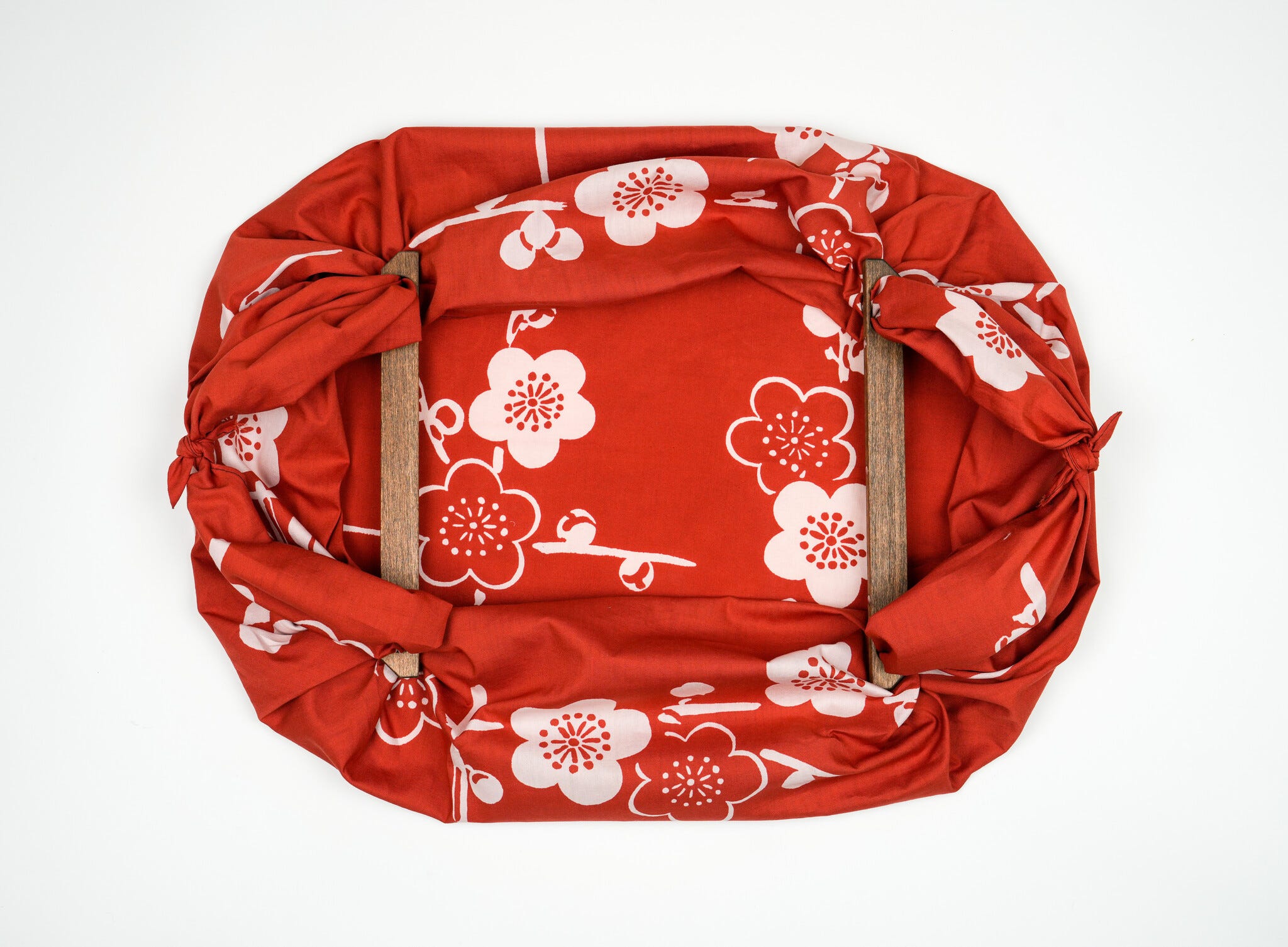
One practical note worth making. The wooden handles used on Renaras bags — patchin — are a structural element, not a decorative one. They are made in the Japanese tradition and carry the weight of the bag; they are not wrapped in silk or carved to mimic the obi’s pattern. The design logic is honest: the wood is wood, the silk is silk, the metal hardware is metal. Nothing pretends to be what it is not. This is its own small inheritance from the Japanese craft tradition — shokunin discipline applied to contemporary construction.
Two forms, one silk
A wall piece and a bag made from the same obi will teach you different things. The wall piece will teach you the pattern, the compositional intelligence, the cultural depth of the motif. The bag will teach you the weight, the drape, the behaviour of the silk inside a moving life.
The Journal tends, by instinct, to write more often about the wall pieces — they are easier to describe in prose, and the contemplative register suits them. But the bags are doing something the wall pieces cannot. They are returning ceremonial silk to the condition in which it was always meant to be encountered: with a body inside it, in the world, in motion.
If you want to understand vintage Japanese silk, look at a framed obi. If you want to know it, carry one.
· · ·
Further reading: The Obi: A Field Guide to the Most Complex Textile Document — a longer meditation on how to read an obi’s structural and compositional vocabulary.
Explore the current Renaras bag collection — contemporary accessories in vintage ceremonial silk, each with patchin wooden handles.
The Silk Journal · Renaras · journal.renaras.com
One silk. One story. One piece. Never repeated.