

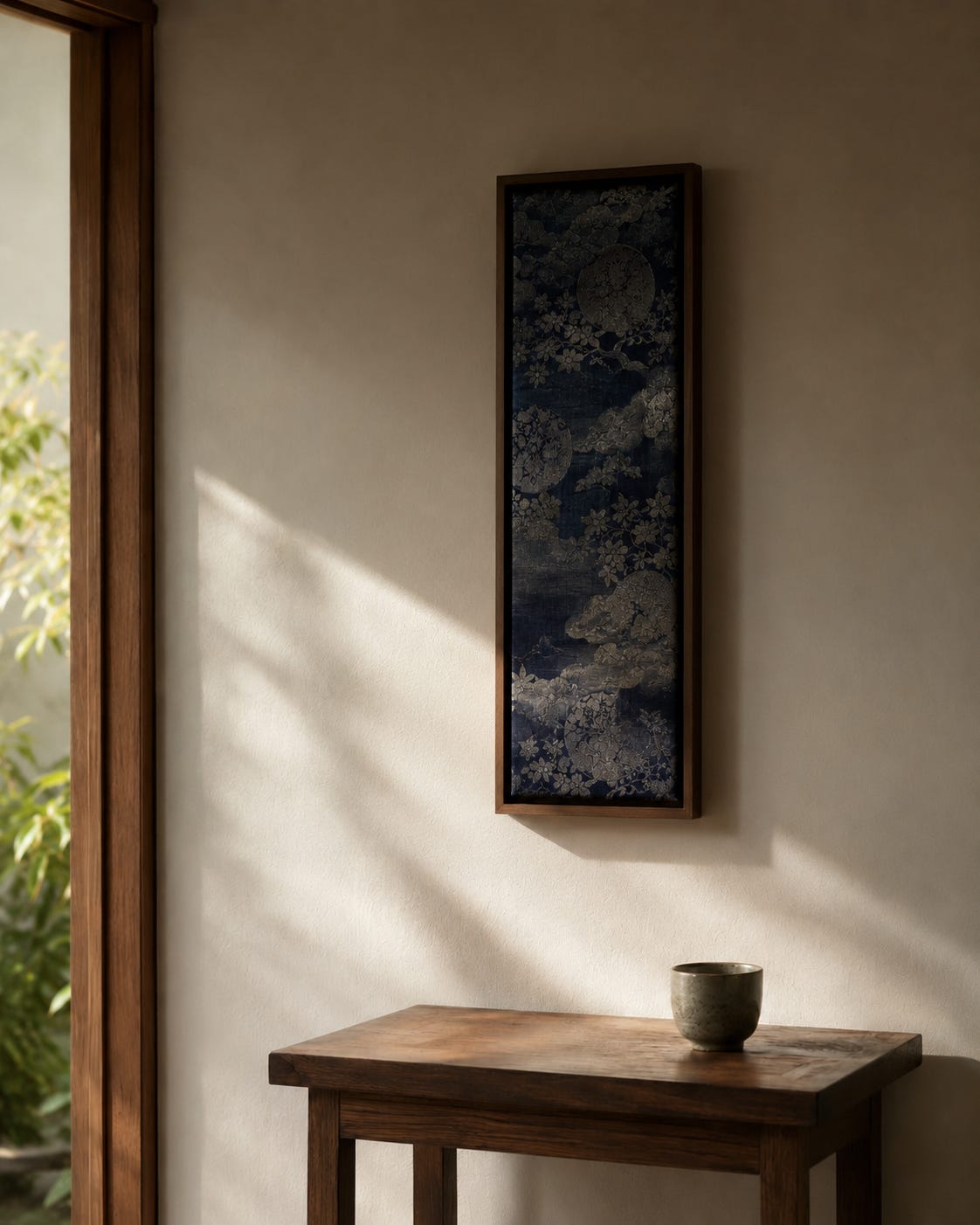
There is a piece of silk on the wall above the table where I drink my tea. Late afternoon, the light comes from the left and lifts the indigo out of the cloth — not all at once, but in the slow way light reveals weave when there is time to watch it. The cup cools. The room is otherwise empty. I am, by any honest definition, alone.
This essay is about three things, held together: loneliness as Louise Bourgeois understood it, the Japanese idea of ma — the inhabited interval — and what happens when you live, day after day, with a single piece of ceremonial silk in an ordinary room.
This is not a sentence I would have written ten years ago without flinching. Aloneness, then, was something to be solved — a state to be managed with company, with sound, with the small bright loops of attention the screens had only just begun to offer. To name it was to admit a failure. Now I write it and the sentence does not embarrass me. Something has changed, and I think the silk had a hand in it.
— —
The ground, not the wound
“You are born alone. You die alone. The value of the space in between is trust and love.” Louise Bourgeois wrote this in her diary, and the line has the brevity of something arrived at rather than composed. She was eighty-something when she wrote it, working still, sleeping less, making the spider sculptures that would outlive her. She was not, I think, complaining. She was reporting. Aloneness as the ground from which everything else is wrested — not the wound, the soil.
I want to take her seriously. I want to take seriously the possibility that what we have begun calling loneliness — the great, vague, statistical loneliness of the present, the one the public health reports keep measuring — is not the absence of connection. It is the absence of the practice of being with. With another person, yes, when that is available. But also with a tree, a meal, a hand, a piece of cloth. The practice of letting one thing register fully before reaching for the next.
That practice has been thinning. Not because anyone wished it to, but because the shape of the day has changed. There are now voices in the room that are not voices. There are eyes on the screen that are not eyes. There are sentences arriving from somewhere — solicitous, grammatically perfect, instantly available — that come from no one in particular and are addressed, finally, to no one in particular. The encounter is real. The presence is not. And the body, which has spent two hundred millennia calibrating itself to the difference, knows.
This is not an argument against the screens. They are not the subject of this essay. The subject is what we have stopped doing in their company, which is paying the slow kind of attention that another body — or an old, woven, hand-touched object — used to ask of us by default.
— — —
Ma and the practice of being with
The Japanese word for what I am circling is ma — 間. It is one of those words English does not quite have. The character itself shows a gate (門) with the sun (日) shining through it: an opening, an interval, the moment of light passing through a frame. Ma is usually translated as “negative space” or “the space between,” but those translations make it sound passive — empty, awaiting content. Ma is not empty. Ma is charged. It is the inhabited interval.
Put more simply: ma is the pause that gives the note its meaning. The gap between two roof beams that lets the architecture breathe. The silence in conversation that, if you do not rush to fill it, becomes the place where understanding happens.
A garden has ma. A tea room has ma. A well-set table for one has ma. So does the wall behind a single, well-chosen piece of silk.
Ma is the philosophical key to the question I am trying to ask, because ma reframes aloneness entirely. Aloneness is not a deficit of company. It is a ma — an interval — and like any ma, its value depends on what we do with it. If we evacuate it, fill it with noise and scroll and the half-attention of a thousand small inputs, we waste it. If we inhabit it — if we let one thing register, slowly, in its proper weight — we discover that aloneness is one of the few remaining contexts in which presence becomes possible at all.
This is also why a Renaras piece is meant to live one to a wall, not in a gallery cluster. A single ceremonial silk above an otherwise quiet expanse is not minimalism for its own sake; it is the practical expression of ma. The wall is not the background. The wall is part of the composition. Crowd the wall with three more silks and you have not added meaning, you have evacuated the interval. The silk needs the empty wall to fly into, the same way the crane on the obi needs the room.
The silk, on the wall above my table, is doing something specific in this ma. It is not decorating the interval. It is occupying it the way a single bell-tone occupies a temple courtyard at dusk — fully, without crowding.
— — —
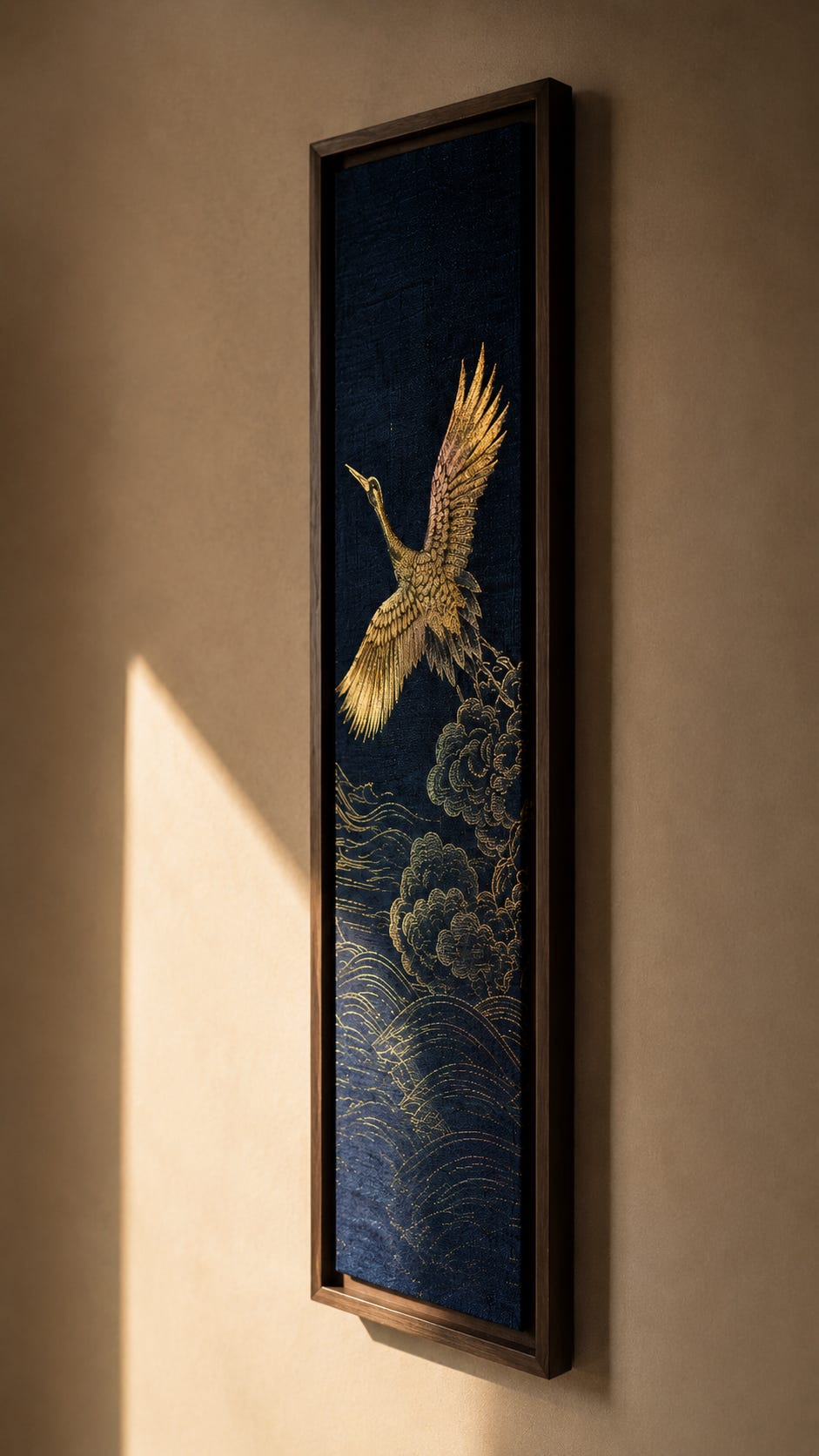
The piece I keep returning to is a fukuro obi from, I think, the early 1960s. The ground is a deep indigo that has aged to the colour of a sea about to be night. The pattern is sparse: a scatter of pine needles in oxidised silver thread, and a single crane in flight near the upper edge, picked out in a thread that was probably gold once and is now the colour of old wheat. I bought it three years ago from an estate in Kyoto, where it had been folded for six decades inside a paulownia chest belonging to a woman I will never know. She was, I was told, a tea practitioner. The obi was part of her formal wardrobe. She had worn it perhaps four times in her life. It now hangs in our Amsterdam atelier, on the wall above the table where I am writing this.
I want to tell you what it is like to live with this silk. Not because the object itself is the point — there are thousands of obi like it, each one singular, none of them more important than the last — but because the kind of presence it offers is what I am trying to describe. A presence that does not perform. A presence that does not ask anything of you. A presence that, on a quiet afternoon, simply is in the room, and by being in the room, changes what the room is.
The crane, in particular. It is not where you would expect a crane to be in a Western composition — not centred, not balanced against another motif, not making any visible argument about the picture plane. It is high and to the right, slightly off from anywhere your eye wants to settle. For the first month I owned the obi, I kept feeling the crane was misplaced. I would look at it and feel, vaguely, that something had been done wrong. Then one evening I understood: the crane is not flying across the silk. It is flying out of it. The composition is not the obi. The composition is the obi and the room. The crane needs the wall to fly into.
The silk had been waiting six decades for the wall.
— — —
Trust and love, Bourgeois said, are what we wrest from the space between. I have been thinking about that verb. Wrest. It means to pull with effort, to take from something that resists. Not to receive. Not to be given. To wrest. The implication is that aloneness does not yield trust and love automatically; they are extracted from it, by some kind of work, in the same way silk thread is extracted from the cocoon of the silkworm by patient hands and warm water.
What is the work? I think it is the work of paying attention to one thing long enough that it begins to give back. The cup of tea, before you drink it — the steam curling, the colour of the brew against the white of the cup, the temperature of the porcelain in your palm. The silk on the wall — the way the indigo is not one indigo but eight, depending on the angle of the weft. The light moving across the room — the room becoming a different room four times a day, every day, for as long as the room exists.
This is not contemplation in any grand or religious sense. This is small. This is what people used to do without naming it, when there was nothing else to do. It is what the silk asks of you, when you live with it: not devotion, not study, just the willingness to look at it, occasionally, the way you might look at a friend who has come to sit with you in silence.
— — —
Living with ceremonial silk
The silks that come into the atelier carry, every one of them, the trace of a hand. Sometimes literally — an oil mark from a finger that touched the cloth in 1958, a slight thinning where someone gripped the fabric repeatedly while tying it. More often, the trace is structural: a place where the weaver’s tension shifted, a section where the dye took deeper because the mordant bath was a degree warmer that morning. The hand is there, even when you cannot see the hand.
This is, I think, what is most quietly radical about living with ceremonial silk in the present moment. The objects we increasingly inhabit our lives with have no hand in them. The interface is smooth. The voice is even. The image is generated. There is nothing under the surface but more surface. None of these things is wrong, exactly — but a life made entirely of them starves a particular hunger, and the hunger has a name even if we have not been using the name. We are hungry for the evidence of other people. Not for the fact of other people necessarily, but for the trace. The proof that something was made by a body, for a body, in a real place, on a real day, with weather.
A piece of ceremonial silk is, among other things, a long piece of evidence. The dye came from a plant someone grew. The thread came from cocoons someone tended. The pattern was drawn by someone who had spent a lifetime learning to draw it. The cloth was woven on a loom by someone whose great-grandfather had probably worked the same loom. The garment was sewn for a specific occasion in a specific woman’s life — a wedding, a coming-of-age, a tea gathering for a friend’s mother — and was worn by her, and folded by her, and kept by her, and inherited by her daughter, and forgotten in the bottom of the chest, and rediscovered by a grandson who did not know what it was, and sold to a dealer, and shipped to Amsterdam, and unfolded on the worktable in our atelier, and looked at, and looked at again, and finally cut by my own hands — carefully, with the original motif preserved — into something that could live on a wall in a room where someone drinks their tea alone in the late afternoon.
That is a long chain of hands. The silk is what carries the chain.
— — —
The cup of tea, in this essay, is not chanoyu. I want to be clear about that. The Japanese tea ceremony is a magnificent and specific tradition, and it is not what I am pointing at. I am pointing at the thing that almost everyone has access to and almost no one does any more: making yourself a cup of tea, slowly, and drinking it without doing anything else.
Not while reading. Not while scrolling. Not while listening to a podcast or a meeting or a song. Just the tea, in the cup, in your hand, in the room.
If you have not done this for some time, the first attempt is uncomfortable. The mind, deprived of its usual stream of input, will protest. It will offer up tasks, anxieties, lists, half-remembered conversations, anything to fill the ma. This is not a failure of the practice; it is the practice. The discomfort is the muscle realising it has gone slack. After a few minutes, if you stay with it, the discomfort gives way to something else — a kind of quietness that is not the absence of thought but the presence of the room. You become aware of the tea. The tea becomes aware of you. (I am being precise, not poetic. Something is exchanged.)
This is the small ceremony. It is not a thing you have to learn. It is a thing you have to remember.
The silk, on the wall, is what makes the remembering easier. Not because it instructs you. Because it sits there, doing nothing, asking nothing, being itself, and its mere being is a model for how to be with the cup. The silk has been quiet for sixty years. It is in no hurry. It will not check its phone. It is here, fully here, and if you are willing to be fully here with it, something in the room shifts.
This is what I mean when I say the silk is a witness. Not a metaphor. A witness. Something that is present with you while you do the thing.
— — —
There are myths the silk carries, and I have been wondering all afternoon how to name them without flattening them.
The crane on my obi is not, exactly, a crane. It is also Orihime — the Weaver Star, who in the old story crosses the river of heaven once a year to meet the cowherd Hikoboshi, the two of them separated for the rest of the year because their love made them neglect their work. Orihime weaves the cloth of the gods. Her tears, when she cannot reach Hikoboshi, are the rains that come in early July. The crane in flight, on a piece of silk, may be only a crane. It may also be Orihime crossing the heavens. The maker, very probably, knew both. The maker, very probably, did not feel obliged to choose.
There is Amaterasu, the sun goddess, who hid in a cave when her brother’s violence became unbearable, and whose return — coaxed out by music and laughter and her own reflection in a bronze mirror — is the reason there is light in the world at all. There is the Crane Wife, who weaves cloth from her own feathers in secret, and is destroyed when her husband cannot resist looking. There is the silkworm itself, which in the oldest Japanese cosmologies is born from the body of a goddess who was killed by another god and from whose remains rose all the useful things — silk, rice, millet, beans, the materials of human life.
No one of these stories is the meaning of the crane. They coexist in the cloth the way several memories coexist in a family object — none cancelling the others, all of them present at once, available to whoever is paying attention.
These stories are not decoration on the silk. They are in the silk, the way salt is in the sea. The hand that drew the crane was a hand that had grown up hearing these stories, and the line of the crane’s wing carries the memory of the stories whether or not the maker was thinking of them in the moment of drawing.
When you live with such a piece, you live in proximity to a culture that did not separate the everyday from the sacred. You do not have to believe the myths. You do not have to know them. They are in the room with you, the way the silk is in the room with you, and they make the room a slightly different room than it would otherwise be. They make the ma slightly more inhabited.
The silk is a touch from before — but not before in the sense of nostalgia, not before in the sense of “things were better then.” Before in the sense of: before we mistook information for presence, before we mistook stimulation for attention, before we mistook the surface for what was under the surface. The silk has been waiting for us to come back. It is patient. It has time.
— — —
Mottainai and wasted presence
Mottainai (もったいない) is the Japanese word for what one feels when something of value is wasted — when food is thrown away that could have been eaten, when wood is burnt that could have been carved, when a fabric is discarded that could have been worn for another generation. The word is often translated as “what a waste,” but that is too thin. Mottainai contains a moral and almost spiritual recognition that a thing has being, and that being deserves to be honoured by use, not extinguished by carelessness.
I have come to think there is a mottainai of presence too. (I am not being metaphorical here. I mean this as an ethical claim about attention.) We are wasting it. We are wasting our intervals, our ma, our quiet hours, our cups of tea, by filling them. The interval is the thing of value. The interval is what we throw away when we cannot bear to be alone with ourselves and so we reach for the screen, the voice, the next thing.
The silk on the wall is, partly, a quiet reproach to this. It will not let itself be filled. It will not perform for you. It will not give you a stream of new information. It is the same piece of silk today that it was yesterday, and it will be the same piece of silk tomorrow, and the day after that, and in a year, and in twenty. Its sameness is not boring; its sameness is what gives it the gravitational weight to anchor the ma of the room.
You learn, slowly, to want this kind of object more than you want the other kind. You learn that the surfaces that ask nothing of you also give nothing back, and that the surface that asks one thing — look at me, slowly — gives more, over a lifetime, than all the bright loops of attention combined.
[Image: A hand resting beside (not holding) a ceramic cup, with the silk softly out of focus in the background. Purpose: to embody the “small ceremony” — the body present, the object present, no performance, no action.]
— — —
I will end where I began. The silk is on the wall above the table. The light has moved further across the room. The tea in the cup is cold now; I forgot to drink it, which is itself a kind of paying attention, since I was instead paying attention to the silk and to the writing of this. I am still alone. The aloneness is still aloneness — it is the ground, it does not go away. But the quality of it has changed. It is not the aloneness of waiting to be reached. It is the aloneness of being with what is here.
The silk is here. The cup is here. The light is here. The room is here. The hands that made the silk are here, in their trace. The woman who folded it for sixty years is here, in the memory of the cloth. The crane is still flying out of the upper edge. There is a great deal of company in this room, if you know how to count it.
The screens, when I return to them, will still be there. The voices that are not voices will still arrive. None of that is going away, and I am not interested in pretending it should. What I am interested in is the small, recoverable practice — five minutes, a cup, a piece of cloth, a willingness to stop — that the silk teaches without ever speaking. The practice of being with. The wresting of trust from the interval. The honouring of the ma.
You can do this without silk. You can do it with anything that has been touched by a hand and asks nothing of you. A wooden bowl. A stone. A book you have already read. The point is not the object. The point is the relationship the object makes possible.
But the silk is what taught me. So the silk is what I write about.
· · ·
The wall panel holds the silence; view the wall art collection.
The Silk Journal · Renaras · journal.renaras.com
One silk. One story. One piece. Never repeated.