

There is a cloth in Japan so fine it is mistaken for silk, and it is not silk at all. It is a bast fibre, like linen; strictly, ramie, the long thread of Boehmeria nivea, a quiet relative of the nettle, split from the stalk by fingernail and twisted by hand. The bolt that results is featherweight and faintly translucent. Hold it to a window and the light walks through it. Lay it against your arm in August and it does what silk, for all its luxury, cannot do half so well. It keeps you cool.
The Japanese have names for this cloth, and the names matter. Jōfu (上布), the fine bast weaves. Chijimi (縮), the crinkled summer crepe. These were the cloths of the Japanese summer, before air conditioning, before synthetics, when a person dressed for the heat rather than against it. To follow them back is to follow a thread that runs through twelve centuries, two lakes, and a great many winters of snow. The strange thing, the thing worth holding onto, is that a cloth made for the hottest weeks of the year is born entirely in the cold.
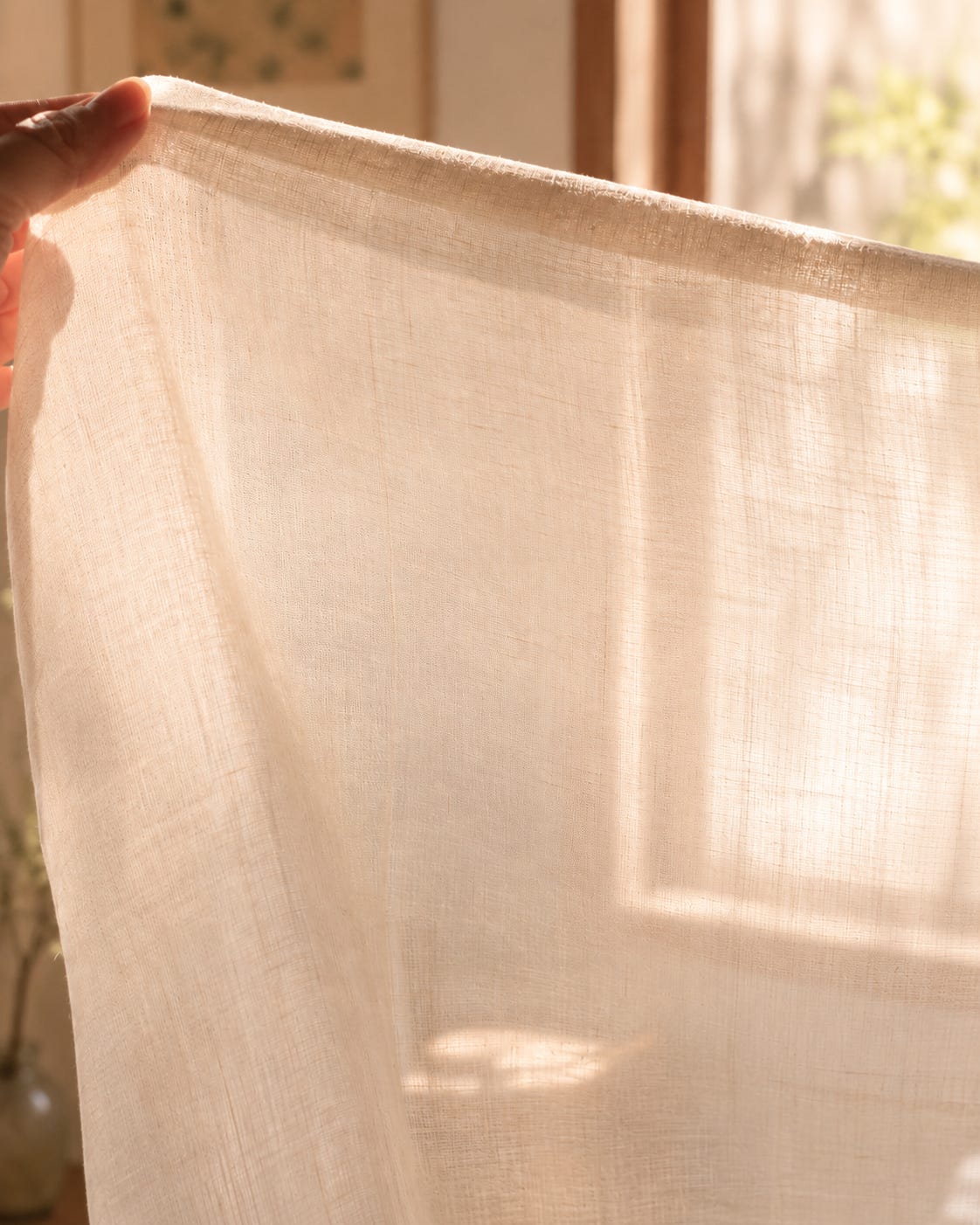
What survives in the treasure house
Begin in Nara, in a sealed wooden repository called the Shōsōin, where the possessions of an eighth-century court were closed away and have been kept, untouched by most hands, ever since. Among the bast-fibre cloth stored there is tax cloth from Echigo, the old province that is now Niigata, dating to the mid-700s. One account fixes a presentation to the imperial court in the year 731. The cloth was already, then, a thing worth keeping for twelve hundred years.
So the fine ramie of the snow country is old in a way that is documented rather than merely claimed. Echigo jōfu takes its name from the province and from the word for finely woven ramie. Records have it given as a personal gift from emperor to favoured courtier, one such mention placed around 1192. Merchants travelled to buy it, and the market town of Shiozawa grew up on the trade. Each village in the snow country came to be known for a variety of its own, as if the cloth carried the name of the valley it was made in.
How the work was done was set down in Hokuetsu Seppu, the “Snow Country Tales” of Suzuki Bokushi, a merchant of the Echigo region who recorded the life of the place in the early nineteenth century. The making was never a secret. It was simply too hard for most people to want it.
The cloth was already, in the eighth century, a thing worth keeping.
A samurai, a hard twist, and the wrinkle that cools
For most of that history the Echigo cloth was woven flat and smooth. The crinkle came later, and it came, by tradition, from a stranger.
The story told in Ojiya runs like this. Sometime in the seventeenth century a man connected to the Akashi clan, in what is now Hyōgo, arrived in the snow country carrying a technique used for Akashi crepe. His name is given as Hori Masatoshi, sometimes Horijirō, and the new craft is dated to around 1670. What he brought was a single idea with large consequences: twist the weft thread hard before weaving, then wash the finished cloth in hot water and work it with hand and foot until the over-twisted yarn draws back on itself and the surface lifts into thousands of tiny wrinkles. That puckering is called shibo, and the cloth that carries it is chijimi, “shrunk.”
How much of the man is history and how much is the tidy shape a story takes in the retelling, no one can quite say; the sources themselves grow careful at this point, and the careful word is “said.” What is certain is that the technique took hold. Ojiya chijimi, an improvement on a cloth that already had a thousand years behind it, became famous the length of Japan. At its Edo-period height the region is said to have turned out some two hundred thousand bolts a year. The work fell mostly to women, and the skill passed down the female line, from mother to daughter, from mother-in-law to wife, through the shut-in months when snow closed every other door.
The other lake
There is a second home for this cloth, far to the south and west, and its story rhymes with the first in a way that feels less like coincidence than like inevitability.
On the eastern shore of Lake Biwa, the Kotō plain sits in humidity drawn off the lake and its rivers, a climate that suits ramie as the snow country suits it. Cloth has been woven here since the medieval period, the knowledge carried, it is said, by craftsmen who came down from nearby Kyoto. Under the patronage of the Hikone domain in the Edo period it grew into a true industry, and the merchants of Ōmi, famous across Japan for their commercial nerve, brought ramie down from the northeast and carried the finished cloth back out along the trade roads. This is Ōmi jōfu, and its crinkled cousin Ōmi chijimi: an everyday fineness rather than a rarefied one, but the same fibre, the same instinct, the same answer returned to the same question.
Two lakes, then, and one idea arrived at twice. Wherever the air stayed humid enough that the spun thread would not snap, Japan learned to make summer out of a nettle.
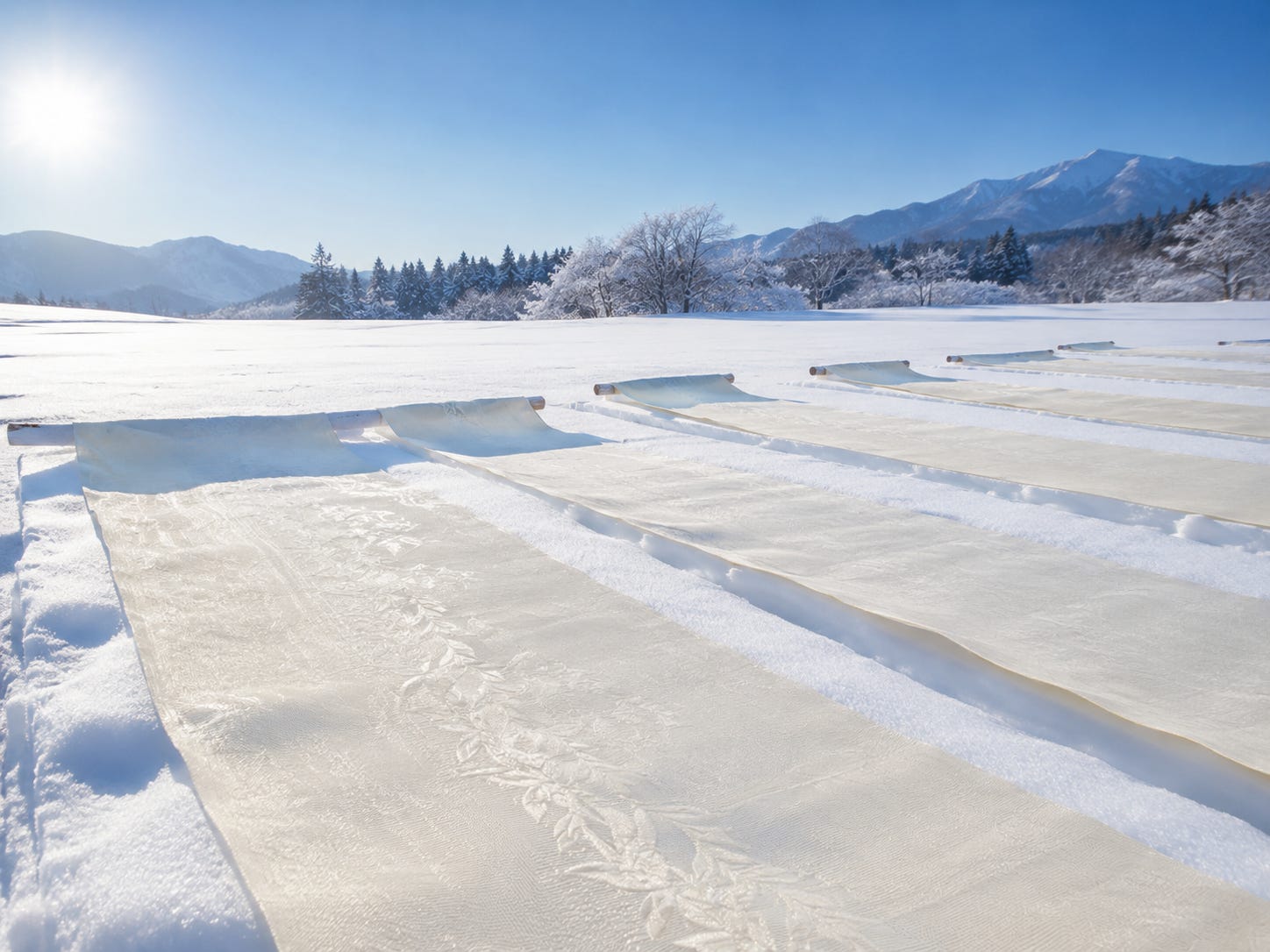
Born in the cold, worn in the heat
The making is slow past reason, and the snow is part of it, not a backdrop but an ingredient.
A skilled spinner produces only a few grams of ramie thread in a day. A single bolt can take months, the fibre kept damp at the fingertips so it will not break. The thread is bound and dyed by hand for the kasuri patterns, woven on a jibata back-strap loom worked from the floor, then washed, trodden underfoot, and carried out onto the snowfields. This last step is the strangest and the most beautiful. The woven cloth is spread across the snow on clear winter days for ten to twenty days, and the sun, working through the ozone that forms over the bright snowfields, draws the colour pale and sets it. Rows of finished kimono cloth laid out rainbow-bright on white, with nobody near them, slowly changing. The fabric is born in the cold and worn in the heat.
In 1955 the authentic cloth of Ojiya and Echigo was named an Important Intangible Cultural Property, under five strict conditions: the ramie hand-spun, the kasuri threads hand-tied, the loom a floor-worked jibata, the finish done by hot-water kneading or foot-trampling, the bleaching done on snow. In 2009 it became the first Japanese textile inscribed on UNESCO’s list of Intangible Cultural Heritage. The honour records a fragility as much as a glory. Where the region once produced two hundred thousand bolts a year, only a few dozen bolts of the certified Echigo cloth are made now, by some counts closer to ten. A whole tradition narrowed to a handful of lengths a year, each one a winter’s work. The cloth that survives is the cloth that earns its slowness.
· · ·
The small lesson
Now the practical part, because poetry should pay its way.
In real summer heat, wear linen, not silk.
The reason is in the fibre. Silk is a protein filament, smooth and dense, and it holds warmth close to the body: the very quality that makes it luxurious in a cool room makes it close and heavy in a hot one. It marks, too. Sweat sits on silk and stains it, and the mark is hard to lift. Linen and ramie are the opposite. They are bast fibres, quick to drink moisture off the skin and quick to give it back to the air, so the body’s own cooling can do its work. Ramie does this better than almost anything that grows. It absorbs and dries fast, and its fibres hold their strength when wet, which is why a ramie kimono could be washed through a humid month, again and again, and lose nothing of itself.
The snow country turned that plain physics into craft. The shibo of chijimi is not ornament. Those wrinkles lift the cloth a hair’s breadth off the body so air moves underneath and the fabric never clings. A garment engineered, three centuries before the word, to keep its wearer dry.
So the cloth that looks like silk is the wiser choice precisely because it is not. Lighter than a feather. Born of snow, by hands that may no longer be there to make it. Worn against the worst of the heat, and equal to it.
One silk. One story. One piece. Never repeated.
This was fascinating! I switched to wearing linen as much as I could in the summer when I moved to Texas years ago and I can confirm that it actually keeps you cooler!