

The Silk Journal · Renaras · journal.renaras.com
Hana-fubuki
On the Philosophy of the Falling Blossom, the Spring Palette of Japanese Silk, and What Impermanence Actually Teaches Us About Beauty
花吹雪
There is a word in Japanese for the moment when the cherry blossoms fall all at once. Hana-fubuki. Flower snowstorm. It describes the particular quality of the air when the petals release together — a suspension of pink and white in the wind that lasts, at most, a few minutes before the ground is covered and the tree stands bare again.
The Japanese have a word for it because they noticed it. Because they noticed it for long enough, and with enough precision, that the moment accumulated sufficient weight to require its own name.
The Western relationship with cherry blossom has always been, broadly, with the blossom itself. The fullness, the photogenic abundance, the bloom held at its peak. What Japanese aesthetics has always understood — and what hana-fubuki encapsulates with unusual directness — is that the moment of falling is not the ending of the blossom’s meaning. It is the culmination of it.
This is not sentiment. It is a philosophical position about where beauty actually resides. And it has consequences for how an entire textile tradition was built.
The Goddess Who Made the Blossoms Fall
In the oldest layer of Japanese mythology, the cherry does not simply bloom. It is commanded to bloom by a deity: Konohanasakuya-hime, the Princess of Blossoming Flowers, whose name is sometimes translated as the spirit of Mount Fuji and sometimes as the incarnation of the cherry itself.
Her story, as recorded in the Kojiki (compiled 712 CE), contains a detail that Western retellings tend to omit: she proved her fidelity by giving birth in a burning parturition house, the flames unable to touch her children because her virtue was genuine. The blossoms she commands are beautiful, yes — but they emerge from an act of extreme courage and self-possession. They are not decorative. They are proof.
The mythological significance is this: the Japanese cherry blossom is not simply a pretty thing that happens every spring. It arrives bearing the authority of a goddess who has already passed through fire. Its brevity — the seven to ten days of full bloom, the sudden release of hana-fubuki — is not a flaw in the natural order. It is the point. Konohanasakuya-hime does not offer permanence. She offers intensity. The distinction, for anyone serious about Japanese aesthetics, is everything.
This is why the cherry blossom became one of the most contested and carefully governed motifs in the classical textile tradition. Not because it is pretty, though it is. Because it carries with it a specific philosophical argument: that the most beautiful things are the most fleeting, and that this is cause not for sadness but for complete attention.
What the Spring Calendar Demanded of Silk
The seventy-two micro-seasons of the Japanese calendar — Shichijūniko — do not treat spring as a single, undifferentiated condition. They divide it into roughly eighteen five-day windows, each with a specific name derived from observed natural phenomena, each making specific demands on the textile tradition.
The transition that matters most is the one from awase to hitoe: from the fully lined winter kimono to the single, unlined silk of the transitional months. This shift does not happen on a fixed date. It happens when the calendar and the body agree that the world has changed sufficiently — when the particular quality of late-April air, as the swallows arrive from the south and the earth warms from below, makes the added layer feel not like warmth but like weight.
But the textile response to spring begins much earlier than this practical shift. It begins in the palette.
In early February, in the first micro-seasons of Risshun, the world is still cold. The awase remains. The lined silk stays. And yet the colour begins to move. The deep, compressed palette of winter — near-black over dark indigo, the kareno combination of withered field and bare clay — begins, fractionally, to open. Not toward spring yet. Toward the memory of spring. A warm grey that might, in a different light, be the lightest imaginable sage. The world has not yet changed, but the silk announces that it is about to.
This is the intelligence of the kasane no irome tradition — the layered colour system of the Heian court — at its most subtle. It does not wait for the season to arrive before responding to it. It reads the approach.
Usu-beni, Moegi, Kogane: The Chromatic Grammar of Spring
Three colours define the spring palette of the classical Japanese textile tradition, and each one is a precise perceptual argument about a specific moment in the turning of the year.
薄紅 — Usu-beni. Pale crimson. The exact tone of a cherry blossom at the moment before full bloom — not the deep pink of the open flower but the flushed, almost-white of the petal still forming. It is a liminal colour: warm enough to register against winter’s greys, restrained enough not to announce itself. In the kasane no irome codification, it appears as an outer layer over white, creating at the hem the precise visual argument of blossom against snow — the particular beauty of early spring when both conditions are simultaneously true.
萌黄 — Moegi. Young onion shoot. A yellow-green of extraordinary precision, named not for green in the abstract but for the specific chartreuse of the first vegetable growth pushing through cold ground. Moegi is the colour that arrives before you are ready for it — that particular early spring green that seems almost wrong, too vivid against the still-bare branches, and is precisely correct because the world itself is slightly ahead of your expectation. In interior practice, it grounds the ethereal warmth of usu-beni against something living and specific.
黄金 — Kogane. Hidden gold. This is not the gold of ceremony or display but the gold of light at a specific moment: morning sun breaking through early spring mist, the brief interval between winter’s flat white sky and the full luminosity of April. In the textile tradition, kogane threads appear woven rather than applied — light encoded in the structure of the cloth rather than added to its surface. The silk does not reflect this gold. It holds it.
These three colours are not a designed palette. They are observations of the natural world made precise enough to be reproduced in silk. A court lady wearing them in the correct micro-season was not making an aesthetic choice in the modern sense. She was demonstrating that she had been paying attention — that she knew, from the quality of the morning air and the state of the garden, exactly where in the year she stood.
To wear usu-beni before the cherry had budded was premature. To wear it after hana-fubuki had swept the petals to the ground was a failure of attention bordering on bad faith. The window was specific. The silk marked it.
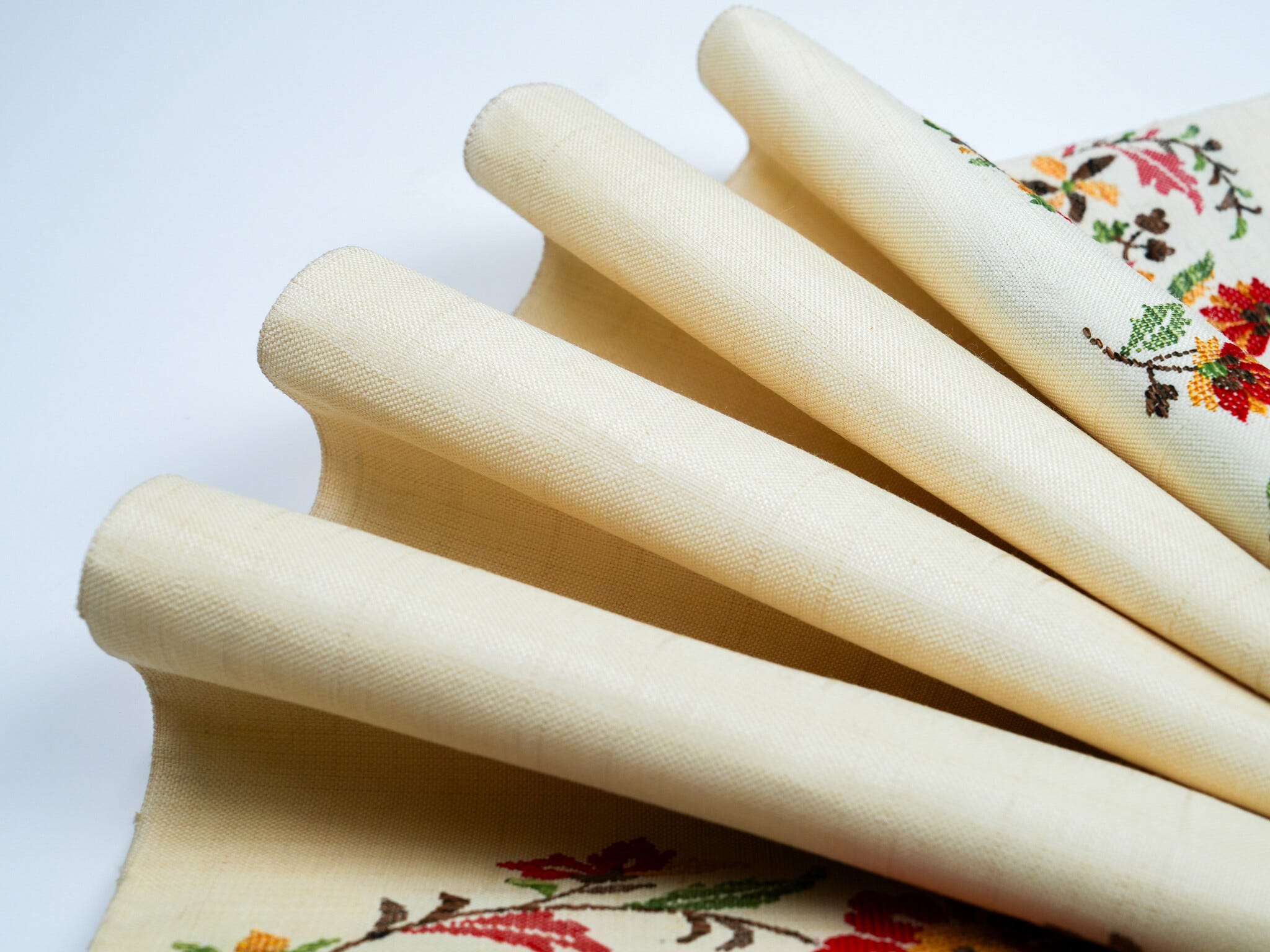
The Obi as Seasonal Document
Of all the elements of the classical kimono ensemble, the obi carries the most concentrated seasonal meaning. Wider than the kimono itself, worn at the body’s centre, it is the primary chromatic statement — and in the finest examples of the tradition, it is a declaration of the exact micro-season in which it was intended to be worn.
A spring fukuro-obi woven with cherry blossom motifs is not simply a beautiful object. It is a temporal document. The weaver who made it understood which micro-season it would be worn in — the brief window between full bloom and hana-fubuki, when the blossom is at the precise threshold between abundance and release. The motif encodes this. The palette confirms it. The weight of the cloth — lighter than winter, heavier than summer, calibrated to the specific quality of April air — completes the argument.
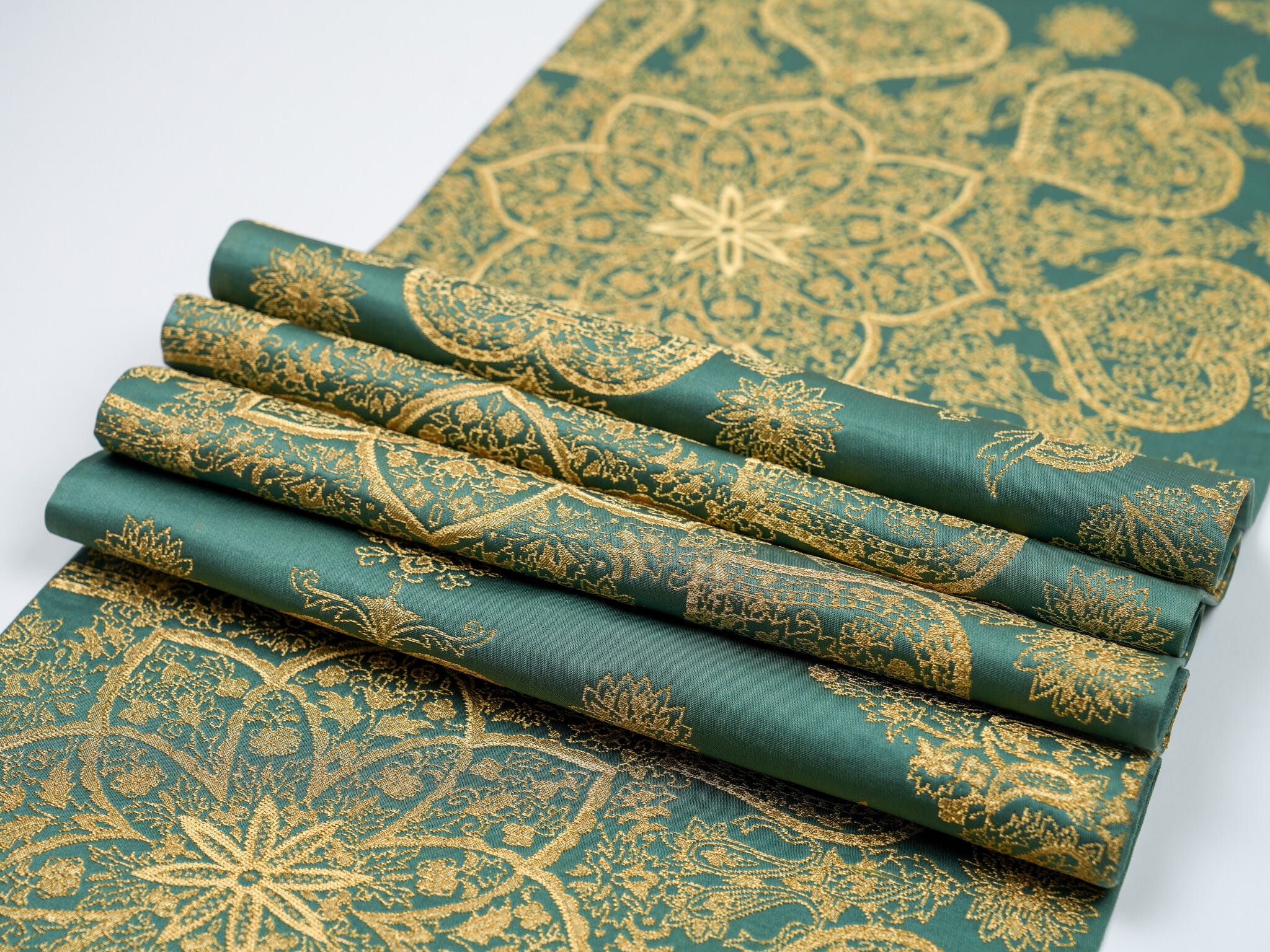
A vintage spring obi brought into a contemporary space carries all of this. Not as history, exactly. As presence. The micro-season encoded in its fibres does not expire with the ceremony it was made for. It continues — available to any eye that knows how to read it, any room that has sufficient stillness to receive it.
This is what the spring textile tradition understood about beauty that the West has largely forgotten: it does not reside in the object’s permanence but in its precision. The silk does not try to outlast the season it was made for. It captures it. Holds it. Offers it back, unchanged, to any spring that comes after.
What Impermanence Actually Teaches
The Western discomfort with impermanence is, at its root, a discomfort with attention. If the beautiful thing will not last, we reason, then the beauty itself is somehow unreliable — a quality that cannot be trusted because it cannot be held.
The Japanese tradition proposes the opposite. It is precisely because the cherry blossoms for seven days that it requires — and rewards — complete attention. The thing that lasts does not teach us to look. The thing that is already falling does.
This is the practical meaning of mono no aware — the pathos of things — as it applies to the textile tradition. A vintage silk obi bearing the motifs of spring cherry was made for an occasion that has now passed. The woman who wore it is, in all likelihood, gone. The specific quality of the April light in Kyoto on the day she dressed is irretrievable. And yet the silk holds something of all of this — not as a record in the archival sense but as a quality of material presence that trained attention can still access.
To bring such a piece into a contemporary space is not nostalgia. It is a different relationship with time: one in which the past is not behind us but alongside us, in the cloth, in the gold thread, in the specific weight of the lined silk and the specific palette of usu-beni at the hem.
Impermanence does not devalue these things. It is the source of their value.
The blossom is already falling. This is the right moment to look.
The Silk Journal · Renaras · journal.renaras.com
One silk. One story. One piece. Never repeated.