

The word arrives in our language later than you would expect.
Empathy is barely a hundred years old in English. Edward Titchener coined it in 1909, translating a German term — Einfühlung — that the philosopher Robert Vischer had introduced in his 1873 dissertation on aesthetics. Einfühlung means, literally, feeling-into. And in its first life, before psychology borrowed it and softened its strangeness, the word had nothing to do with one human being understanding another. It was a word for what happens between a person and an object.
Vischer was trying to describe a particular experience — the way, when we stand before a sculpture or a building or a painted figure, we lend it our own bodies. We feel the weight in the column. We feel the breath the marble torso is not taking. We feel the tension in the bowstring of a drawn arm. We feel, even in a folded textile, the way it would fall if it were allowed to unfold. The object does not, of course, possess these feelings. We project them. The aesthetic experience, Vischer argued, is the moment at which we forget we are doing this — the moment at which the form seems to feel us back.
I think about this in the atelier whenever a new piece arrives, and I have come to think it is the most useful single concept for understanding what ceremonial silk asks of the people who live with it.
I. A word for what happens between a person and a thing
The story of Einfühlung is improbable. Vischer was a young man finishing his dissertation in Tübingen, working in the long shadow of his more famous father, the aesthetician Friedrich Theodor Vischer. The son’s contribution was small, dense, and at the time mostly ignored — a hundred-odd pages arguing that we cannot properly describe what we feel before a work of art unless we accept that we are, in some literal sense, putting ourselves into it. Not metaphorically. Bodily. The way a child unconsciously leans when watching another child fall.
Theodor Lipps, the Munich psychologist, took up the concept thirty years later and gave it the academic apparatus that would carry it across Europe. By the early 1900s Einfühlung was the word being used in the German-speaking aesthetics seminars to explain why a Romanesque arch produced a different sensation in the body than a Gothic one, why certain musical phrases made the listener’s own breath shorten, why some paintings exhausted you and others left you weightless.
Then Titchener, working at Cornell, needed an English word. Sympathy would not do — it already meant something else, a softer thing, fellow-feeling at a distance. He built empathy from the Greek empatheia, in-feeling, on the model of the German. It entered English as a technical term in experimental psychology in 1909, drifted through the aesthetic theory of the 1910s and 1920s, and only after the Second World War took on its current meaning of one person’s capacity to feel what another person is feeling.
We have, in other words, almost completely forgotten what the word originally meant. We have kept the human application and discarded the older, stranger one — the application to objects, to art, to the silent things that ask something of us when we stand before them.
II. Rilke at the rue de Varenne
Rainer Maria Rilke arrived in Paris in the late summer of 1902, twenty-six years old, sent by a German publisher to write a monograph on Rodin. He was, at that point, a poet of considerable reputation in the German-speaking world but no settled aesthetic. He had been moving through the aesthetic and psychological circles around Lipps and his contemporaries; he had absorbed enough of Einfühlung to use the vocabulary fluently. He had not yet learned what the vocabulary was actually pointing at.
Rodin was sixty-two, at the height of his fame, working in the converted hôtel particulier on the rue de Varenne that is now the Musée Rodin. Rilke’s German was no use; Rodin spoke only French. Their first meetings were awkward, conducted partly in the younger man’s broken French and partly through the sculptures themselves — Rilke walking the studio, looking, while Rodin worked.
What Rilke described in his letters from those weeks, and later in the monograph itself, was an education in Einfühlung that no seminar in Munich could have given him. He had thought the word meant something the viewer did to the work — an act of projection, a generosity of attention bestowed on the inert. Rodin’s sculptures taught him it was the other way around. The work was already complete. The work was already breathing. What the viewer did was learn to recognise the breath that was already there.
Rilke wrote to his wife about standing in front of The Thinker for nearly an hour without moving. He described the bronze as if it held a temperature of its own — not warm, but occupied. The figure was not pretending to think. The figure was thinking. What was required of Rilke was not to project thought into it but to slow himself enough to perceive the thought that was already underway.
Three years later he became Rodin’s private secretary. The arrangement ended badly — Rodin was difficult, Rilke was proud, there was a misunderstanding about a letter — but the lesson held. It marks every poem Rilke wrote afterwards. The famous lines from “Archaic Torso of Apollo,” composed in 1908, are an entire theory of Einfühlung in fourteen lines: the headless, armless marble that nevertheless sees the viewer, that nevertheless judges, that issues the command Du musst dein Leben ändern — You must change your life. The viewer goes to the sculpture expecting to look at it. The sculpture looks back. The work was always already alive. We have only to become quiet enough to notice.
III. What a 60-year-old silk knows
I keep returning to this older meaning of empathy because it describes, more accurately than any contemporary vocabulary I have found, what happens between a person and a piece of ceremonial Japanese silk.
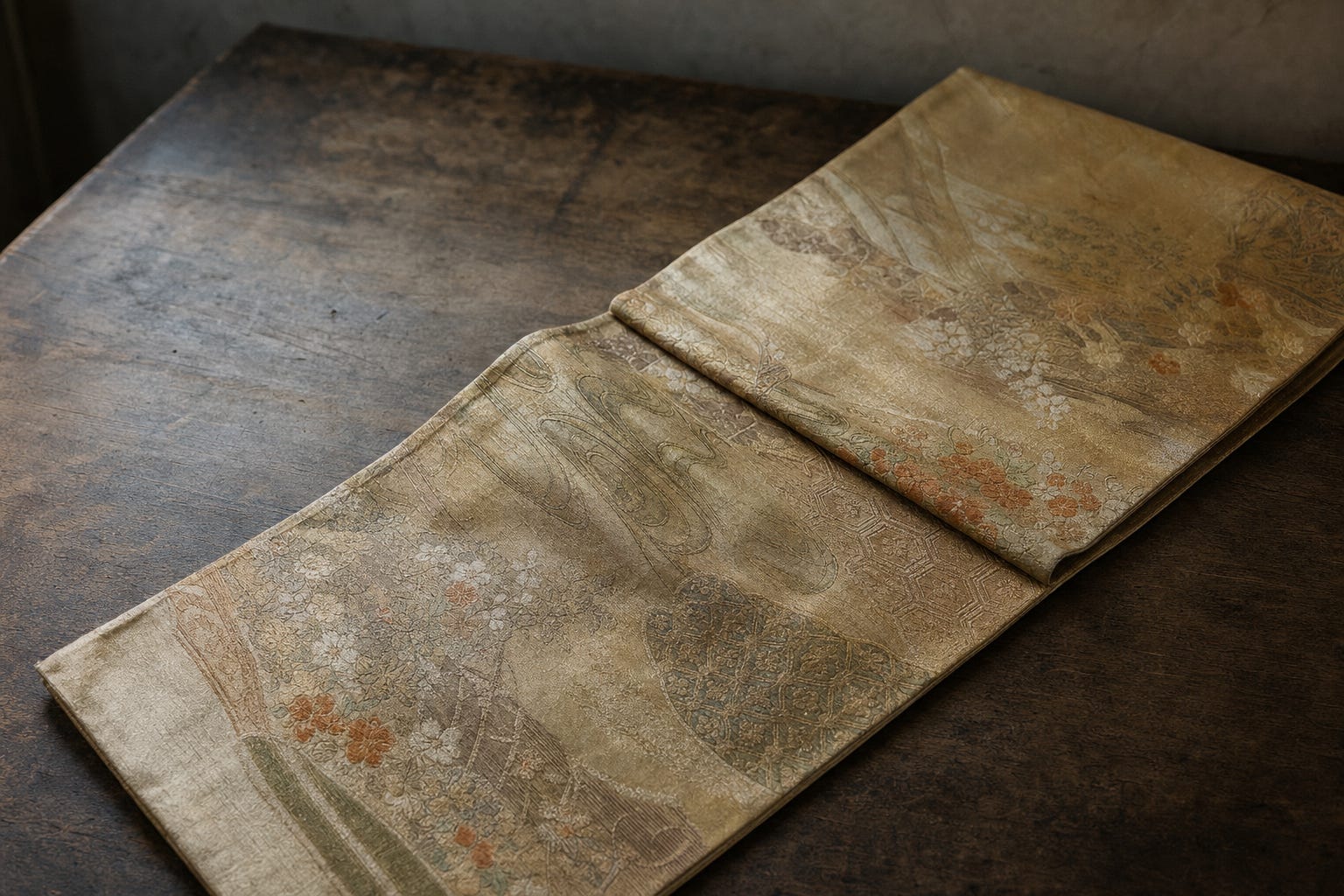
Consider what arrives. A fukuro obi, woven in Nishijin in 1962, by a master whose name we will probably never know. These silks were woven not for the everyday — ke — but for hare: life’s elevated ceremonial moments, the days set aside from the calendar of ordinary time. A fukuro obi of this register was made to appear in a handful of such moments over the course of a life — formal visits, weddings, the New Year — and then to return to the tansu chest until the next occasion worthy of it.
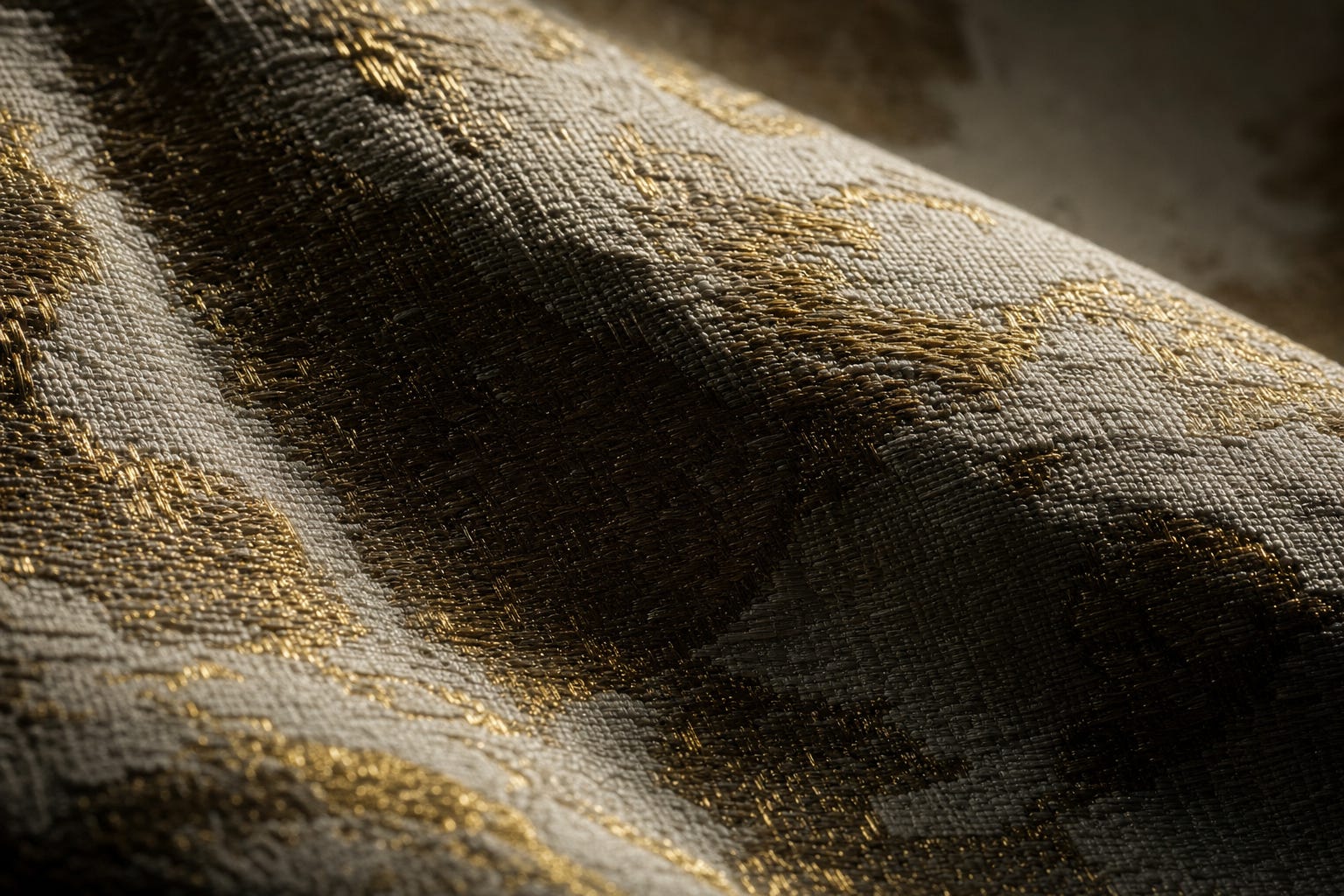
The silk itself was reeled by hand from cocoons that were themselves the product of a five-thousand-year continuous tradition of sericulture, a tradition whose technical vocabulary — reeling, degumming, twisting, throwing — has remained essentially unchanged since the Han dynasty. The threads were dyed with botanical pigments — madder, indigo, gardenia, sappanwood — in a process that requires the dyer to read the weather, the water temperature, the mineral content of the mordant bath, the particular receptivity of that day’s silk. The pattern, perhaps stylised pine branches against a ground of oxidised silver, was charted by a designer who was thinking simultaneously about the ceremony the obi would attend, the kasane palette of the season in which it would first be worn, the body of the woman who would wear it, and a thousand-year history of how pine motifs have meant in Japanese visual culture.
The obi was woven over weeks. It was finished. It was sold. It was worn — perhaps once, perhaps a handful of times, on the occasions that justified its formality. It was folded with the precision that ceremonial silk requires. It was placed in a tansu chest. It waited there for sixty years.
Now it is on the cutting table in Amsterdam.
What does it ask of us?
The contemporary vocabulary of decoration is useless here. The obi is not “an accent.” It is not “a statement piece.” It is not “vintage texture.” These words assume the cloth is inert — material to be deployed, surface to be arranged, decoration to be bestowed upon a room. The cloth is none of those things. The cloth is the condensed result of an enormous quantity of human attention. Generations of attention. Whole guild traditions of attention. The attention of the silkworm farmer who watched the cocoons. The attention of the dyer who watched the colour develop. The attention of the weaver whose tension at the loom is recorded in the cloth, millimetre by millimetre, like a seismograph of the hours she sat there. The attention of the ceremony for which the obi was made. The attention of the woman who folded it and laid it down in the tansu, sixty years ago, knowing she was setting it aside for an unseen future.
What the obi asks of us is Einfühlung in Vischer’s original sense. We do not bestow significance upon it. We become quiet enough to perceive the significance that is already there.
IV. The atelier as a school of attention
This is what we are doing in the atelier, and I have not, until now, found the right word for it.
When a piece arrives — and they arrive irregularly, in small consignments from contacts in Kyoto and Osaka — the first thing we do is nothing. We unfold the textile on the cutting table and we look. Often for an hour. Often longer. Not yet to plan the cut. Not yet to imagine the eventual object. Only to perceive what is already there. The cloth has been sleeping for decades. It is not yet ready to be addressed; we are not yet ready to address it.
This may sound precious. It is not. It is the only practical way to make the design decisions that come next. A piece of obi karaori is not uniform across its length. The motif shifts. The weave structure shifts. The weaver’s tension shifts. There are passages of three or four metres in which the supplementary weft threads are denser, the surface more bas-relief; there are passages in which the silk is almost translucent, ground colour bleeding through. To decide where to cut a lumbar pillow from such a length is to decide which passage of the weaver’s hours to honour and which to set aside. The decision cannot be made by measuring. It can only be made by looking.
I think of one obi in particular. It arrived last autumn — a fukuro in deep aubergine ground, with a motif of wisteria that I had planned, before seeing it, to mount as a framed wall panel. The photograph from Kyoto had suggested a balanced, almost symmetrical composition. What arrived on the table was different. The wisteria was not balanced. It drifted. One end of the six-metre length was dense with blossom, the clusters hanging low and heavy; by the middle the flowers had thinned to a few suspended racemes; by the far end they had disappeared entirely into a field of leaves. The weaver had charted an entire season into the length of the cloth — early spring full bloom, mid-spring dispersal, late spring green. You could not cut this into a square and frame it. To do so would have been to stop the weather. We cut it instead into a long runner that preserved the full arc of the bloom, and a single lumbar pillow from the leafy end, which now carries late-spring stillness into whatever room it enters. The finished objects were not the ones I had imagined. They were the ones the cloth had been asking for.
What we are doing, in those hours of looking, is learning to feel ourselves into the cloth. Vischer’s word exactly. We are becoming able to perceive the difference between a section the weaver was rushing through and a section in which she found her rhythm. We are becoming able to see where the dye bath was at perfect temperature and where it had cooled by half a degree. We are becoming able to read, in the cloth, the trace of the body that was at the loom.
Only after this — sometimes days after — do we begin to think about the contemporary object the cloth will become. A wall tapestry. A framed textile painting. A pair of lumbar pillows. A bag with patchin handles. A tie. The object is chosen not by what we want to make but by what the cloth is asking to become. A passage of high-density karaori, with a complete pine motif and the weaver’s strongest tension, asks to be framed and held still — it has done enough work; it deserves stillness. A passage of looser, more lyrical weaving, in which the motif breathes, asks to be carried — to become a bag whose folds will reveal new aspects of the pattern as the body moves through the day.
This is Einfühlung as a working method. It is not mysticism. It is the attention that a sixty-year-old ceremonial textile has earned by being what it is.
V. What a room can learn
Something I did not anticipate, when we began this work, is what happens to the rooms in which the finished pieces eventually live.
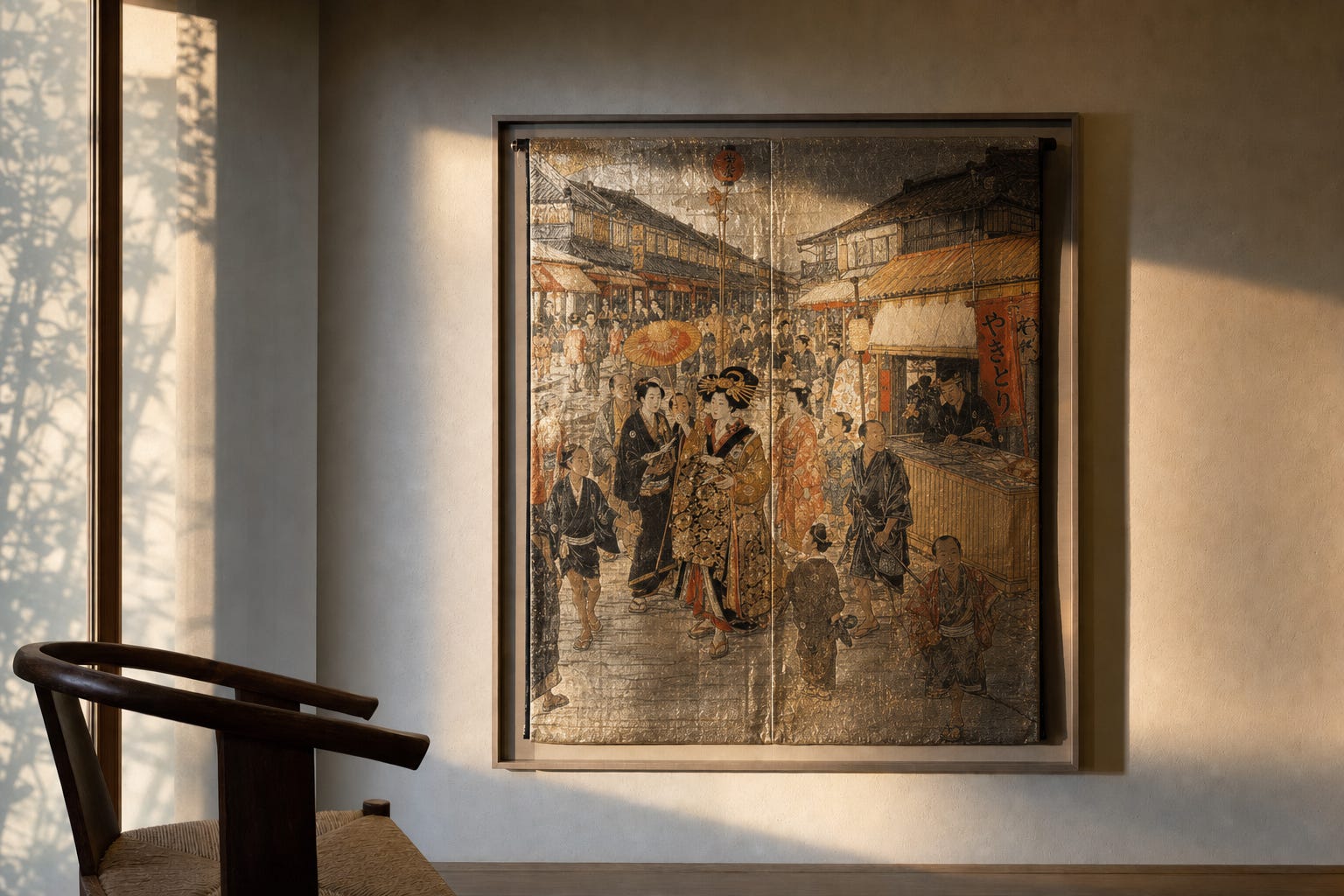
A client in Antwerp has, in her dining room, an obi panel we framed for her last spring. It hangs on a wall painted in a deep clay colour, above a long oak table. She wrote to me a few months after the installation. She had begun, she said, to notice the panel differently at different hours. In the morning the silver threads receded and the indigo ground came forward. By late afternoon the silver had returned, almost dimensional, catching the western light. In the evening, by candlelight, the whole panel went warm — colours she had not seen before emerged from the weave.
She had begun, she wrote, to arrange dinners differently. Not consciously, at first. She had simply found herself sitting where she could see the panel. Then she had begun choosing her dinner times to coincide with the hours at which the panel was at its most extraordinary. Then she had begun choosing her flowers — for the table — in colours that conversed with what the panel was doing that week.
What she described, without using the word, was Einfühlung. She had projected herself into the panel often enough that it had begun, in Rodin’s sense, to look back. The room had become a conversation between the silk and her attention to it. The attention was changing the room. The room was changing her.
This is not, I think, a small thing, in an era when interiors are asked to carry more psychological and symbolic weight than ever before. We are spending, in 2026, an enormous amount of design conversation on what people call “meaning-rich” interiors — rooms that resist the white-box minimalism of the past decade, rooms that hold objects of provenance and weight. The conversation is real and the trend is welcome. But it can become, easily, another form of acquisition. Buy the meaningful object. Display the meaningful object. Be a person who owns meaningful objects. The object is treated as inert; the meaning is treated as a property the buyer purchases along with the object.
The older meaning of empathy points to something different. The meaningful object is meaningful only insofar as the person living with it is willing to do the work of perceiving the meaning that is already there. The obi panel above the dining table is not meaningful because it cost what it cost or because it was woven where it was woven. It is meaningful because the woman in Antwerp spends real attention on it, several times a day, and the panel — sixty years old, full of the weaver’s hours and the dyer’s hours and the ceremony’s hours — meets her attention with everything it has.
The panel in Antwerp is not an example; it is itself the entire phenomenon. There is only this one. Its conversation with that room will never be repeated.
VI. The thing the word still has to teach us
I have come to believe that the migration of empathy from the older meaning to the newer one was a real loss, even though the newer meaning is itself precious. We needed a word for what one human being can do to feel what another human being is feeling. Empathy now does that work and we cannot give it back.
But we lost, in the migration, a word for the older capacity. The capacity Vischer was pointing at. The capacity Rilke learned in Rodin’s studio. The capacity that the silent objects in our lives — the ones that have been sleeping in tansu chests, the ones that have travelled centuries to reach our walls — have always asked of us. The capacity to slow ourselves enough to perceive what is already alive in the things we have surrounded ourselves with.
The Japanese kept this capacity. They did not lose it. The whole apparatus of mono no aware — 物の哀れ, the pathos of things, the tender awareness that objects and moments carry their own interior lives and are already passing — assumes it. Motoori Norinaga, the eighteenth-century scholar who gave the term its fullest elaboration, argued that the cherry blossom moves us not because it is beautiful but because we can feel, in looking at it, its own knowledge of its falling. The object is not inert. The object is already in the act of its own transience, and our task is to be present to it.
The kasane no irome system — the Heian court’s grammar of layered silk colours, keyed to the micro-seasons — assumes the same thing. A spring kasane might layer pale green over soft pink to echo young leaves over late blossoms; the wearer’s body thus became a surface on which the season could recognise itself. A court lady who wore momiji-gasane — crimson over deep red, the palette of autumn maples — in late tenth-month Kyoto was not wearing a costume. She was completing a conversation between her silks and the hillside outside. The hillside was asking to be met. The silks met it. Einfühlung is not a German invention. It is a re-naming, in the language of nineteenth-century European aesthetics, of an attention the Japanese have practised for a thousand years.
When a piece arrives in the atelier and we spend an hour looking at it before we touch it, we are practising a discipline that the cloth itself was made within. The cloth assumes that it will be encountered by a person who knows how to feel themselves into it. We are honouring the assumption.
When the piece eventually goes to a client’s wall or shoulder or table, we are passing the discipline along. The piece will continue to ask, every day, for the attention it was made within. The client who is willing to give that attention will find — as the woman in Antwerp found — that the piece begins, after a while, to give attention back. The room will become a slow conversation. The light will become information. The hours will begin to mean something they did not previously mean.
This is what ceremonial silk has always asked. It is what Einfühlung meant before we narrowed the word. It is the older empathy — the one we extend to the things that have spent generations of human attention to arrive in our hands — and it is, I think, what we have been doing in the atelier all along, without quite having the word for it.
Rilke learned it from Rodin in the studio on the rue de Varenne. We learn it, week by week, from sixty-year-old silk laid out on a table in Amsterdam. It is the same lesson. It requires only that we become quiet enough to receive it.
· · ·
The Antwerp panel began here; view the wall art collection.
The Silk Journal · Renaras · journal.renaras.com
One silk. One story. One piece. Never repeated.