

There is a week in Japan, sometimes less, when the whole country seems to pause.
The cherry trees, sakura (桜), have been building toward it for months. Through the grey patience of winter. Through the cold that turns the branches to ink against a white sky. And then, without announcement, the blossoms arrive, all of them, as though the trees had agreed on it in the night.
Within days, sometimes within hours, the petals begin to fall.
This is hanami (花見), flower viewing: the old practice of gathering beneath the cherry trees to witness something beautiful precisely because it will not last. Families spread their goza (ご座) mats beneath the branches. Lanterns are lit as the evening comes. Sake is poured. And everyone, from the oldest grandfather to the youngest child, sits inside the quiet understanding that the moment is already ending.
I have been to Japan in cherry blossom season. I have sat beneath those trees. What I brought home was not a photograph, not a souvenir, not a memory pressed like a petal between pages. What I brought home was a different understanding of silk.
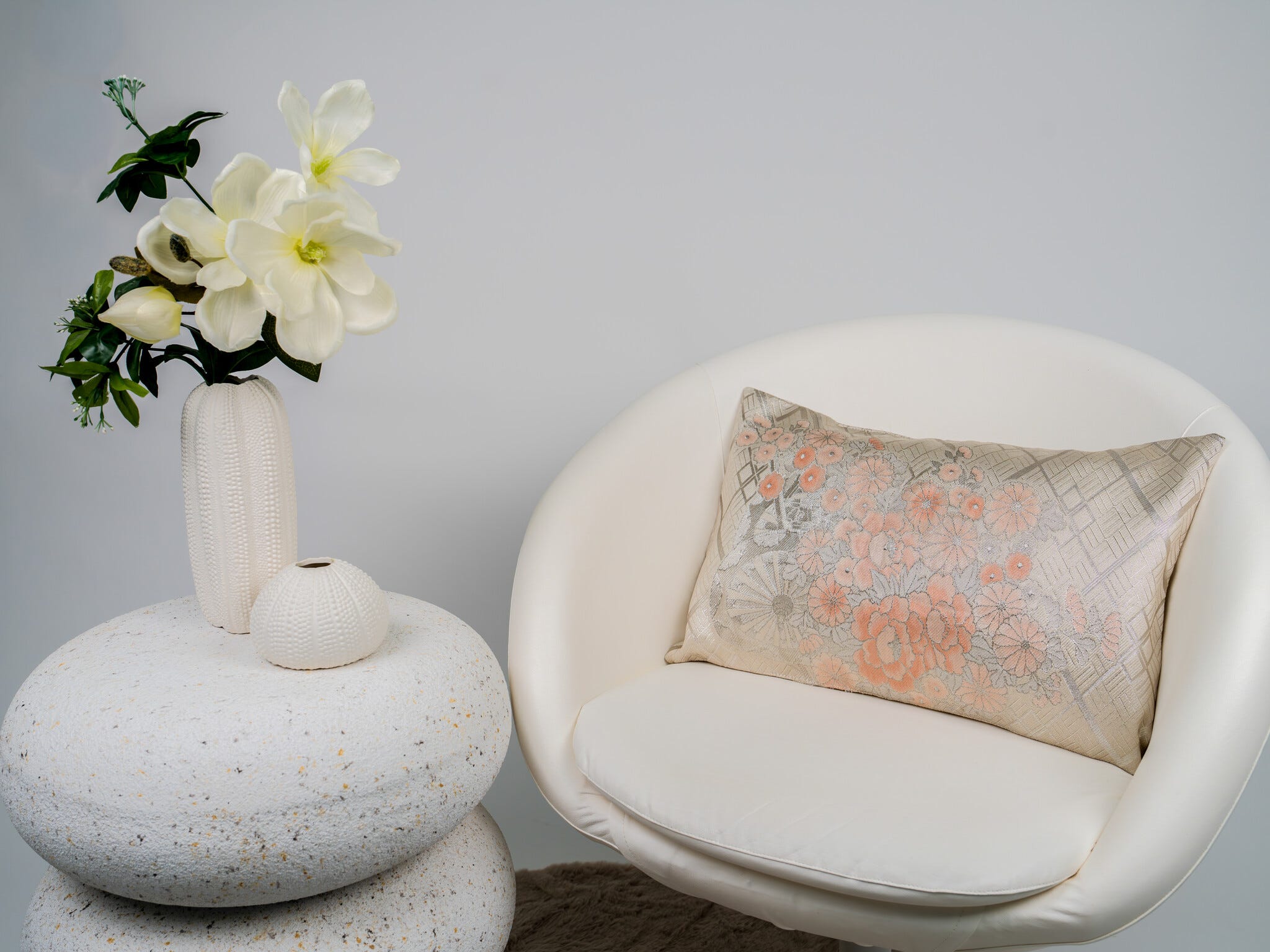
What the cherry blossom knows that we have forgotten
In Europe we have a complicated relationship with things that do not last. We restore. We preserve. We seal and protect and archive. We raise cathedrals meant to stand for a thousand years and fill museums with objects rescued from time. There is beauty in that impulse toward permanence, and it has given us remarkable things. It has also given us a particular anxiety: the feeling that a thing only has value if it endures.
Japan teaches the opposite.
Mono no aware (物の哀れ) has no clean English equivalent, though the bittersweet ache of impermanence comes near it. It is not a consolation for loss. It is a way of seeing that finds the deepest beauty not in spite of transience but because of it.
The cherry blossom carries this further than anything else. Sakura blooms for perhaps a week, and its whole symbolic weight in Japanese culture, woven through poetry and painting and ceremony for over a thousand years, comes from that brevity. Remove the falling and you remove the meaning.
Chiru (散る), to scatter, to fall, is among the most emotionally loaded words in the language. The falling petal is not loss. It is the blossom completing its purpose.
I think about this when I hold a piece of Japanese ceremonial silk.
The thread that fell, and was caught
Somewhere in Japan, in a cedar tansu chest in Kyoto, a silk merchant’s archive in Nishijin, the back room of a family home in Kanazawa, a length of silk was folded away and left to wait.
It waited through economic miracles and quiet catastrophes, through decades of changing fashion and shifting rooms. And then, slowly, as the generation that treasured it grew old and the generation that inherited it forgot its name, it began to move toward disappearing.
Japan holds what researchers estimate to be hundreds of thousands of such pieces. Obi (帯). Fukuro obi (袋帯). Kinran (金襴), the gold brocade woven on the Nishijin looms of Kyoto, where silk has been woven without interruption since the fifth century. Pieces of great beauty and rare craft, sitting in the dark, fading not from anything in the cloth but from forgetting.
This is what Renaras takes in.
Not only as conservation, though it is that. Not only as commerce, though it is that too. It begins with mottainai (もったいない): the regret that something of value should be allowed to vanish unused, unloved, unseen. When a piece of Nishijin silk arrives at the atelier, is documented and given its passport and placed in a European home, it does not stop being Japanese. It carries Japan with it, its ceremony and its seasons and its centuries, into a new room, a new light, a new life.
What silk and sakura share
Stand beneath a cherry tree at mankai (満開), full bloom, and look up. The blossoms are not uniform. Each petal differs slightly. The light moves through the clusters differently at every angle. The whole tree is, in the language of Japanese aesthetics, full of ma (間): meaningful space, breath, the intervals that let the music happen.
Now hold a piece of Nishijin silk up to the light.
The Goshoguruma-Kiku, our fukuro obi silk textile painting woven in Nishijin kinran gold, carries the gosho-guruma (御所車), the imperial carriage, and the kiku (菊), the chrysanthemum of the Imperial House. The light moves through it differently at every angle. The gold thread, worked by hand on a loom that has not fundamentally changed since the Heian period, catches and releases the light the way something living does. This is katachi (形): form so refined it passes beyond its own making.
The Oshidori-Goshoguruma carries the oshidori (鴛鴦), the mandarin ducks that stand in Japanese tradition for fidelity and the devotion of two souls. It was woven for ceremony, for weddings, for the moments when silk said what words could not. The ducks do not decorate the obi. They are a prayer in gold for love that outlasts a single season. On a wall in Amsterdam, the prayer keeps its meaning. It simply finds a new listener.
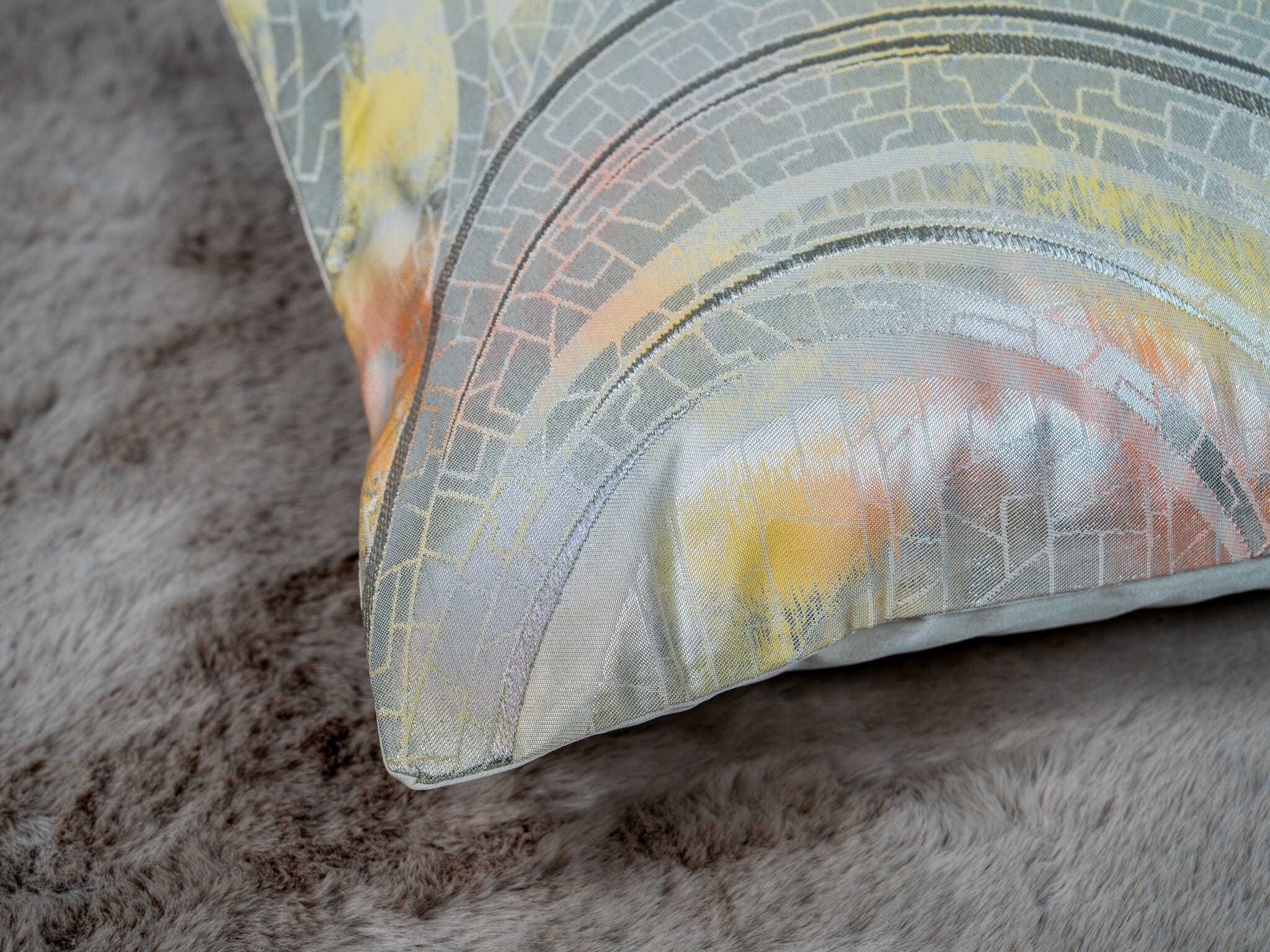
Hanami at a European table
There is something in hanami that most Western accounts miss. It is not only the viewing of blossoms. It is the preparation of the ground beneath them: the careful laying of mats, the arrangement of food and vessels, the making of a small, temporary world of beauty under temporary branches. Hanami is, at heart, an act of setting a table, the understanding that the surface on which we share food is itself a kind of ceremony.
I think of that when I see the Imperial Garden silk placemat and table runner, carrying the imagery of the imperial gosho (御所), the Kyoto palace gardens tended for over a thousand years, laid on a European dining table.
The table does not know it has joined something old. But it feels it. The guests feel it. The attention in the room shifts. Dinner slows. The light catches differently. Someone reaches out to touch the edge of the silk. This is ma, arriving uninvited at a European meal.
Our Champagne Orchard table runner, its champagne ground woven with the loose, dreaming quality of an orchard in early spring, blossoms implied rather than stated, does to a room what sakura does to a park. It turns the space into somewhere time moves a little more slowly.
The Champagne Embroidered Wildflower Obi carries its wildflowers tumbling across the champagne silk like the memory of a Japanese spring. Not a reproduction of that spring. The memory itself, worked into thread by hand. Set it on the table in March, when the first European blossom is beginning, and watch the room settle around it.
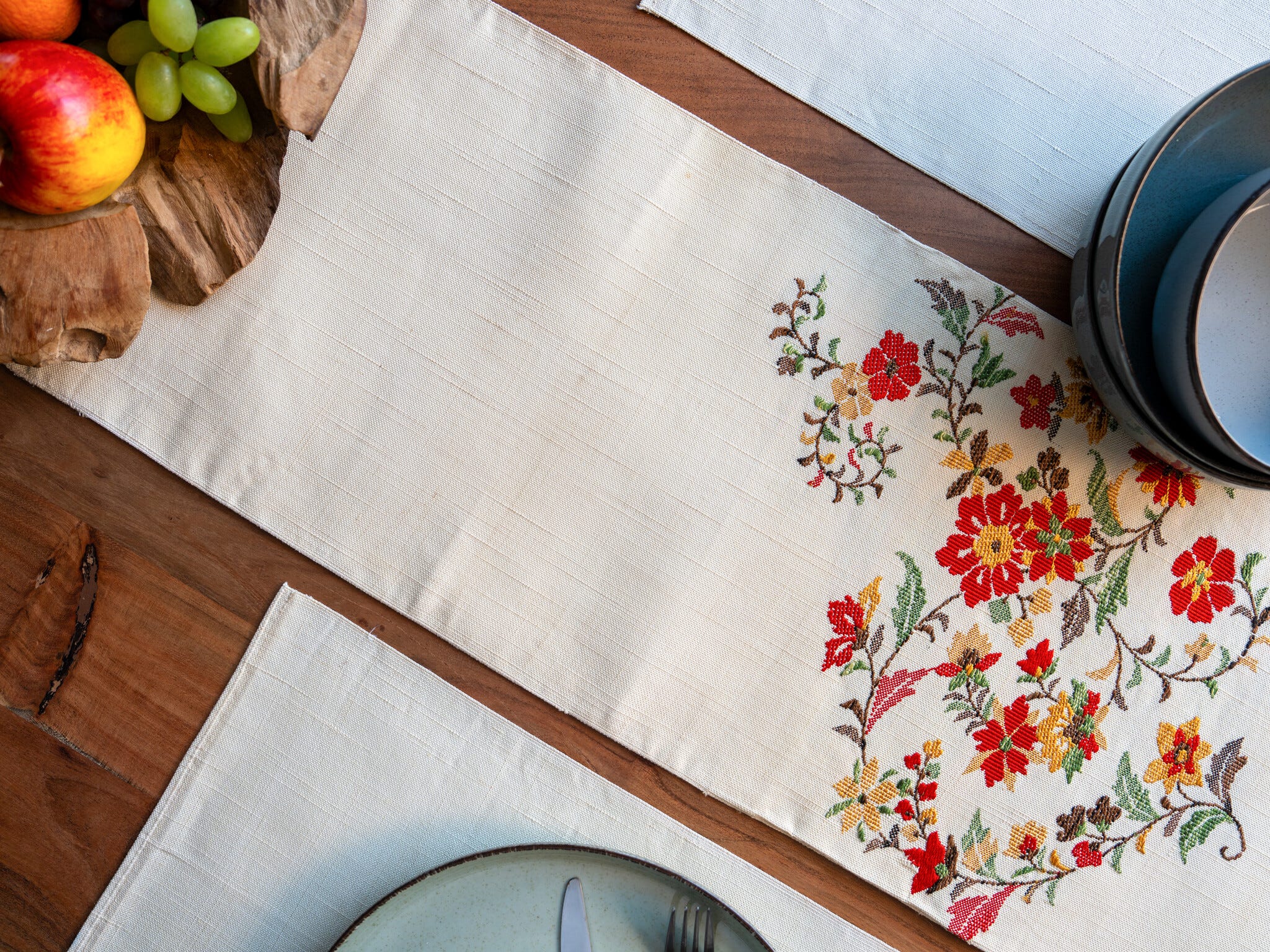
The pillow that holds a season
There is a house in the Netherlands where a silk lumbar pillow sits on a reading chair beside an east-facing window.
In the morning the first light comes through that window and finds the Imperial Gosho Narrative, our lumbar pillow carrying the full visual language of the Kyoto imperial gardens: the kiku, the botan (牡丹, the peony of nobility), the gosho-guruma carriage, the seasonal flowers of the court. The gold in the weave gathers the morning light and gives it back into the room, and the only word for what it does is ceremonial.
The woman who lives there wrote to us after the pillow arrived. She said she sits with her coffee in the morning and looks at it and feels she is somewhere else, somewhere older and quieter and more considered, and does not want to move.
This is yugen (幽玄): grace so deep it pulls you beneath the surface of the ordinary into something that can only be felt. The Silver Gosho-guruma Carriage Floral Obi carries it another way. Where the gold pieces glow, the silver ones shimmer. The light moves across them like water, like mist in a garden in November, like the last light of an October afternoon when the momiji (紅葉), the autumn maple, is burning red against a grey sky.
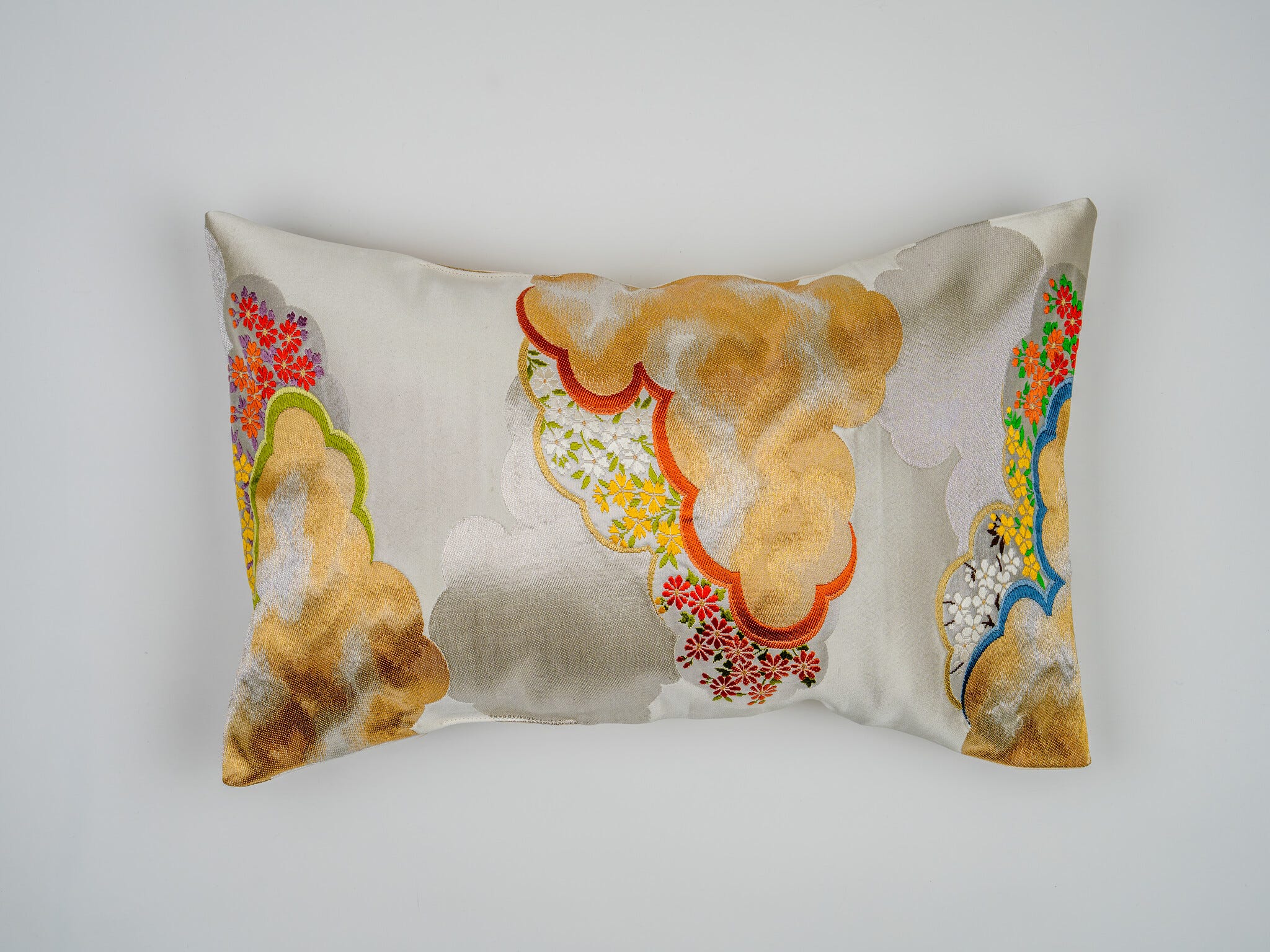
What hanami teaches the European interior
The Japanese go to see the cherry blossoms not because they are the most beautiful flowers in the country. Japan has more spectacular blooms: the wisteria tunnels of fuji (藤), the botan peonies of the imperial gardens, the ajisai (紫陽花) hydrangeas of the rainy season. They go to the cherry blossoms because of what the cherry blossoms mean. They mean: this will not last, so be here, fully, now.
That is what a piece of Renaras silk brings to a European room. Not only beauty, though the beauty is real. Not only history, though the history is long. Presence. The object’s insistence on being fully here, in this room, in this light, with this quality of attention.
The Nishijin Champagne Gold Fukuro Obi, woven on the Nishijin looms in the champagne and gold of imperial ceremony, carries the whole vocabulary of Japanese courtly beauty: the gosho-guruma in its stately procession, the botan in full bloom, the kiku standing for longevity and the emperor’s grace. It is not a decorative object. It is a season, held in silk, asking to be seen.
A note for March and April
If you are thinking of bringing Japanese ceremonial silk into your home, there is no better moment than this one. Not because of trends, not because of any forecast. Because outside your window, somewhere in your city, the first blossom is coming. And inside, on a wall or a table or a reading chair, a piece of Nishijin silk is waiting to carry on the same conversation the cherry trees have been holding for a thousand years.
Mono no aware. The bittersweet beauty of what cannot last.
Except that silk, unlike sakura, does last. It lasts and deepens with each decade, carrying forward every season it has witnessed. It is the cherry blossom that did not fall.
Each Renaras piece is unrepeatable, and comes with its passport: a small handmade record of the silk’s first life and its continuation. Once it is gone, it is gone.
One silk. One story. One piece. Never repeated.
Each Renaras piece is authenticated, one of a kind, and accompanied by a certificate of provenance. Once it is gone, it is gone forever.
Explore the collection — including the Imperial Garden, Champagne Orchard, Goshoguruma-Kiku and Oshidori-Goshoguruma pieces — at renaras.com
Follow The Silk Journal: pinterest.com/renaras_atelier | @renarascom