

In Japanese aesthetics there is a concept called ura-omote: the hidden face and the visible face. Everything has both. The kimono’s lining is as considered as its exterior. The back of a screen painting is not blank. The inside of a lacquer box is finished with the same care as the outside.
The Aki-No-Mori reversible silk runner is built on this principle.
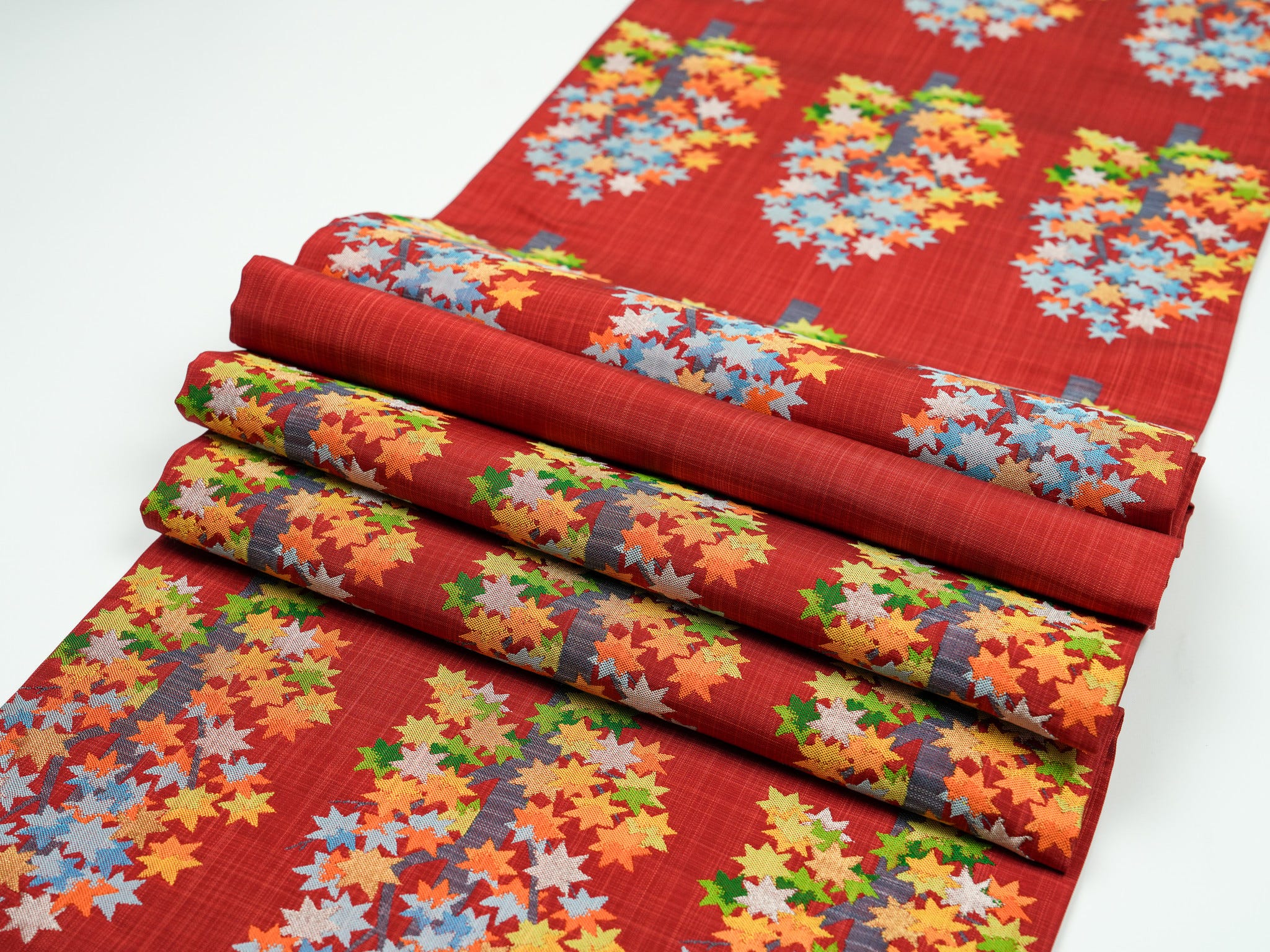
One face presents a dense, polychromatic forest: woven trees in azure, marigold, sage, and rust against a deep crimson ground. This is full-density relief weaving, not print, the kind of structural textile work that mirrors the weight and drape of a formal fukuro obi. It is vivid. It fills a table with colour and presence. Against dark walnut or ebonised ash, with matte ceramics and simple flatware, it gives a minimal dining arrangement its centre of gravity.
Turn it over and the runner becomes a different object entirely. The reverse is solid vermillion, a raw, tactile cross-weave that functions as an architectural surface rather than a narrative one. Here, the silk recedes. It becomes a foundation for whatever you place on top of it: elaborate plating, structural flowers, the objects of a more maximal table.
Two moods from one piece of cloth. This is the practical intelligence of ura-omote: the understanding that the best objects serve more than one purpose, adapt to more than one occasion, reveal more than one face depending on what the moment requires.
The Aki-No-Mori is woven from 100% vintage pure silk and is one of a kind.
Explore the Vintage Japanese Silk Table Runner Collection at renaras.com
https://renaras.com/collections/table-couture-japanese-silk-table-runners